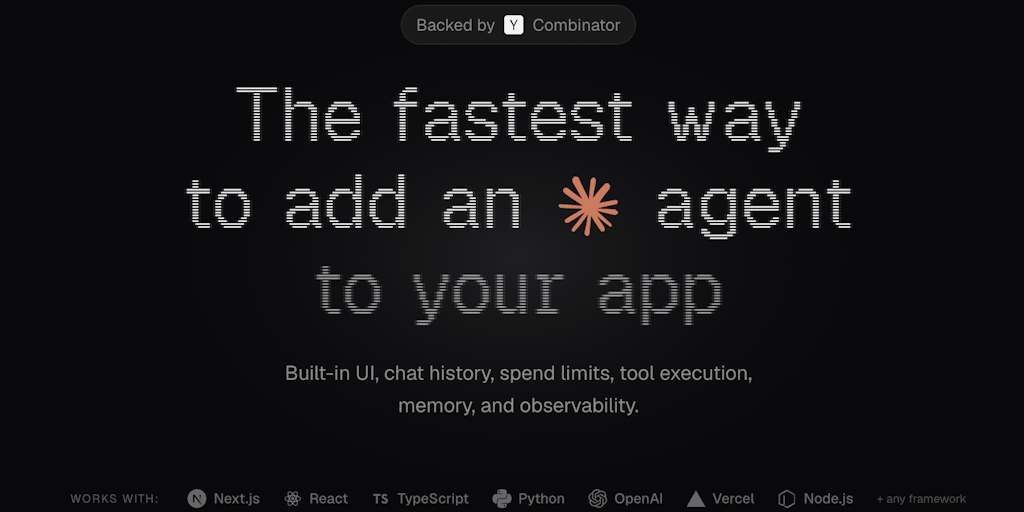
21st Agents SDK is the fastest way to add an AI agent to your app. Define your agent in TypeScript, deploy in one command, and embed a production-ready chat UI with built-in streaming, session management, usage billing, and observability.
21st Agents SDK is the fastest way to add an AI agent to your app. It is a developer-friendly SDK designed for TypeScript developers who need to integrate AI-powered conversational agents into their applications quickly and reliably. The core value lies in its simplicity: you define your agent's logic and behavior using familiar TypeScript syntax, then deploy the entire agent infrastructure with a single command. This eliminates the complexity of setting up backend services, managing state, or building a chat interface from scratch. The SDK targets developers building SaaS products, internal tools, or customer-facing applications that require an intelligent, interactive agent capable of handling user queries, executing tasks, or providing recommendations.
The primary problem the 21st Agents SDK solves is the significant engineering overhead involved in creating a production-ready AI agent. Without it, developers must orchestrate multiple services: a language model provider, a streaming server, a database for conversations, a billing system for usage tracking, and a frontend chat component. This often takes weeks or months to integrate and requires expertise across different domains. The SDK abstracts all of that away, allowing developers to focus on the unique behavior of their agent rather than the underlying infrastructure. This matters because it dramatically reduces time-to-market, lowers engineering costs, and lets smaller teams ship AI features that would otherwise require a dedicated infrastructure team.
The first major feature group is the TypeScript-based agent definition. You write your agent's logic in TypeScript, leveraging its type safety and tooling ecosystem. The SDK provides a clear API for defining the agent's instructions, tools (functions it can call), and conversation flow. This design makes the agent code testable, maintainable, and easy to version control. By using TypeScript, developers get autocomplete, compile-time error checking, and seamless integration with existing codebases. The benefit is that you can build sophisticated agent behaviors using the same language and patterns you already use for your application backend, reducing cognitive load and enabling rapid iteration.
The second feature group is the one-command deployment system. Once your agent is defined, you run a single deploy command that provisions all necessary cloud resources – including the AI model endpoint, streaming server, database for session storage, and the chat UI endpoint. This command handles configuration, security, scaling, and network setup automatically. The usefulness is profound: it eliminates the need for developers to manage cloud infrastructure, write deployment scripts, or worry about server maintenance. It also ensures that your agent is deployed consistently across environments, from local testing to production, with minimal friction.
Publisher
A
admin
Launch Date2026-03-07
Platformweb
Pricingfree
Tech Stack
#React#TypeScript#Claude Code
Domain Authority
Ahrefs DR64/100
Traffic Insights
Month2026-01
Estimated Visits756K
MoM Visits Growth+9.7%(+66.9K)