Agihalo serves as an autonomous API management layer specifically designed for AI agents, functioning as an LLM router that facilitates decentralized operations and AI SaaS applications. Its core purpose is to enable AI agents to manage their own Large Language Model expenses and payments independently, utilizing the USDC cryptocurrency on X402 payment rails. This product is engineered for developers and organizations building autonomous agent systems, providing them with the infrastructure needed to deploy always-on agents that can pay for their own computational resources without constant human oversight. By integrating payment logic directly into the agent workflow, Agihalo removes a significant operational bottleneck, allowing for truly self-sustaining AI applications that can operate 24/7 within defined economic parameters.
The fundamental problem Agihalo addresses is the lack of financial autonomy in current AI agent deployments, where human intervention is typically required to manage API credits, track usage costs, and handle payment authorizations. This creates friction in scaling autonomous systems, as agents cannot independently refuel or pay for the LLM calls they need to function, limiting their potential for long-running, complex tasks. Developers and businesses face challenges in precisely tracking costs per agent, preventing budget overruns, and integrating payment systems that align with decentralized or automated workflows. Traditional payment methods like credit cards are not agent-native and require manual top-ups, breaking the automation loop and hindering the vision of fully autonomous AI economies where agents can earn, spend, and manage resources.
A primary feature group is the effortless migration and integration process, which requires minimal code changes to adopt. Users can migrate their existing LLM integrations to Agihalo by simply updating their API baseURL, eliminating the need for complex code refactoring or significant development overhead. This unified approach consolidates all X402 payment logic and agent capabilities into a single SDK, providing a streamlined interface for developers. The system is designed for zero-friction integration, allowing teams to upgrade their AI infrastructure rapidly and start managing their agents through an intuitive dashboard. This reduces the barrier to entry for adopting autonomous payment systems and enables quick experimentation and deployment of agent-based applications with built-in economic layers.
admin
The second major feature group revolves around autonomous 402-powered recharging and payment handling. Utilizing the 402 (Payment Required) protocol, Agihalo enables AI agents to monitor their own balances and recharge credits independently, ensuring uninterrupted operation. This X402 automation handles the entire payment flow—request, pay, and retry—seamlessly without manual intervention. Agents can autonomously manage and refuel their own LLM credits through integrated sub-LLM systems, creating a self-sustaining economic loop. This capability is foundational for building decentralized agents that operate on a pay-as-you-go model, managing their expenses in real-time based on actual usage. The system shifts payment authority to the agents and DAOs using USDC, bypassing traditional credit card dependencies and enabling a more programmable financial layer for AI.
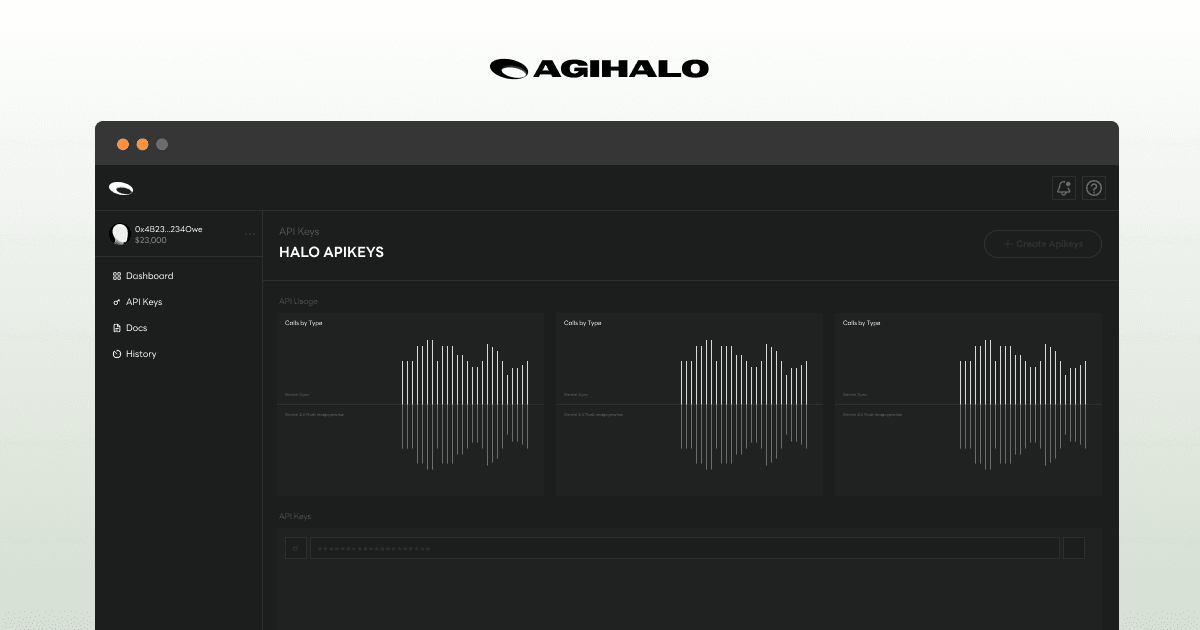
A third critical capability is granular cost tracking and API governance through unlimited, issuable API keys. Users can issue unlimited API keys to track and limit costs for every individual agent precisely, gaining detailed control over resource allocation. The platform provides real-time usage tracking, allowing users to monitor API call volume by type with detailed analytics and cost breakdowns. This offers full visibility into LLM expenses and API lifecycle management through an intuitive, unified dashboard, helping prevent budget overruns at the agent level. Users can optimize spending with real-time analytics on usage patterns, making it easier to forecast costs and allocate budgets efficiently across multiple autonomous agents or projects. This feature transforms opaque API spending into a transparent, manageable operational expense.
Technically, Agihalo operates as an intermediary routing layer between AI agents and LLM providers like Google's Gemini. It intercepts API calls, manages authentication via its own API keys, and handles the payment transaction using USDC on the X402 rail before forwarding the request to the destination model. The product's architecture is built around the 402 protocol standard, which is an HTTP status code extension designed for micropayments. This allows for real-time, usage-based payments directly tied to each API call. The system consolidates this complex payment and routing logic into a single SDK, abstracting away the intricacies of cryptocurrency transactions and payment gateway integrations from the developer. The backend provides a dashboard for key management, usage analytics, and cost monitoring, creating a full-stack solution for agent economy management.
Users benefit from measurable outcomes including precise cost control per agent, reduced operational overhead from manual payment management, and the ability to scale autonomous systems without proportional increases in financial administration. The 20% discount on Gemini models provides direct cost savings on compute expenses. The autonomous payment system ensures 24/7 agent uptime by eliminating credit expiration as a point of failure, as agents can recharge themselves. Developers gain a unified interface for managing multiple agents and their economics, simplifying DevOps for AI applications. Businesses can experiment with agentic workflows at lower risk due to granular spending limits and clear visibility into costs, enabling more innovative use of AI without fear of unexpected bills.
Concrete use cases include deploying customer support agents that can analyze tickets and identify recurring issues autonomously, paying for their own LLM calls as they work. Marketing teams can use agents to update website content like pricing page layouts, with each agent managing its budget for copy generation and image analysis tasks. Research agents can continuously monitor data sources and generate reports, independently paying for information retrieval and summarization calls. Development teams can create coding assistant agents that pay for their own API usage when helping with code reviews or documentation. Content moderation agents can operate around the clock, using image preview capabilities to filter content and handle payments for each analysis request without human approval delays.
The target users are developers, AI engineers, and organizations building and deploying autonomous AI agents and AI SaaS applications. This includes startups and enterprises experimenting with agentic workflows, decentralized autonomous organizations (DAOs) needing programmable treasury management for their AI tools, and developers integrating LLMs into products who require better cost control. The platform integrates with existing AI agent frameworks and supports major LLM providers, starting with Google's Gemini models including Gemini 3 Pro, Gemini 3 Flash, Gemini 3 Pro Image, and Gemini 2.5 Flash Image Preview. The tech stack leverages the X402 payment rail and USDC cryptocurrency for transactions. Pricing is based on a pay-as-you-go model with the listed Gemini model rates, enhanced by promotional discounts like the 20% off event.
In summary, Agihalo provides the essential economic infrastructure for the next generation of autonomous AI, removing payment friction and enabling true agent independence. By combining seamless integration, autonomous 402 payments, and granular cost control, it allows developers to build AI systems that can manage their own resources. This unlocks scalable, always-on agent deployments that operate within defined economic parameters, paving the way for more complex and long-running AI applications. The platform represents a critical step toward a decentralized AI economy where agents are not just tools but active economic participants capable of sustaining their own operations.
Developers, AI engineers, and organizations building autonomous AI agents and AI SaaS applications are the primary users. This includes startups and enterprises experimenting with agentic workflows, decentralized autonomous organizations (DAOs) that need programmable treasury management for their AI tools, and product teams integrating LLMs who require precise cost control and payment automation. The platform is designed for those seeking to deploy always-on, decentralized agents that can manage their own LLM expenses without constant human oversight.
Updated 2026-04-30