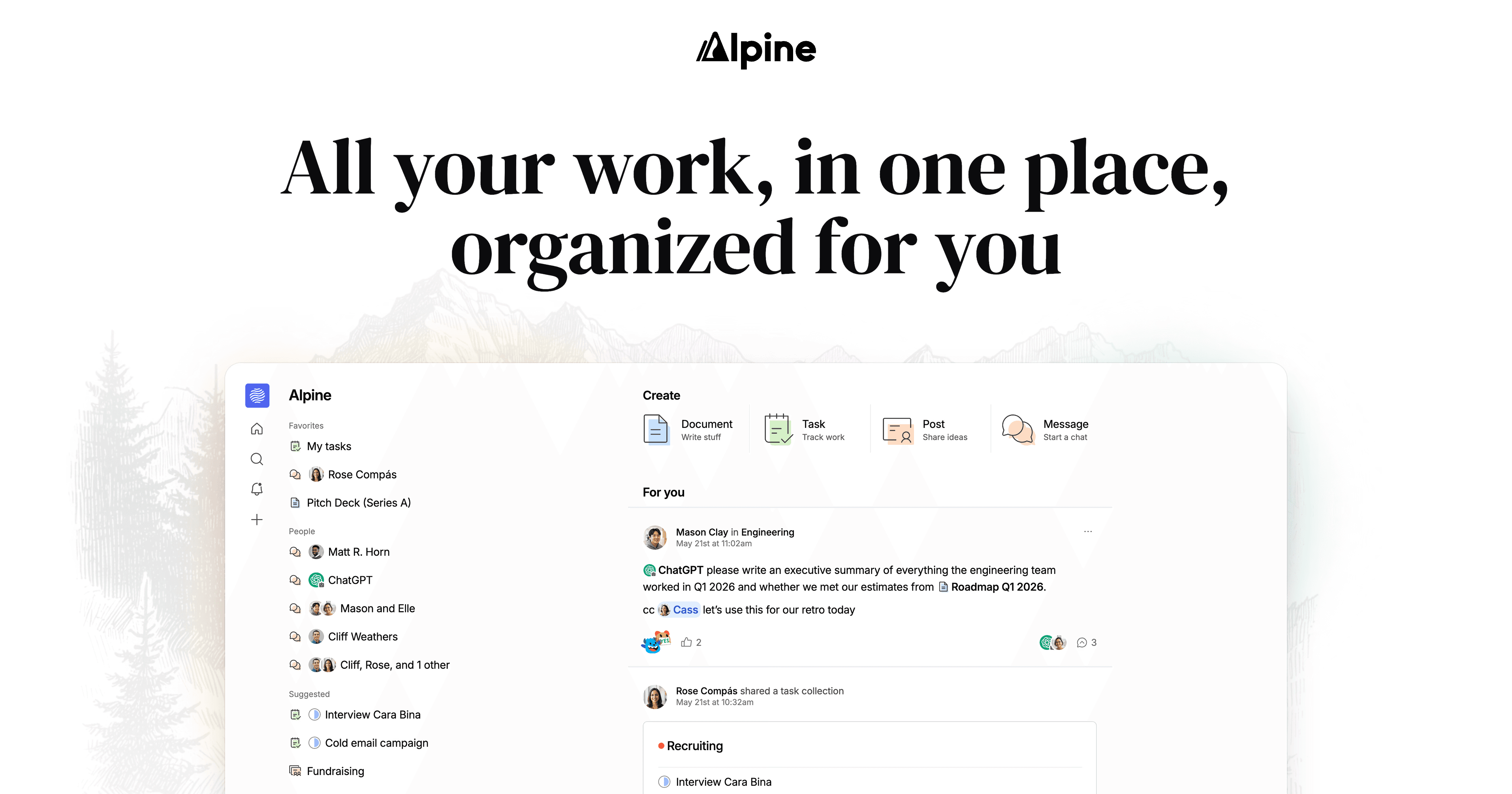
Alpine is a comprehensive work platform designed to consolidate scattered work tools into a single, organized application that automatically manages context for its users. It integrates documents, tasks, chat forums, and AI capabilities into one cohesive suite, eliminating the constant need to switch between disparate productivity apps. The product is built for professionals and teams who are frustrated by the fragmentation of their digital workspace, where important information gets lost across different platforms. Its primary purpose is to reverse the erosion of work quality caused by tool sprawl by preserving context and letting computers handle organization, suggestion, and creation tasks. Alpine aims to help users reclaim focus and spend more time on meaningful work rather than on managing their tools.
Modern work has become increasingly fragmented as conversations, tasks, and documents are scattered across tools that do not communicate with each other. Professionals constantly sort documents into folders, switch between different productivity apps, and struggle to remember where they stored a task or thread from last week. This context switching and management overhead erodes productivity and focus, as workers spend more time organizing their tools than doing actual work. The pain point is a lack of a unified workspace that can bring together all elements of work while intelligently organizing them. Alpine addresses this by providing a single place where all work components coexist and are organized automatically, reducing cognitive load and administrative overhead.
One major feature group is Alpine's Documents module, which offers simple, beautifully designed document creation with advanced capabilities. It includes image galleries that automatically transform dropped photos into stunning visual layouts, presentations that allow users to focus on content rather than dragging text boxes, and AI-generated covers that give each document a distinct aesthetic without distracting from the content. The documents are effortless to use and maintain a consistent, tasteful design across all types of content. This feature matters because it removes the friction typically associated with document formatting and presentation, enabling users to produce professional-looking materials quickly. By handling layout and design automatically, Alpine lets users concentrate on the substance of their work.
Another significant feature group is the Tasks module, which serves as a personal task tracker that scales to teams. It allows fast task capture with intuitive shortcuts like pressing enter to add a new task or tab to create subtasks, and users can paste entire lists to get started quickly. Tasks are private by default for early ideas and sensitive items, with sharing enabled only when ready. The system includes powerful filters and sorts to create personalized workflow views, including an opinionated 'My tasks' view. It is built for performance, handling over one million tasks with ease due to engineering optimizations, and facilitates collaboration by ranking team members based on interaction frequency. This comprehensive task management reduces the overhead of tracking work across different tools.
admin
Alpine's Forum feature enables asynchronous collaboration in a familiar, thread-based format. It moves away from channel-based noise by delivering relevant posts directly to a personalized feed, so users do not need to join every channel. Every post is inherently a complete thread, eliminating the need to move conversations to separate threads. New replies are silently added to the user's inbox, waiting until they are ready to engage, which reduces disruptive pings and supports focused work. This design ensures that important discussions find the user rather than requiring constant monitoring of multiple channels. The forum integrates seamlessly with other Alpine components, maintaining context across discussions, tasks, and documents within the unified platform.
The Chat functionality is deeply integrated where work happens, allowing users to reduce context switching by having conversations alongside their docs and AI. A key innovation is the ability to respond to specific text within a message by selecting it, eliminating the clutter of quoting entire paragraphs. This precision in communication keeps discussions focused and reduces misinterpretation. Chat exists within the same environment as documents and tasks, so conversations retain full context of the ongoing work. This integration means users do not need to alt-tab between a chat app and their work tools, preserving flow state and reducing the cognitive load associated with managing separate communication platforms.
Alpine provides measurable benefits by significantly reducing the time spent managing tools and switching contexts. Users experience fewer distractions as the inbox sorts signal from noise, putting important work on top and only pinging when truly needed. The personalized feed surfaces updates from people and projects the user cares about, eliminating the need to monitor every channel. Search across everything uses relevance, recency, and LLMs to deliver the best results, not just keyword matching. AI coworkers are available with full context across all work, enabling intelligent assistance. Overall, users can focus more on their core work and achieve better outcomes with less administrative overhead.
Concrete use cases include using Alpine for documents and tasks while keeping Google for email and calendar, or using Slack for chat alongside Alpine for documents and tasks. Teams can adopt Alpine partially, with some teams using it while others use different tools that best suit them, as Alpine is designed to fill gaps without requiring full migration. For example, a team might use Alpine's forum for asynchronous collaboration and its task manager for project tracking, while maintaining existing chat tools. Another workflow could involve using Alpine's AI for generating document covers and presentations while collaborating on tasks within the same platform. These flexible integrations allow gradual adoption.
Target users include professionals and teams frustrated by tool fragmentation, especially those who value design and performance. The platform integrates with existing tools like Google, Slack, and others, allowing partial adoption. Its tech stack is engineered for high performance, with frontend optimizations to avoid loading spinners and backend p99 durations under 500ms. Pricing currently includes a free tier for feedback collection and a limited lifetime access plan at $250 USD, which offers increased agent token limits and file storage. The team plans future integrations with AI agents, meeting notetakers, whiteboarding, email, and more, positioning Alpine as a modern office suite.
In summary, Alpine reverses work tool erosion by bringing docs, tasks, chat, and AI into one organized application that preserves context. It reduces management overhead and context switching through intelligent features like personalized feeds, integrated search, and AI assistance. The platform is designed for flexibility, allowing users to adopt components as needed without migrating entirely from existing tools. By letting computers handle organization and suggestion tasks, Alpine enables users to focus on their best work. Its thoughtful design, performance focus, and security foundations make it a compelling solution for modern, fragmented work environments.
Alpine targets professionals and teams frustrated by tool fragmentation and constant context switching between apps like docs, tasks, and chat. It is for users who spend too much time managing tools instead of focusing on their best work, including those who value design, performance, and intelligent organization. The platform suits both individual users seeking a unified workspace and teams needing scalable collaboration with async communication. It appeals to organizations looking to reduce administrative overhead and preserve work context across documents, tasks, and discussions. Alpine is designed for flexible adoption, allowing users to integrate it with existing tools like Google or Slack without requiring full migration.
Updated 2026-02-28