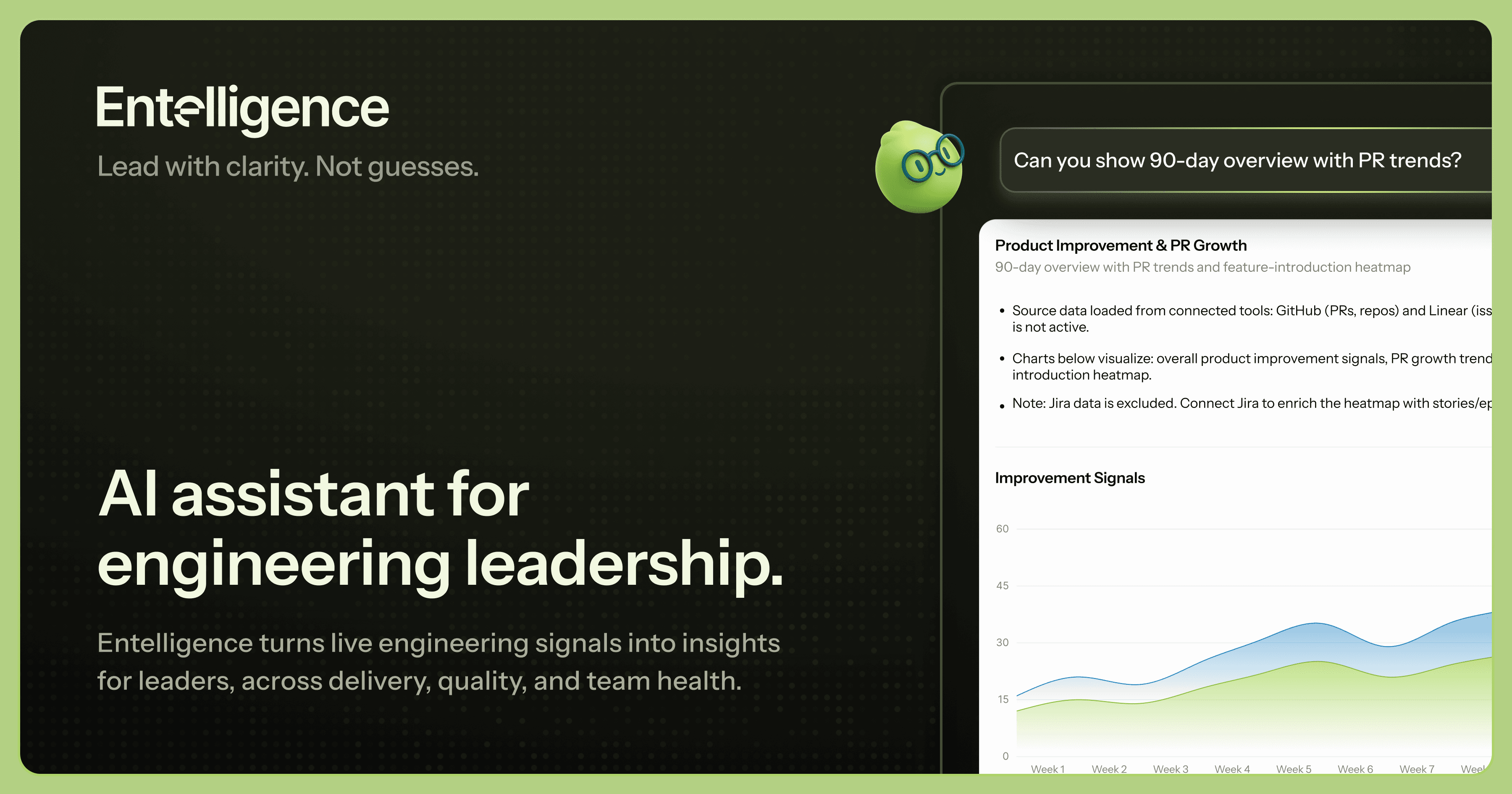
Ask Ellie is an AI engineering chat agent designed to provide engineering context directly within Slack, as described on its product page. The tool is built for engineering leaders, managers, founders, CTOs, and team members who need immediate answers about code changes, pull request status, sprint velocity, production issues, and product analytics. Its core value proposition is eliminating the need to dig through multiple dashboards—instead offering one place to ask and one clear answer, mirroring the site's tagline 'One place to ask. One clear answer. No digging, no delays.' By pulling data from connected tools such as GitHub and Linear, Ellie brings real-time engineering intelligence into daily conversations, helping teams make informed decisions without leaving their communication hub. This approach reduces context-switching and accelerates understanding of what is happening across the engineering organization.
Engineering teams often face a common pain point: valuable metrics and signals are scattered across separate tools like version control, project management, incident management, and analytics platforms. This fragmentation forces engineers and managers to spend significant time digging through dashboards, collecting data manually, and trying to correlate events to understand root causes. The core problem Ask Ellie solves is this lack of centralized, actionable insight. Instead of providing raw metrics, the tool composes answers from multiple signals, offering direct responses to natural language questions. This means users can ask about release risks, bug backlogs, team delivery trends, or production incidents and receive a coherent answer without manual assembly. For engineering leaders, this reduces delays in decision-making and helps focus on priorities rather than data retrieval.
One of Ellie's primary features is its ability to generate reports on demand by understanding PRs, reviews, commits, and delivery flow from GitHub and Linear. Users can simply ask what changed, what slowed down, and why, and Ellie compiles the information into a clear answer. This goes beyond standard dashboards because it surfaces the context behind metrics. Additionally, the feature 'Answers real engineering questions' allows users to ask a question in Slack and receive a direct response, with a chart included only when it helps comprehension. The tool distinguishes itself by not simply displaying raw metrics but reasoning about the data to provide meaningful answers. For example, instead of showing a cycle time graph, Ellie can tell you which teams have the best or worst cycle time and why based on recent commit and review activity.
admin
The next group of features focuses on turning answers into action and understanding production incidents. Ellie connects signals across tools, linking releases, errors, and incidents so you know exactly what changed and what broke. It doesn't show isolated metrics; instead, it composes answers from multiple signals to give full context. For instance, if a deployment caused a spike in errors, Ellie can correlate the release with the incident history and reveal which code changes are likely responsible. This capability is particularly valuable for engineering managers who need to assess the impact of a release quickly. The 'Turns answers into action' feature ensures that after receiving an answer, users have the context they need to decide next steps, whether that means rolling back a change, creating a ticket, or alerting the team. One question leads to one answer with full context, reducing the time from insight to action.
Beyond core question answering, Ellie incorporates advanced understanding capabilities. It builds a model of your system by learning ownership, recurring failure patterns, and relationships between components, not just isolated events. This allows it to reason across time, comparing what changed before, during, and after certain events to provide deeper context. Furthermore, Ellie understands the intent behind the work, distinguishing planned changes from regressions, incidents, and other unplanned activities. This nuanced understanding helps teams differentiate between intentional modifications and unexpected problems. Finally, Ellie tailors its answers based on who is asking; it frames responses differently for engineers, managers, and leaders, ensuring the information is relevant to each role. For example, a developer might get detailed technical context, while a CTO receives a summary of impact and recommendations. These capabilities make Ellie more than a simple bot—it becomes an intelligent engineering assistant.
The overall workflow of Ask Ellie is designed to fit seamlessly into engineering teams' existing routines. Ellie integrates with popular tools like GitHub, Linear, and incident management systems to pull data continuously. It builds a model of the system by learning from code changes, delivery flow, and incident patterns over time. When a user asks a question in Slack, Ellie reasons across this model to compose an answer that considers the current state, historical trends, and the user's role. The approach is not about displaying raw metrics but about providing actionable insights. For example, instead of showing a list of recent PRs when asked about release risks, Ellie analyzes the commits, known failure patterns, and incident history to identify which changes are most likely to cause problems. This methodology ensures that every answer is contextual and directly useful, reducing the cognitive load on engineers who would otherwise need to manually correlate data from multiple sources.
Ellie supports several real-world workflows that enhance team productivity. Engineering managers can start their day by asking Ellie about recent incidents, cycle time trends, and team velocity without opening multiple dashboards. The tool also automates error ticket creation in Linear based on Slack conversations, streamlining the process from detection to remediation. Sprint analysis becomes straightforward: teams can ask about code quality and deliverables, getting a summary of what was accomplished and what risks remain. Product analytics integration with PostHog allows users to ask about user conversion and feature adoption directly in Slack. In production incident scenarios, Ellie correlates releases with errors and incidents, enabling rapid root cause analysis. The outcome of these use cases is significant time savings—engineers report being able to answer questions in seconds rather than minutes or hours. Decision-making becomes faster and more informed because answers come with full context from across the engineering stack.
Ask Ellie is designed for a broad range of users within engineering organizations, including founders, CTOs, VP Engineering, engineering managers, and individual developers. The platform integrates natively with Slack, GitHub, Linear, and PostHog, and can connect to other tools through its data model. A free trial is available via the 'Start free' button on the site, and a demo can be booked for enterprise evaluation. The tool relies on building a continuous model of the engineering system, learning from code, releases, incidents, and product signals. In summary, Ask Ellie delivers on its promise of providing engineering visibility without adding more dashboards. By centralizing answers in Slack and offering contextual responses tailored to the user's role, it helps teams move faster with confidence, making it a valuable addition to any engineering team's toolkit.
Ask Ellie is specifically designed for engineering leaders, including CTOs, VP Engineering, and engineering managers who need to track team performance, release risks, and incident trends. It is also valuable for founders and executives who want a high-level view of engineering health without depending on technical staff to gather reports. Development teams benefit from Ellie's ability to answer detailed technical questions about code changes, PRs, and production issues, enabling faster debugging and context switching. The tool is also useful for product managers who want to correlate product analytics with engineering output. In summary, Ask Ellie serves any role within an engineering organization that needs instant, reliable answers about the state of their systems and workflows.
Updated 2026-02-28