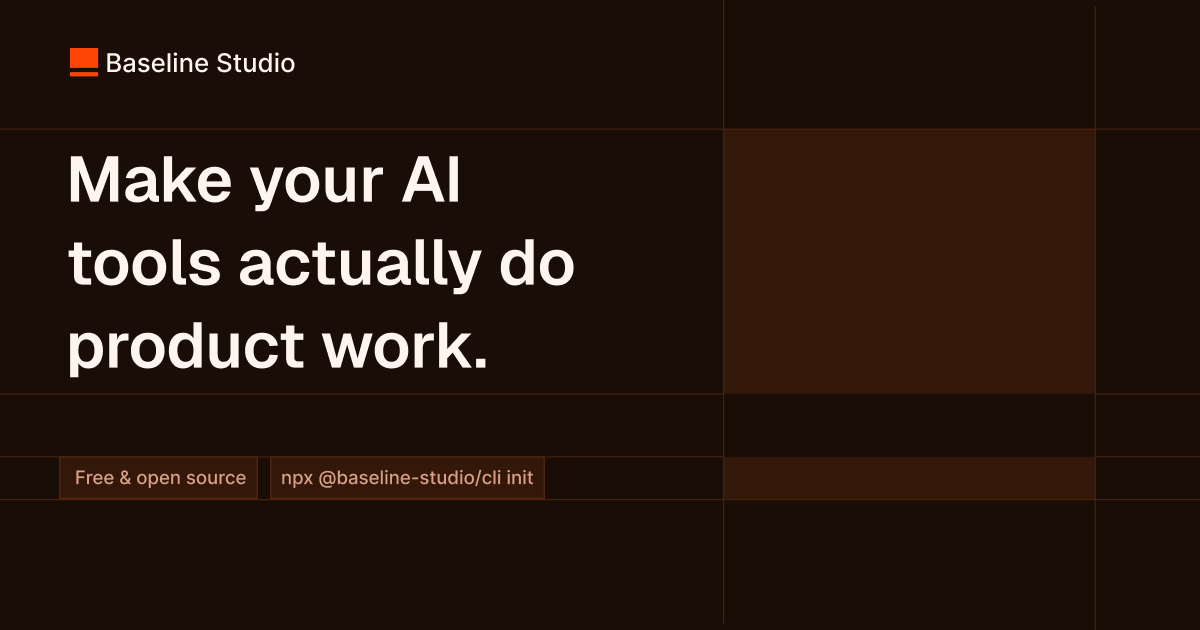
Baseline Core is an open-source product system designed to integrate business context and product methodology directly into AI tools, ensuring they operate with explicit rules and instructions rather than relying on implicit assumptions. It is built for product teams, designers, developers, and strategists who utilize AI in discovery, research, strategy, design, specification, and planning workflows, aiming to enhance consistency and accuracy in AI-assisted outputs. The primary purpose is to make critical business knowledge and methodological frameworks accessible to AI agents, enabling them to follow documented guidelines and produce work that aligns with organizational standards and objectives.
In the realm of AI-assisted work, a significant challenge arises when AI tools lack explicit context about business goals, product methodologies, or creative styles, leading to outputs that may be inconsistent or misaligned with organizational needs. This problem is particularly acute in discovery phases, where AI agents must navigate complex domains without clear guidance, often inventing their own rules or making unfounded assumptions. Baseline Core addresses this by transforming implicit knowledge into explicit, structured resources that AI can reliably reference, thereby reducing errors and improving the relevance of AI-generated content across various stages of product development.
The system includes 12 distinct skills that cover essential areas such as user research, competitive analysis, strategy formulation, design thinking, specification writing, and project planning. Each skill is detailed through frameworks and reference files that provide step-by-step instructions, templates, and examples, allowing AI tools to understand and execute tasks with precision. For instance, the research skill might include frameworks for conducting interviews or analyzing data, while the design skill could offer guidelines for UI components or usability principles, ensuring AI outputs adhere to established best practices and organizational standards.
Additionally, Baseline Core offers 14 frameworks that structure approaches to common product development challenges, such as defining product vision, creating roadmaps, or validating hypotheses. These frameworks break down complex processes into manageable steps, complete with decision trees, checklists, and criteria for success, which AI tools can follow to generate coherent and actionable outputs. The frameworks are designed to be modular and adaptable, enabling teams to customize them for specific projects while maintaining consistency across AI-assisted workflows, thereby streamlining collaboration and reducing the cognitive load on human team members.
admin
The product also provides 34 reference files that serve as authoritative sources of information on topics ranging from market trends and user personas to technical specifications and design systems. These files are formatted for easy ingestion by AI tools, often via markdown or structured data formats, ensuring that agents have access to up-to-date and relevant context. By centralizing this knowledge, Baseline Core prevents AI from relying on outdated or generic information, instead empowering it to produce outputs that reflect the unique nuances of a business's environment and objectives.
Baseline Core is delivered via a Command Line Interface (CLI) that facilitates the loading of its resources into any AI tool capable of reading AGENTS.md files, a common standard for agent instructions. This technical approach ensures seamless integration with existing AI workflows, allowing teams to quickly deploy the system without extensive configuration. The open-source nature, under the MIT license, means users can freely modify, extend, or contribute to the codebase, fostering a community-driven evolution of the tools to meet diverse needs across industries and use cases.
Users benefit from measurable outcomes such as increased efficiency in AI-assisted tasks, reduced time spent correcting AI errors, and enhanced alignment between AI outputs and business goals. By providing explicit context, Baseline Core minimizes the risk of AI hallucinations or deviations from established methodologies, leading to more reliable and consistent results. Teams can expect improved collaboration, as AI tools become predictable partners that adhere to documented processes, ultimately accelerating product development cycles and improving the quality of deliverables.
Concrete use cases include a product manager using Baseline Core to guide an AI in generating user research reports based on specific frameworks, ensuring all insights are structured and actionable. A designer might employ it to have AI produce design specifications that follow a documented style guide, maintaining brand consistency across projects. Similarly, a strategist could leverage the system to develop competitive analyses or roadmaps that align with business objectives, with AI tools referencing the provided frameworks to produce comprehensive and relevant outputs.
Target users include product managers, UX designers, software developers, business strategists, and AI engineers working in organizations that integrate AI into their workflows. The system integrates with any AI tool that supports AGENTS.md, such as various agent frameworks or platforms, and is built on a tech stack that includes Node.js for the CLI. Pricing is free due to its open-source MIT license, with no plans for paid tiers, making it accessible for individuals, startups, and enterprises alike to adopt and customize.
In summary, Baseline Core fundamentally enhances AI tool performance by making business context and product methodology explicit, enabling agents to operate with precision and alignment. It transforms implicit knowledge into structured resources that AI can reliably follow, reducing errors and improving consistency across research, strategy, design, specs, and planning tasks. This open-source system empowers teams to harness AI more effectively, ensuring outputs are both high-quality and closely tied to organizational goals.
Target users include product managers, UX designers, software developers, business strategists, and AI engineers in organizations that integrate AI into workflows. They seek to enhance AI tool performance by providing explicit business context and product methodology, ensuring outputs are consistent and aligned with goals. The system is ideal for teams involved in research, strategy, design, specs, and planning, who value open-source, customizable tools under an MIT license for free adoption and modification.
Updated 2026-02-28