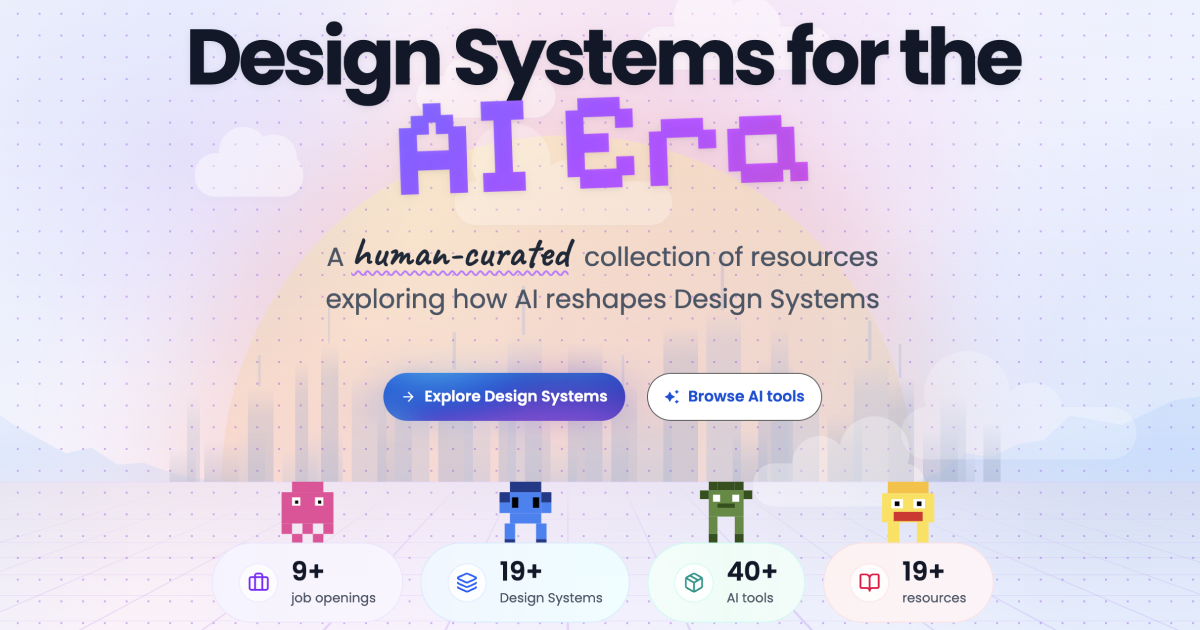
The Design Systems repo for the AI Era serves as a comprehensive, human-curated repository dedicated to exploring and documenting the intersection of artificial intelligence and modern design systems. This platform is specifically designed for product designers, design system engineers, product managers, and technology leaders who are actively navigating the integration of AI capabilities into their design workflows and component libraries. Its primary purpose is to aggregate, organize, and present a vast array of resources that illustrate how AI is fundamentally transforming the creation, maintenance, and scaling of design systems, providing a centralized hub for knowledge and tools in this rapidly evolving field. The repository functions as a living collection that continuously grows with community contributions, ensuring it remains current with the latest developments, tools, and methodologies in AI-augmented design.
The emergence of AI in product design and development has created a significant knowledge gap and operational challenge for teams responsible for design systems. Traditionally, design systems have been static or slowly evolving collections of components, guidelines, and patterns that ensure consistency and efficiency across digital products. However, the rapid advancement of AI introduces new complexities, such as how to design for AI-powered features, how to incorporate AI tools into the design system workflow itself, and how to maintain coherence when AI can generate or suggest design variations. This repository addresses the critical pain point of information overload and fragmentation by curating only the most relevant and high-quality resources, saving practitioners countless hours of research and helping them avoid the pitfalls of adopting unproven or poorly integrated AI solutions.
One major feature group is the curated selection of official Design Systems that have already begun implementing artificial intelligence features. The repository has reviewed over 500 systems to present a focused collection, including notable examples like Lightning DS, Cloudscape, and Carbon. This section provides concrete, real-world patterns and guidelines from leading technology companies, showing how AI considerations are being formally incorporated into design language documentation. It allows users to study how organizations are establishing principles for AI interactions, designing components for AI features like chatbots or predictive interfaces, and creating governance models for AI-generated design assets. This is invaluable for teams looking to benchmark their own efforts or find proven patterns to adopt, reducing the risk and uncertainty associated with pioneering AI integrations from scratch.
admin
A second major feature group is the extensive directory of AI tools and resources that are revolutionizing Design System workflows. This collection includes over 67 tools, such as v0, Figma, Make, and Bolt, which represent the cutting edge of automation and augmentation in design. These tools encompass a wide range of functionalities, from AI-powered design assistants that generate component variants or suggest layout improvements, to automation platforms that can translate design tokens into code or manage design system documentation. By aggregating these tools, the repository provides a practical toolkit for designers and developers to enhance their productivity, automate repetitive tasks, and explore new creative possibilities enabled by machine learning, all within the context of maintaining a coherent and scalable design system.
The repository further extends its value by aggregating career opportunities and a curated reading list, forming additional critical capabilities. It lists job openings from top companies like Meta, Google, and Microsoft, specifically for roles that combine Design Systems expertise with AI knowledge, signaling the growing market demand for this hybrid skill set. Simultaneously, the reading list compiles over 37 articles, guides, and resources from authoritative sources like Google PAIR, IBM Carbon, and Microsoft Design, offering deep dives into the theories, case studies, and best practices at the confluence of AI and design systems. These sections help users not only implement technical solutions but also advance their careers and foundational understanding of the field.
The product works overall as a meticulously organized, community-driven portal. It structures information into clear categories: Design Systems with AI, AI tools & resources, Job opportunities, and a Curated reading list. Each category is populated through a human curation process that evaluates and selects resources for their relevance and quality, rather than relying on automated aggregation. The technical approach is to present this data in an accessible, browsable format on a website, allowing users to filter and explore based on their immediate needs. The platform emphasizes being a 'living collection,' meaning it is regularly updated as new systems, tools, jobs, and articles emerge, ensuring the information remains timely and actionable for its audience.
The benefits for users are substantial and measurable. Practitioners save significant research time by having a pre-vetted, centralized source of information, accelerating their learning and implementation cycles. Teams can de-risk their AI integration projects by learning from the published guidelines and patterns of industry leaders. Individuals can identify skill gaps and career advancement opportunities through the job board. Ultimately, using this repository helps organizations and professionals build more robust, future-proof, and intelligent design systems faster, leading to more consistent user experiences, more efficient design-to-development handoffs, and a stronger competitive edge in creating AI-infused products.
Concrete use cases illustrate its practical value. A design system lead at a mid-sized tech company, tasked with adding AI component guidelines, can browse the 'Design Systems with AI' section to study how Carbon or Cloudscape document AI patterns, then use those as a template. A product designer exploring automation can go to the 'AI tools' section, discover a tool like v0 for generating UI code from prompts, and integrate it into their workflow to speed up prototyping. A developer considering a career shift can monitor the 'Job opportunities' to find roles requiring both design system and AI skills. A team planning an AI design sprint can use the 'Curated reading list' to assign foundational readings from Google PAIR to align their strategy.
The target users are primarily professionals involved in creating, maintaining, or using design systems: design system managers, UI/UX designers, front-end engineers, product managers, and design technologists. The repository integrates resources from across the tech stack and industry, featuring tools that plug into popular platforms like Figma and listing jobs from major software companies. While specific pricing plans are not mentioned in the content, the website is presented as a free, publicly accessible resource. Its model is community-driven, encouraging contributions to grow the collection, and it is designed to be a persistent, bookmarkable reference that users return to regularly for updates.
In summary, the Design Systems repo for the AI Era is an essential, one-stop knowledge base for anyone looking to understand and apply artificial intelligence within design systems. It solves the critical problem of fragmented information by providing curated, high-quality resources across multiple dimensions—real-world system examples, practical tools, career paths, and expert readings. By leveraging this repository, teams and individuals can navigate the complex AI design landscape with greater confidence, efficiency, and strategic insight, ultimately enabling them to build more adaptive and intelligent design systems for the future.
The primary target audience includes product designers, UI/UX designers, design system engineers, front-end developers, design technologists, product managers, and design system managers who are responsible for creating, maintaining, or utilizing design systems. It also serves technology leaders and decision-makers looking to integrate AI capabilities into their product design processes. The repository is tailored for professionals navigating the intersection of design systems and artificial intelligence, whether they are seeking practical tools, implementation guidelines, career opportunities, or educational resources to advance their work and skills in this emerging field.
Updated 2026-02-28