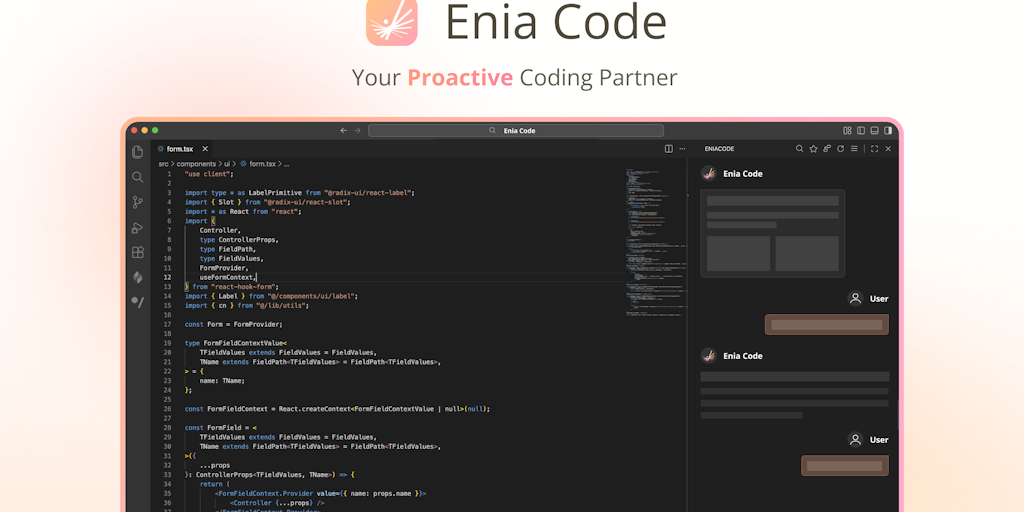
Enia Code is a proactive AI coding agent that detects bugs, performance issues, architectural inconsistencies, and refactoring opportunities as you write code. Unlike reactive tools, it works without prompting or context re-explaining while adapting to your coding habits.
Enia Code is a proactive AI coding agent that fundamentally redefines how developers interact with code. Unlike traditional chat-based assistants, it operates as a silent partner that brings solutions directly to the developer without requiring any prompting. Built for both individual engineers and teams, its core value lies in eliminating the friction of manual context re-explaining and reaction-time debugging. By monitoring the code as it is written, Enia Code catches bugs, performance issues, architectural inconsistencies, and refactoring opportunities in real time, effectively acting as an intelligent partner that ensures code quality from the first keystroke.
Developers frequently waste hours toggling between code editors and chat interfaces, repeatedly explaining their project context and past decisions. This reactive workflow disrupts focus and delays critical bug detection until after code is run or reviewed. Moreover, team best practices often remain undocumented, forcing senior developers to manually guide juniors or rely on impromptu code reviews. Enia Code directly addresses these pain points by observing the codebase and developer habits continuously, offering proactive signals for issues like memory leaks or redundant hooks without any ask. It solves the fundamental problem of context loss across sessions and team members, making coding more fluid and less prone to oversight.
The first major feature is Proactive Signal, which delivers zero-prompt, instant solutions to code issues as they arise. While a developer types, Enia Code silently analyzes the file for potential defects, from simple syntax inconsistencies to complex logical errors. When it detects a problem, such as a redundant code pattern or a memory leak, it immediately presents a ready-to-apply fix directly in the editor. This transforms the development workflow from a reactive debugging loop into a continuous improvement process. Developers no longer need to stop their flow to run diagnostics or search for solutions; the tool brings the answer before the question is even conceived. The benefit is a dramatic reduction in technical debt accumulation and an earlier detection of critical bugs, boosting overall confidence in code correctness.
Persistent Memory is the second cornerstone feature, establishing a continuous conversation that never resets. Unlike conventional AI tools that lose context after each chat, Enia Code builds a long-term understanding of the developer's preferences and habits. It remembers how the user names variables, which coding patterns they favor, and all previously discussed architectural decisions. There are no context window limits or 'start new chat' friction. This persistent state means that the tool becomes smarter the more it is used, adapting its suggestions to align perfectly with the individual's style. For teams, this continuity ensures that onboarding a new member or switching between tasks feels seamless, as the AI retains all relevant history and provides guidance that reflects the team's accumulated wisdom.
Publisher
A
admin
Launch Date2026-03-04
Platformdesktop
Pricingfree
Domain Authority
Ahrefs DR4/100
Traffic Insights
Month2026-01
Estimated Visits0
MoM Visits GrowthN/A(+0)
Avg Time on Site0s