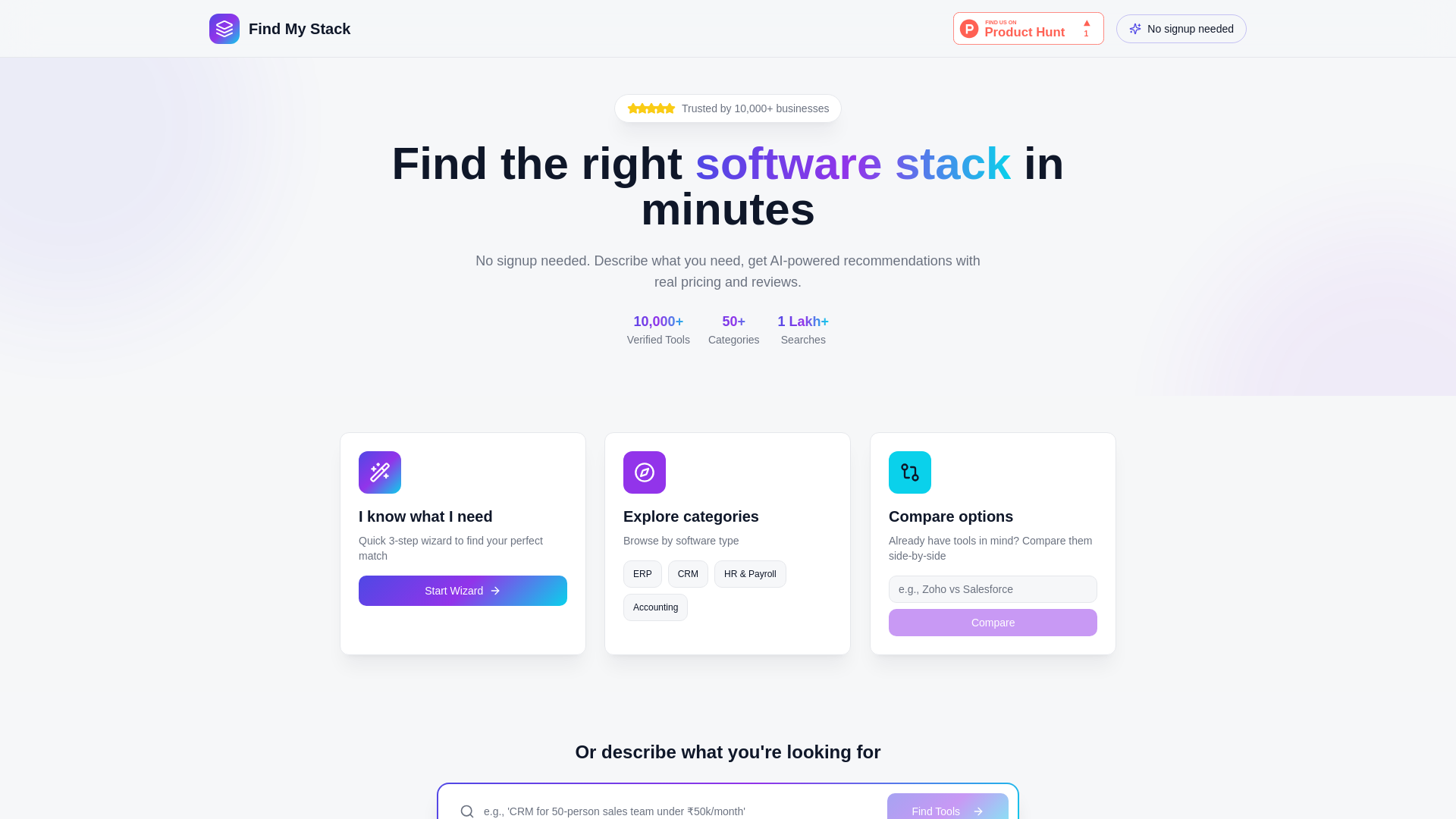
Find My Stack is an AI-powered platform designed to help businesses efficiently discover and select the ideal software tools for their specific operational needs. It serves companies of all sizes that are looking to implement or upgrade their software stack, particularly in core business areas like ERP, CRM, HR & Payroll, and Accounting. The platform's primary purpose is to eliminate the guesswork and extensive manual research typically involved in software procurement by delivering personalized, data-driven recommendations. It aggregates a vast database of verified tools to provide users with actionable insights, including real pricing information and aggregated reviews, all accessible without requiring an initial signup. This streamlined approach aims to save businesses significant time and resources while increasing the confidence in their software investment decisions.
The traditional process of selecting business software is notoriously complex, time-consuming, and fraught with uncertainty. Decision-makers often face an overwhelming marketplace with thousands of tools across dozens of categories, making direct comparison difficult. Key pain points include sifting through marketing claims to find genuine feature capabilities, uncovering true and current pricing structures that are often hidden behind sales inquiries, and synthesizing user feedback from multiple disparate review sites. This research burden can delay critical technology implementations for weeks or months, leading to operational inefficiencies and potential competitive disadvantage. Businesses struggle to match their unique workflow requirements and budget constraints with the most suitable software solutions, often risking costly mismatches or overspending on features they do not need.
The platform's first major feature group is its AI-Powered Matching and recommendation engine. This system intelligently processes a user's described needs to generate smart, personalized suggestions from its database of over 10,000 verified tools. The AI analyzes the user's input regarding their business function, required features, and other specified parameters to surface the most relevant software options. This matters because it transforms a vague search into a targeted discovery process, dramatically reducing the time spent on preliminary research. By leveraging artificial intelligence, the platform can identify non-obvious matches and consider a wider range of factors than a human might manually, ensuring recommendations are comprehensive and tailored to the specific context provided by the user.
admin
Updated 2026-02-28
A second critical feature group is the comprehensive Side-by-Side Comparison functionality. For users who already have specific tools in mind, the platform allows for direct comparison on a detailed feature matrix, pricing breakdown, and analysis of pros and cons. This feature enables an objective, apples-to-apples evaluation of competing solutions, highlighting key differences in capabilities, cost structures, and user sentiment. The depth of this comparison is vital for informed decision-making, as it consolidates fragmented information into a single, coherent view. Users can weigh trade-offs between different software options efficiently, understanding not just what features are present, but how they are implemented and perceived by actual users in the market.
Additional capabilities include providing access to Real Reviews aggregated from major software review platforms like G2 and Capterra. This offers users a consolidated and verified source of peer feedback, helping to validate vendor claims and understand real-world user experiences. The platform also structures the discovery process through multiple entry points: a quick 3-step wizard for guided searches, the ability to explore broad categories like Marketing and Analytics, and a free-text search to describe specific needs. For users seeking deeper analysis, a premium tier unlocks unlimited comparisons, detailed pros/cons, implementation roadmaps, and PDF downloads, providing an end-to-end tool selection and planning resource.
The product works overall by maintaining a large, continuously updated database of software tools across 50+ categories. Its technical approach combines this structured data with AI algorithms that interpret natural language user queries to find matches. The user interface presents multiple pathways to engage with this data, from browsing categories to using a conversational input to start a search. The system then cross-references the query against tool attributes, features, and review sentiments to generate a ranked list of recommendations. The comparison engine pulls specific data points for selected tools to populate detailed comparison matrices, giving users a clear, analytical view of their options.
The measurable benefits and outcomes for users are substantial time savings and increased decision confidence. Businesses can find the right software stack in minutes rather than weeks, accelerating their digital transformation initiatives. Access to real pricing prevents budget surprises and enables more accurate financial planning. Aggregated reviews from trusted sources reduce the risk of selecting a tool with poor user satisfaction or hidden flaws. The structured comparison and AI recommendations lead to more optimal tool selections that better fit the company's actual needs, potentially improving operational efficiency and user adoption rates post-implementation.
Concrete use cases are varied. A growing startup needing its first formal CRM system can use the 3-step wizard to describe its sales process and budget, receiving tailored suggestions for scalable solutions. An established company looking to replace its legacy HRMS can compare the top 5 shortlisted tools side-by-side, examining feature parity and implementation costs in detail. A finance manager evaluating accounting software can read aggregated reviews to gauge ease of use and customer support quality before engaging vendors. An IT director planning a new marketing tech stack can explore the Marketing category to discover new tools and build a comparison matrix for stakeholder review.
The target users are business owners, founders, IT directors, department heads, and procurement specialists in companies of all sizes who are responsible for selecting and purchasing software. The platform is particularly valuable for SMBs that may lack dedicated IT research teams. It integrates data from major software review aggregators like G2 and Capterra to power its review insights. The tech stack behind the platform involves AI for natural language processing and recommendation algorithms, coupled with a database of tool metadata. Pricing is based on a freemium model: a free tier allows comparison of up to 3 tools with basic insights, while a premium 'Complete Analysis' plan is available for ₹499, offering unlimited comparisons, detailed pros/cons, implementation roadmaps, and PDF downloads.
In summary, Find My Stack delivers primary value by acting as an intelligent, centralized research assistant for software selection. It consolidates tool discovery, comparison, and evaluation into a single, user-friendly platform powered by AI and extensive verified data. By providing personalized recommendations, transparent pricing, and aggregated reviews, it empowers businesses to make faster, more informed, and more confident software purchasing decisions, ultimately helping them build a technology stack that drives efficiency and growth.
Find My Stack is designed for business decision-makers responsible for software procurement and technology strategy. This includes business owners, founders, startup operators, IT directors, and department heads (like Heads of Sales, HR, Finance, or Marketing) across companies of all sizes, from small businesses to enterprises. It is particularly valuable for small and medium-sized businesses (SMBs) that may not have dedicated IT research teams, as well as for consultants and advisors who help clients select software. The platform serves anyone looking to implement, upgrade, or optimize their software stack in core areas like ERP, CRM, HRMS, Accounting, Marketing, and Analytics.