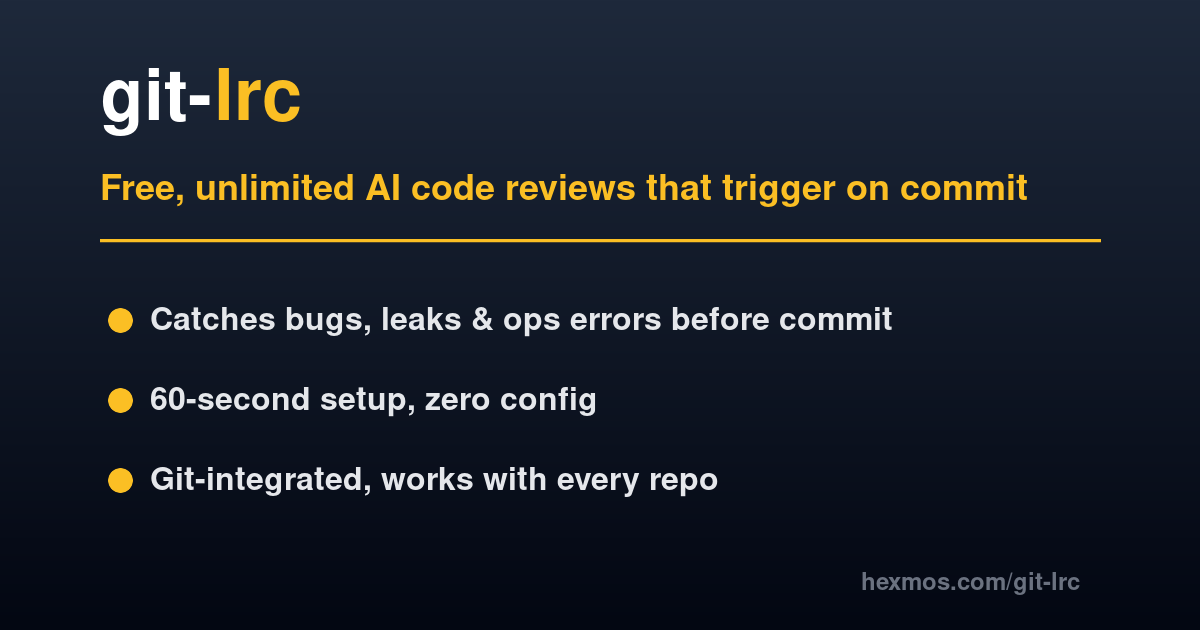
git-lrc is a free, lightweight AI-powered code review tool designed to integrate seamlessly into developers' existing workflows by running micro-reviews directly within the terminal at commit time. It targets engineering teams and individual developers who seek to enhance code quality and security without disrupting their habitual git processes, aiming to catch critical issues before code reaches pull requests or production. The primary purpose of git-lrc is to automate the early detection of bugs, security vulnerabilities, and logic shifts, thereby transforming code review from a manual, often delayed task into an immediate, automated safety net that operates silently in the background.
In modern software development, manual code reviews can become a significant bottleneck, slowing down deployment cycles and allowing subtle yet costly errors to slip through. Developers often face the challenge of catching logic bugs, accidentally leaked credentials, or inefficient cloud calls only after code has been pushed, leading to time-consuming fixes and potential security risks. This problem is exacerbated when using AI coding assistants, which can introduce unexpected logic changes that are difficult to spot during a hurried review, creating a gap where high-risk modifications might go unnoticed until they cause issues in production.
The tool's first major feature group is its seamless terminal Git hooks integration, which allows it to run natively within developers' existing command-line workflows without requiring them to change their habits. By hooking directly into the git commit process, git-lrc triggers reviews automatically as soon as a developer attempts to commit code, providing instant feedback right where they work. This integration ensures that the review process feels like a natural extension of git rather than an external tool, reducing friction and encouraging consistent use. The importance lies in preserving developer efficiency while embedding quality checks directly into the commit stage, preventing problematic code from ever leaving the local environment.
A second critical feature is its ability to perform blazing fast local reviews that execute immediately upon committing, delivering rapid analysis without slowing down the development cycle. These micro-reviews are designed to be lightweight and focused, scanning diffs for specific high-risk patterns such as credential leaks, expensive cloud API calls, and logic alterations introduced by AI agents. The speed ensures developers receive actionable feedback in seconds, enabling them to address issues on the spot rather than waiting for a later review phase. This immediacy transforms code review from a post-commit gatekeeping activity into an in-the-moment coaching tool that educates developers about potential pitfalls as they code.
admin
Additionally, git-lrc promotes the development of healthy early review habits and contributes to maintaining cleaner repositories by catching issues at the source. By flagging problems before code is pushed to remote branches, it helps teams avoid cluttering pull requests with easily preventable bugs, thus streamlining collaborative review processes. The tool also supports a community-driven, open-source ethos, being part of a suite of free developer utilities that prioritize accessibility and flexibility. Its design emphasizes security as a foundational principle, ensuring that checks for vulnerabilities like credential exposure are built into every review from the start, aligning with the belief that security should never be an afterthought.
The technical approach of git-lrc revolves around leveraging AI to analyze code diffs in real-time, focusing on pattern recognition for common error types and security anti-patterns. It operates locally within the git hook ecosystem, meaning it processes code changes on the developer's machine without sending data to external servers unless configured otherwise, which can enhance privacy and reduce latency. The tool is tailored to work with standard git commands, requiring minimal setup—often just a simple installation—to begin automatically reviewing every commit. This lightweight architecture ensures it doesn't burden system resources, making it suitable for continuous use even in resource-constrained development environments.
Benefits for users include measurable outcomes such as drastically reduced onboarding and review cycle times, shifting from hours of manual inspection to minutes of automated analysis. Developers gain the ability to find hidden edge cases and logic shifts instantly, which traditionally might require extensive testing or peer review to uncover. Teams experience fewer production incidents related to credential leaks or costly cloud calls because issues are caught early, leading to more stable deployments and lower operational costs. Moreover, the tool generates highly contextual, line-by-line inline reviews that provide specific feedback, helping developers learn and improve their coding practices over time.
Concrete use cases involve integrating git-lrc into daily development workflows, such as when a developer commits a change that inadvertently includes a hardcoded API key; the tool would flag this immediately, preventing sensitive data from being pushed. Another example is during refactoring or when using AI assistants like GitHub Copilot, where logic might be subtly altered; git-lrc detects these shifts and alerts the developer to review the changes before proceeding. In team settings, it ensures that all commits meet a baseline quality standard before they enter pull requests, reducing the back-and-forth in code reviews and accelerating merge times. For solo developers, it acts as a reliable automated peer, offering a safety net that catches oversights during intensive coding sessions.
Target users primarily include software engineers, DevOps professionals, and development teams of all sizes who use git for version control and seek to enhance code quality without adopting heavy, expensive enterprise tools. The tool integrates natively with git hooks and is designed for terminal-based workflows, making it ideal for developers who prefer command-line interfaces. It is part of a broader ecosystem of free, open-source developer tools from Hexmos, reflecting a commitment to affordability and flexibility. While specific pricing plans aren't detailed, git-lrc is explicitly described as free, aligning with the company's principle that enterprise-grade tools should be accessible to everyone, not just large corporations.
In summary, git-lrc delivers primary value by embedding intelligent, automated code review directly into the commit process, enabling developers to catch critical issues early and maintain high code quality effortlessly. It transforms a traditionally manual and time-consuming task into an automated, continuous practice that supports faster, safer software development. By focusing on micro-reviews that are fast, local, and non-disruptive, it empowers teams to build better software while preserving their existing workflows. Ultimately, git-lrc represents a step toward more autonomous, AI-assisted development where tools work silently in the background to prevent errors and foster a culture of proactive quality assurance.
git-lrc targets software engineers, DevOps professionals, and development teams of all sizes who use git for version control and seek to improve code quality without disrupting their workflows. It is ideal for developers who prefer terminal-based environments and want automated, AI-powered reviews integrated directly into their commit process. The tool appeals to teams looking for affordable, flexible solutions that catch issues like credential leaks and logic bugs early, as well as individuals using AI coding assistants who need to verify code changes. Its free, open-source nature makes it accessible to startups, indie developers, and large enterprises alike, aligning with a community-driven approach to tooling.
Updated 2026-02-28