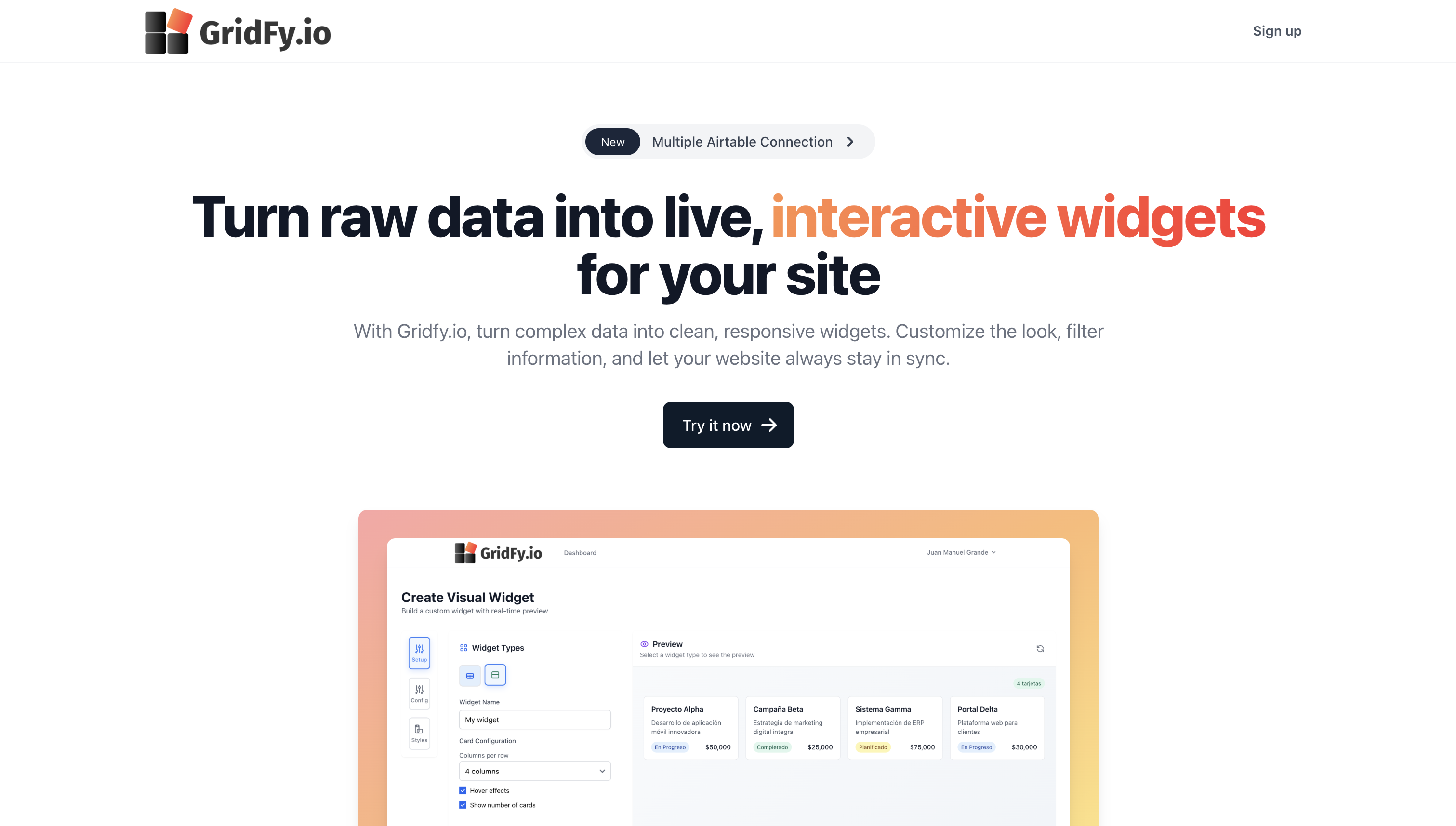
Gridfy.io turns your Airtable, Notion, or Google Sheets data into live, customizable website widgets with no code required. Create interactive, filterable grids that update in real time and match your brand's look and feel.
Gridfy.io is a powerful no-code platform designed for individuals and businesses that need to display dynamic data from spreadsheets and databases directly on their websites. It serves users who want to move beyond sharing ugly spreadsheet links by transforming raw data into beautiful, interactive, and responsive web components. The primary purpose is to enable anyone, regardless of technical skill, to create production-ready widgets that sync with their data sources and integrate seamlessly into their existing websites, eliminating the need for custom backend development or complex APIs.
Traditionally, sharing data from tools like Airtable, Notion, or Google Sheets on a website involved embedding confusing interfaces that lacked branding and offered poor mobile experiences. These native embeds often break a website's design, forcing a compromise between functionality and aesthetics. Users faced the pain point of either developing custom frontend code and APIs, which is time-consuming and requires technical expertise, or settling for rigid, unattractive widgets that detract from their site's professional appearance and user experience.
One major feature group is full visual customization, which ensures widgets do not have a generic 'widget' look. Gridfy components are designed to visually adapt to your brand, respecting your website's specific typography, spacing, and color styles for a truly native integration. This is achieved by generating clean, professional components built with Tailwind CSS, resulting in native-looking blocks that belong on your site without using iframes or locked embeds. This matters because it preserves brand consistency and provides a seamless user experience, making the data presentation feel like an inherent part of the website rather than a third-party add-on.
Another significant feature set involves advanced controls and interactivity for end-users. Gridfy allows you to add smart features like intelligent search, dynamic sorting, and custom filters to each widget. These capabilities increase visitor interaction by enabling users to quickly find and manipulate the displayed information according to their needs. This transforms static data displays into interactive tools, enhancing the utility of the website and improving user engagement without requiring any additional coding from the site owner.
Additional capabilities include enterprise-grade security and management features such as domain access control and usage analytics. You can configure precise lists of authorized domains to ensure your widgets and data are only displayed on websites you explicitly choose. Furthermore, each widget provides clear viewing and performance statistics, and you can set maximum usage limits to maintain control over data access. These features are crucial for professional use, ensuring data security, monitoring widget performance, and managing resource consumption effectively.
Publisher
A
admin
Launch Date2026-01-07
Platformweb
Pricingfreemium
Domain Authority
Ahrefs DR7/100
Traffic Insights
Month2026-01
Estimated Visits0
MoM Visits GrowthN/A(+0)
Avg Time on Site0s