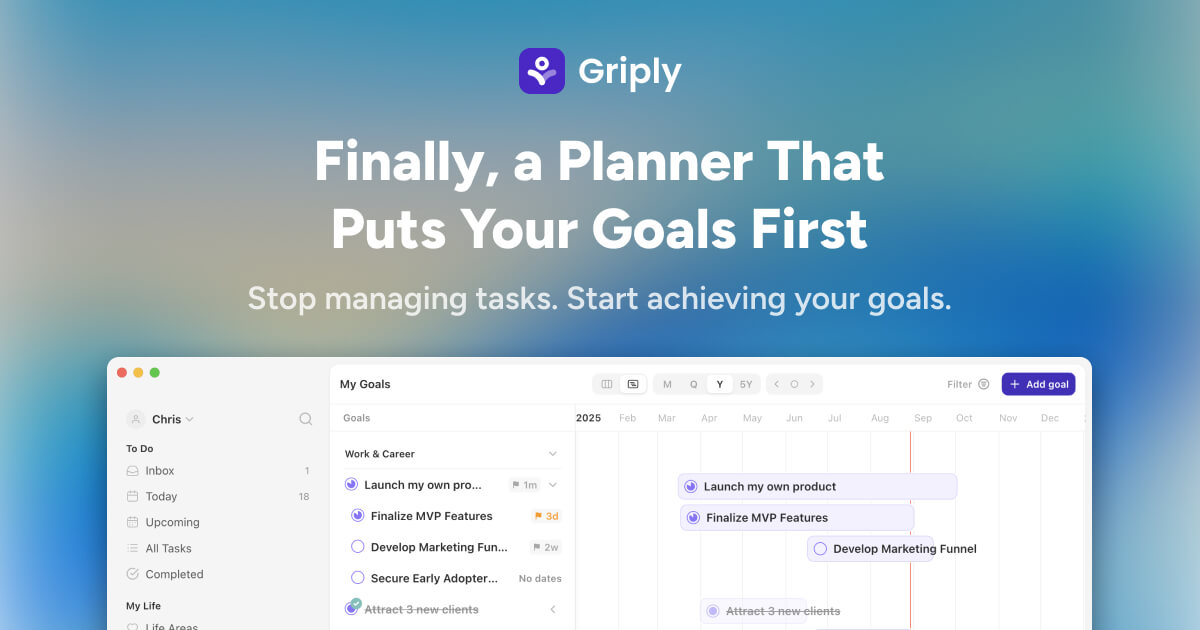
Griply is a comprehensive personal productivity application designed for ambitious individuals who feel busy but not genuinely productive. It serves as a unified system that connects a user's long-term vision, life areas, goals, daily habits, and tasks, ensuring every action is purpose-driven. The app is built on the premise of 'purpose first,' moving beyond simple task management to create a cohesive framework for mapping out and achieving what matters most in one's career, health, finances, and personal growth. By integrating these elements, Griply provides a clear pathway from abstract aspirations to concrete daily execution, making it an essential tool for anyone seeking to close the gap between their daily efforts and their overarching life objectives.
Many people experience a frustrating disconnect between their daily to-do lists and their long-term ambitions, a problem Griply identifies as the 'Action-Purpose Gap.' Traditional task management apps are described as 'Why-agnostic,' efficiently cataloging what needs to be done but failing to connect those tasks to the underlying reasons for doing them. This leads to a haunting feeling where busyness does not translate into meaningful progress toward personal or professional goals. Users often juggle multiple disconnected tools for goals, habits, and calendars, creating fragmentation and losing sight of the bigger picture. Griply addresses this core pain point by providing a single, seamless environment where every task and habit is intrinsically linked to a larger goal and vision, eliminating the sense of aimless activity.
The first major feature group is the Life Planner and Vision definition, which forms the foundational layer of the Griply system. Users start by mapping out their personal vision across defined Life Areas such as 'Career,' 'Health,' or 'Finances.' This process grounds the user in their 'why,' providing a strategic top-down context for all subsequent planning. Unlike apps that begin with tasks, Griply insists on establishing this high-level purpose first, ensuring that every goal and action is aligned with the user's desired life direction. This structured approach prevents goal-setting from becoming a vague or isolated activity, instead making it an integral part of a coherent life map. The Life Planner acts as the strategic compass, guiding all lower-level planning and ensuring consistency across different domains of a user's life.
The second core component is the integrated Goal Planner and Tracker, which transforms vague ambitions into actionable, measurable plans. This feature allows users to break down large goals into manageable Subgoals and attach specific Success Metrics to track real, quantifiable progress. It moves beyond simply listing goals to providing a clear roadmap for achievement, where progress is measured against defined criteria rather than just checking boxes. The planner creates a true hierarchy, connecting these detailed goal plans back to the overarching Life Areas and Vision defined earlier. This integration ensures that working on a subgoal directly contributes to a larger life objective, making progress tangible and motivating. The tracker provides visibility into this progress, helping users stay focused and adjust their plans as needed.
admin
The third essential feature group encompasses the Habit Tracker and Task Manager, which are the execution engines of the system. The built-in Habit Tracker is not an add-on but a core feature designed to help users build meaningful, goal-oriented routines. Habits can be linked directly to specific goals, ensuring that daily repetitions contribute directly to long-term success. The Task Manager is similarly designed with a goal-first philosophy, prioritizing and organizing daily to-dos based on their connection to higher-level objectives. This connection transforms mundane tasks into purposeful steps, addressing the 'Why-agnostic' nature of standard to-do lists. Together, these tools ensure that both recurring behaviors and one-off actions are aligned with the user's defined purpose, creating a powerful synergy between routine and project-based work.
Griply's overall technical approach is to function as an integrated, opinionated system rather than a blank sandbox or a cluttered bundle of separate features. It provides a seamless workflow that connects Vision > Life Areas > Goal Plans > Subgoals > Tasks & Habits in a logical hierarchy. The system includes calendar integrations and time-blocking capabilities, allowing goals to flow directly into a user's weekly schedule. Features like Task Smart Recognition enable quick capture of tasks in plain English, which are then automatically scheduled and assigned to the correct Life Area. The design philosophy prioritizes an uncluttered interface that discourages endless 'tinkering' and instead facilitates focused action, providing the structure needed to achieve goals without the complexity of building the tool itself.
The primary benefits for users are a profound shift from feeling busy to feeling genuinely productive and a clear understanding of how daily efforts contribute to long-term success. Measurable outcomes include the ability to track real progress through Success Metrics, gain unified insights into goal and habit trends via a dedicated dashboard, and maintain focus through interactive home screen widgets. Users report finally having a system that connects all the pieces of their life, eliminating the fragmentation caused by using multiple apps. This leads to reduced anxiety about 'busyness,' increased motivation as progress becomes visible, and a stronger sense of control and direction. The system is designed to create consistent, purposeful action that compounds over time into significant life achievements.
Concrete use cases include managing complex work projects by creating a 'Work' Life Area, setting project goals and subgoals, and linking all related tasks and habits to ensure alignment with professional vision. Another example is personal health improvement, where a user can define a 'Health' vision, set a goal like 'Run a marathon,' break it into subgoals for training and nutrition, and link daily running habits and meal-prep tasks directly to that goal. Students can use it to manage academic and personal life by linking study tasks to degree completion goals within an 'Education' area. Freelancers can track business growth goals, client project tasks, and habit-building for networking or skill development, all within a unified system that shows how daily work builds their career.
The target users are ambitious individuals, professionals, students, freelancers, and anyone tired of disconnected productivity tools who seek to align their daily actions with long-term aspirations. It appeals to those who have tried apps like Todoist, TickTick, Things 3, or Notion but found them lacking in goal integration. Griply offers integrations with calendar services for time blocking and synchronization. The tech stack is not detailed, but the app is available for download on multiple platforms. Pricing plans include a free tier to start, with premium features likely available through subscription, as indicated by the call to 'Start for free' and the existence of a dedicated pricing page. The company actively engages with its user community through WhatsApp, Reddit, and a public roadmap.
In summary, Griply's primary value is providing a complete, purpose-driven personal operating system that finally bridges the gap between long-term vision and daily execution. It replaces the need for multiple fragmented tools with a single, cohesive environment where every task, habit, and calendar event is meaningfully connected to a user's goals and life areas. By enforcing a 'purpose first' methodology, it transforms productivity from a game of checklist management into a strategic practice of life alignment. The takeaway is that Griply is the definitive solution for anyone who wants to stop merely managing tasks and start consistently achieving what truly matters to them.
Griply is built for ambitious individuals, professionals, students, and freelancers who feel busy but not genuinely productive. It targets users tired of disconnected apps like Todoist, TickTick, or Notion, who seek to align daily tasks with long-term goals. It's ideal for those experiencing the 'Action-Purpose Gap,' where their to-do list feels disconnected from their life vision. The app appeals to people who want a structured, opinionated system that prevents endless tinkering and instead provides a clear path from vision to execution. Users are often goal-oriented but frustrated by tools that only manage tasks without context, seeking a unified personal operating system for their entire life.
Updated 2026-02-28