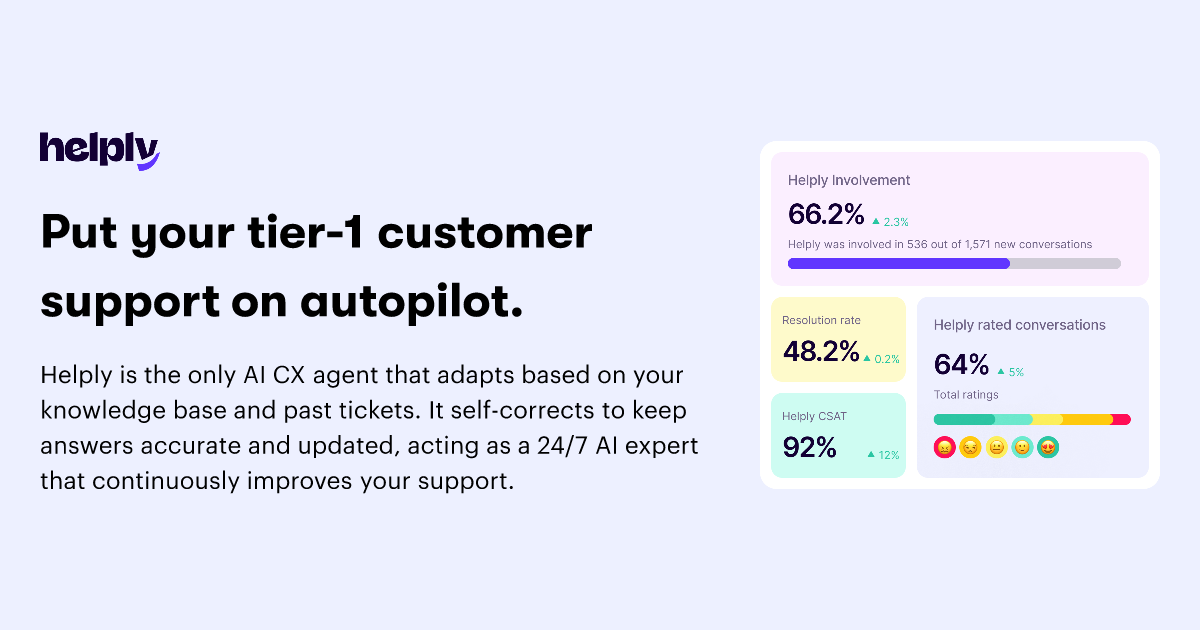
Helply is an AI B2B support platform purpose-built for companies that want to transform customer support from a cost center into a revenue engine. Targeting B2B organizations with $1M to $50M ARR, it consolidates every customer conversation channel—email, chat widget, in-app messages, Slack Connect, and WhatsApp—into a single threaded inbox with unified automations, SLAs, and AI capabilities. The platform is free forever for unlimited seats and users, charging only when the AI produces verifiable outcomes such as a resolved ticket, a detected churn signal, or an identified upsell opportunity. Helply guarantees a 65% AI resolution rate within 90 days; if it fails to meet that threshold, the customer pays nothing. This risk-free model allows B2B support teams to adopt advanced AI without upfront investment, aligning cost directly with value delivered.
B2B support teams often struggle with high ticket volumes that overwhelm agents, leading to slow response times and customer churn. Traditional helpdesk platforms charge per seat and offer limited AI that is bolted on after the fact, resulting in poor accuracy and no accountability for outcomes. Support interactions contain valuable revenue intelligence—churn language, upsell requests, competitor mentions—that is routinely lost in closed tickets. Helply solves this by ingesting every conversation and automatically extracting these signals, routing them to appropriate teams in real time. This prevents churn by enabling proactive outreach and captures upsell revenue that would otherwise go unnoticed. The problem is especially acute for B2B companies where contracts are high-value and relationships depend on swift, informed responses. Helply turns support from a reactive cost into a proactive profit driver.
The first major feature group is the omnichannel inbox and the data layer. Helply’s omnichannel support funnels email, chat, in-app, Slack Connect, and WhatsApp into one unified inbox, eliminating context switching for agents and ensuring consistent SLAs across every channel. The data layer is the intelligence backbone: it connects to the company’s knowledge base, ticket history, Slack conversations, Stripe subscriptions, Gong call transcripts, PostHog product analytics, HubSpot CRM, and Attio data. By training on this rich context, the AI understands the full account picture—past issues, billing status, product usage, and internal communications—before it ever touches a ticket. For B2B support, this context is critical; a resolution that ignores account-specific details is rarely correct. Together, the unified inbox and context layer form the foundation for reliable automated support that scales without sacrificing quality.
admin
The second major feature group is the AI Agent and AI Drafts. The AI Agent resolves tickets autonomously but only when it has high confidence in a complete and correct answer. It loads full account context from the data layer and the knowledge base, and if confidence is low, it gracefully defers to a human. This conservative approach is deliberate: for B2B, getting it right matters more than getting it fast. When the AI cannot answer completely, it creates a draft reply for the support team. The draft is tone-matched to the company’s voice and includes inline citations of the account context used. Agents can review, tweak, and send the reply in seconds instead of composing from scratch. This feature—called AI Drafts—dramatically reduces handle time while ensuring that every human reply is informed by the same context the AI would have used. The combination covers both ends of the complexity spectrum.
The third major feature group is revenue signal detection and routing. Helply scans every incoming ticket for specific indicators: churn language such as cancellation requests, upsell opportunities when customers ask about premium features, competitor mentions referencing rival products, plan-limit hits that suggest upgrades, and product feature requests. Each indicator is tagged and attributed to the account along with its ARR value and renewal date. The platform then routes these signals to the right human without manual triage: churn signals go to the customer success manager, upsell flags to the account executive, feature requests to the product team, and knowledge base gaps to the support lead. This routing happens same day, often before the customer escalates. As a result, revenue teams are no longer blind to what support hears daily, and they act on insights while they are still fresh. Helply turns support conversations into real-time business intelligence.
Helply’s overall workflow rests on three pillars: a free omnichannel platform, an AI that trains on account-specific context, and outcome-based pricing that aligns incentives. The process starts with connecting all customer channels to a single inbox, then integrating business tools like CRM, billing, and product analytics into the data layer. The AI agent trains on this data along with the company’s knowledge base, learning which answers resolve tickets successfully. When a new ticket arrives, the AI evaluates its confidence; if high, it sends a resolution automatically. If not, it drafts a response for a human. Simultaneously, the platform scans for revenue signals and routes them. Every automated action is logged and measured, and the dashboard shows the monetary value of each outcome—resolved tickets, prevented churn, generated upsell pipeline. The system improves over time as the data layer grows, increasing AI resolution rate and signal accuracy.
Concrete use cases and outcomes are evident from Helply’s customers. For Sender.net, Helply turned support into a revenue signal—every onboarding question routed back to product the same week, enabling faster iterations. Covidence automated 30% of its support volume without quality loss, allowing lean teams to focus on complex cases. Proposify consistently sees a 30–35% resolution rate, freeing their customer experience director for strategic work. Kameleo used Helply to keep documentation accurate and measurable, ending the struggle of outdated articles. Gatekeeper Press handled over 1,400 conversations with a 91% resolution rate, changing how they communicate with authors. In each case, common outcomes include reduced ticket volume, faster response times, and actionable revenue intelligence from support conversations. Users report the platform pays for itself within three months through efficiency gains and captured revenue.
Helply targets B2B companies in the $1M to $50M ARR range, specifically customer success managers, account executives, product managers, support leads, and founders who view support as strategic. It integrates with major tools like Zendesk, Slack, Stripe, Gong, PostHog, HubSpot, and Attio, and also serves as a standalone helpdesk. Pricing is unique: the helpdesk is free with unlimited seats and users; costs only come from AI outcomes—each successful resolution, churn alert, or upsell opportunity. There are no per-attempt fees, no seat licenses, no long-term contracts. Helply guarantees a 65% AI resolution rate within 90 days, and if it fails, the customer pays nothing. This low-risk, high-reward model aligns directly with business results. In summary, Helply transforms customer support into a revenue engine by combining a free omnichannel platform with outcome-priced AI and real-time revenue intelligence.
Helply is built for B2B companies in the $1M to $50M ARR range, specifically customer success managers, account executives, product managers, support leads, and founders who view support as a strategic revenue function. These organizations typically operate lean teams and need to maximize efficiency while capturing revenue intelligence from every customer interaction. Helply also serves as a free helpdesk for any B2B team looking to consolidate multiple channels into one platform. The target audience includes technology and SaaS companies that integrate tools like Stripe, HubSpot, Slack, and Gong, and that require a context-aware AI to handle complex, account-specific support queries. Decision-makers are often VPs of Customer Experience, Heads of Support, or CEOs seeking to reduce costs while increasing customer retention and upsell revenue.
Updated 2026-02-28