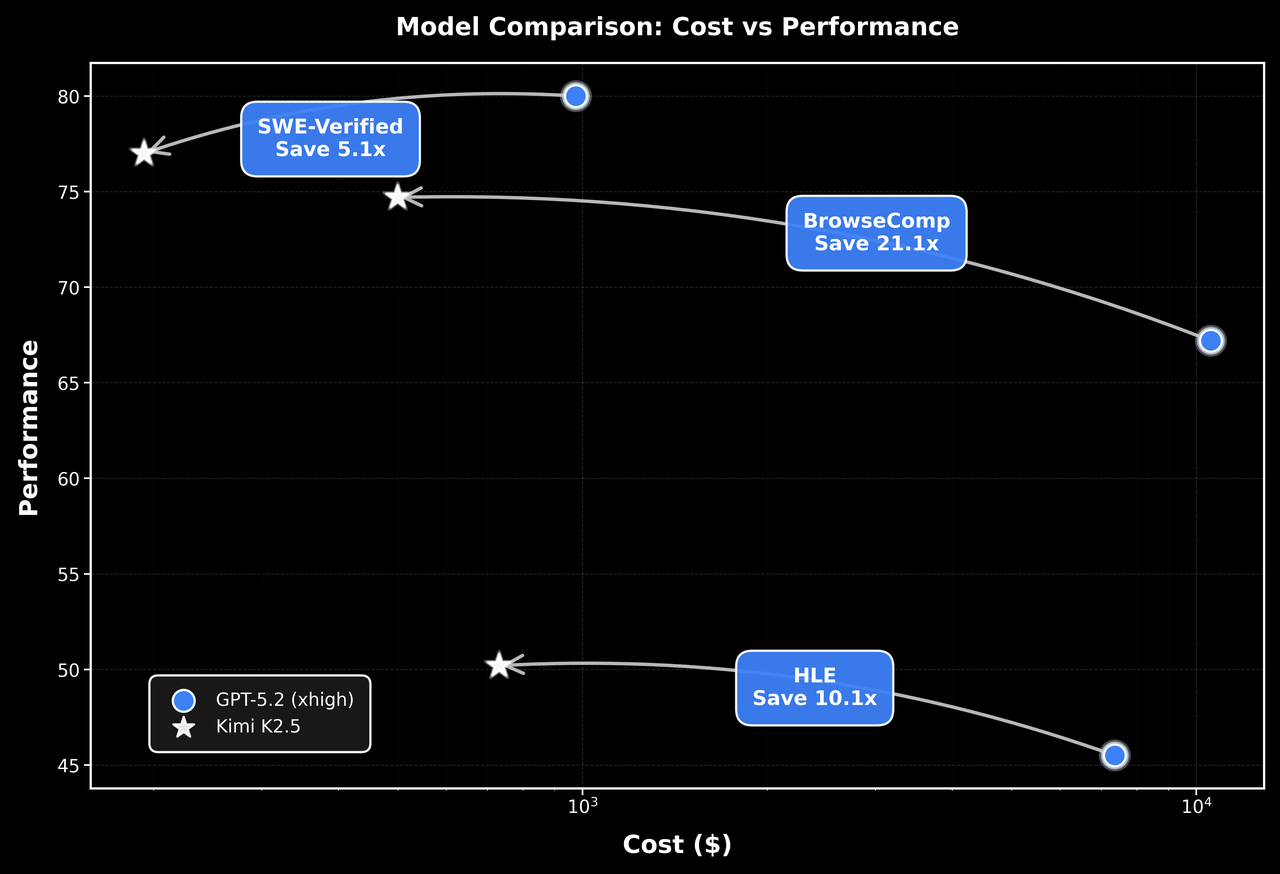
Kimi K2.5 is a native multimodal AI model that sets a new benchmark for open-source AI by integrating state-of-the-art coding and vision capabilities within a single unified framework. This makes it an ideal AI coding agent for developers, researchers, and knowledge workers who need advanced reasoning and perception. The model excels in agent tasks, code generation, visual understanding, and general intelligent tasks, achieving top performance on leaderboards. What truly sets it apart is its ability to deploy self-directed agent swarms that autonomously coordinate and execute complex multi-step workflows. By handling text, images, and code simultaneously, Kimi K2.5 reduces the friction between different modalities, enabling seamless transitions between tasks like reading a diagram, writing code, and generating a report. This core value of unified multimodal AI with autonomous agent coordination makes it a powerful assistant for anyone tackling sophisticated problems in software development, research, and content creation.
The primary pain point that Kimi K2.5 addresses is the fragmentation of AI tools across different modalities and the lack of autonomous task execution. Developers often juggle separate models for coding, vision, and reasoning, leading to inefficiencies and context-switching overhead. Additionally, complex workflows require orchestration of multiple steps that even advanced models struggle to coordinate without human intervention. Kimi K2.5 solves this by offering a single multimodal model that natively understands code, images, and text, combined with self-directed agent swarms that can plan and execute sequences of tasks independently. This is crucial for professionals who need to synthesize information from diverse sources, automate repetitive steps, and maintain accuracy across long pipelines. The result is a dramatic reduction in manual effort and faster completion of end-to-end projects.
Kimi Code is a dedicated feature that leverages the model's state-of-the-art coding abilities through an interactive interface. Users can write, debug, and refactor code across multiple programming languages, with the model providing contextual suggestions and inline explanations. The feature works by feeding the model a combination of natural language prompts, existing codebase sections, and visual diagrams, allowing it to understand the full context of a programming task. Because Kimi K2.5 is a native multimodal model, it can interpret screenshots of user interfaces, flowcharts, or even handwritten notes and translate them into functional code. This is especially useful for tasks like converting a mockup into a responsive website, generating API endpoints from a sequence diagram, or automating spreadsheet transformations. Kimi Code directly improves developer productivity by reducing coding time and minimizing errors through deep contextual understanding.
admin
The Agent Swarm feature introduces self-directed agent swarms that can collaborate autonomously on complex, multi-step projects. Instead of relying on a single AI response, users can launch a swarm of specialized agents that each handle different aspects of a task — for example, one agent performs code generation, another validates outputs, a third queries a database, and a fourth assembles the final report. These agents communicate and hand off results using the model's reasoning capabilities, ensuring coherent progress without manual oversight. The swarm is self-directed, meaning it can adapt to unexpected obstacles, reassign tasks, and even spawn sub-agents as needed. This capability is directly taken from the metadata's description of self-directed agent swarms and is showcased in the product's sidebar link. It transforms Kimi K2.5 into an autonomous problem-solving platform rather than just a question-answering system.
Beyond coding and agents, Kimi K2.5 offers a suite of content creation tools: Slides, Websites, Docs, Sheets, and Deep Research. Deep Research allows users to input a research query and receive a synthesized report from multiple sources, automatically gathering and cross-referencing information. Slides enables the generation of presentation decks from plain text or outlines, complete with AI-designed layouts. Websites turns natural language descriptions into functional web pages, handling both front-end code and styling. Docs creates sophisticated documents with embedded data analysis, and Sheets automates spreadsheet creation, formulas, and chart generation. Each of these features is accessible from the product's sidebar and integrated into the core multimodal model, meaning they can combine any input modality — for example, turning a photographed whiteboard into a set of slides. Together, they reduce the time and skill required for producing high-quality deliverables.
The overall workflow of Kimi K2.5 revolves around a unified input pipeline where users can upload or paste text, images, code snippets, or even entire documents. The model processes these inputs using its native multimodal architecture, which is trained end-to-end to reason across modalities without separate specialist sub-models. Outputs are generated in the form of text, code, or structured data, and users can interact via the chat interface or through dedicated feature modules like Kimi Code or Agent Swarm. The system supports iterative refinement, where users can modify the output, provide follow-up instructions, or ask the model to explain its reasoning. For agent swarm tasks, the workflow is more dynamic: users define a goal, and the swarm autonomously breaks it down, executes steps, and presents results, with the option to intervene and adjust mid-task. This methodology prioritizes flexibility and autonomy, allowing users to focus on high-level decisions rather than micromanagement.
Common use cases for Kimi K2.5 include accelerated software development where a developer describes a feature and the model writes the code, tests it, and creates documentation. In research, a scientist can upload figures, tables, and prior papers, and the model synthesizes a novel hypothesis or literature review. Content creators can produce entire marketing campaigns by uploading a brand guide and receiving a set of slides, website copy, and spreadsheet analytics. Another scenario is automating data pipelines: a data analyst describes the desired transformation, and the model generates the necessary scripts, validates the outputs, and visualizes the results. In all these cases, the outcomes are faster turnaround, higher accuracy, and reduced manual effort, thanks to the combination of multimodal understanding and autonomous agent coordination.
Kimi K2.5 is primarily aimed at developers, researchers, and professionals in AI, software engineering, data science, and content creation. The model is available through the Kimi web platform and can be accessed via the sidebar features for specialized tasks. While specific pricing and plan details are not stated in the provided content, the product is open-source, with SoTA performance claims implying accessibility for experimentation and integration. The tech stack is based on a native multimodal transformer architecture that supports both API and interactive use. In summary, Kimi K2.5 delivers a unique fusion of coding, vision, and self-directed agent swarms, positioning itself as a leading AI coding agent and autonomous workflow solution in the open-source community.
Updated 2026-02-28