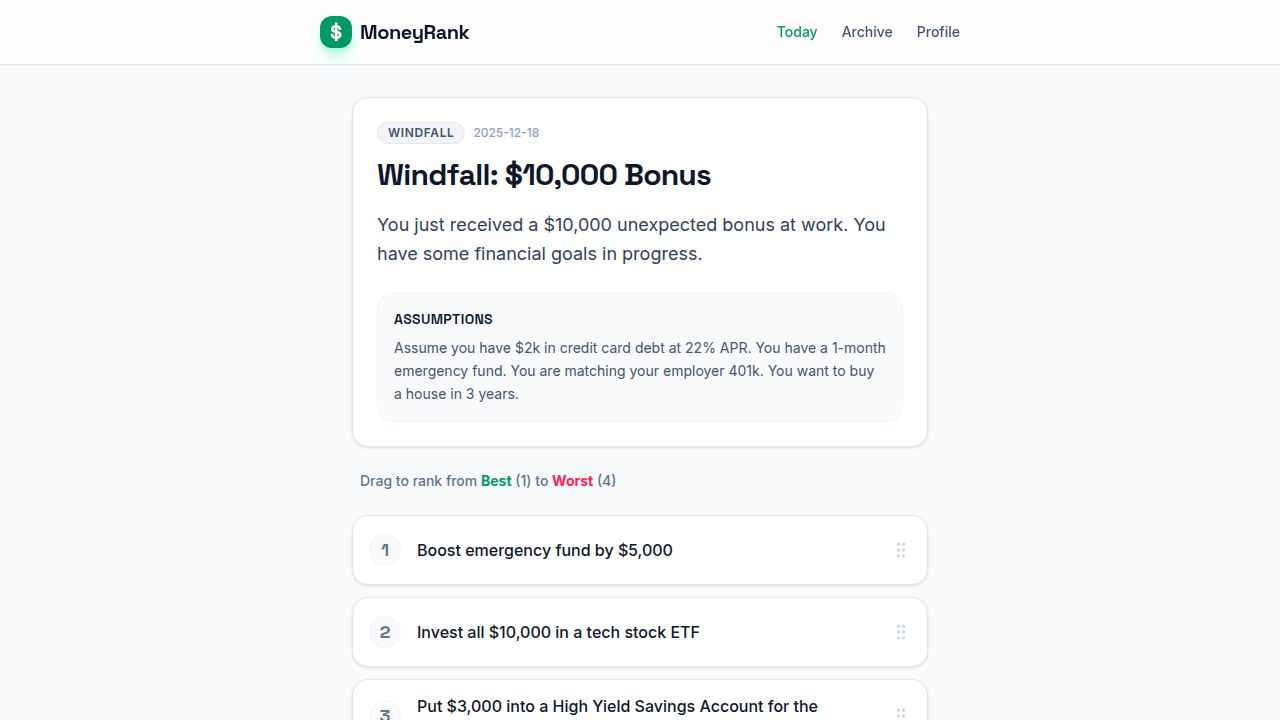
MoneyRank is an interactive financial education platform designed as a daily game that presents users with realistic money management scenarios requiring them to rank multiple options from best to worst. The product specifically targets individuals seeking to improve their financial literacy through practical, engaging exercises that simulate real-life financial decisions. Each daily challenge focuses on concrete topics like retirement planning, investment strategies, budgeting, or debt management, providing immediate educational feedback after users submit their rankings. The primary purpose is to transform abstract financial concepts into tangible decision-making practice, helping users develop better money habits through consistent, bite-sized learning experiences. By framing financial education as a game, MoneyRank lowers the psychological barriers many people face when confronting complex financial topics, making learning both accessible and enjoyable.
Many adults struggle with financial literacy despite recognizing its importance for long-term security and wellbeing. Traditional financial education often involves dense textbooks, lengthy courses, or impersonal articles that fail to engage learners or connect theory to practical decision-making. This gap leaves people uncertain about everyday financial choices, from retirement contributions to investment strategies, potentially leading to costly mistakes or missed opportunities. MoneyRank addresses this pain point by creating a low-stakes environment where users can explore financial scenarios without real-world consequences, building confidence and knowledge gradually. The platform recognizes that financial anxiety often stems from unfamiliarity, and it systematically breaks down complex topics into manageable decisions users can practice daily.
The core ranking mechanism requires users to evaluate four distinct financial options for a given scenario and arrange them from most to least advisable. Each option represents a plausible real-world choice, such as contributing to a 401k catch-up provision, investing in taxable accounts, or maintaining standard contribution limits. This forces users to compare trade-offs, consider priorities, and apply financial principles to specific situations. After submission, the system provides instant feedback explaining the rationale behind optimal rankings, turning each decision into a mini-lesson. This feature matters because it reinforces learning through active participation rather than passive consumption, helping users internalize financial concepts by applying them immediately.
admin
The daily challenge format ensures consistent engagement and progressive learning, with new scenarios covering diverse financial topics regularly. Each scenario includes detailed context and assumptions, like a user's age, income, or specific financial circumstances, making the decisions realistic and personally relevant. The interface guides users through ranking with clear visual cues and the ability to undo or reset choices, reducing frustration during the learning process. This structured approach matters because it builds a habit of daily financial reflection, gradually expanding the user's knowledge base across different areas of personal finance without overwhelming them with information.
Scenario diversity covers essential financial domains including retirement planning, investment vehicles, debt management, tax strategies, insurance choices, and budgeting decisions. For example, one scenario might explore 401k catch-up contributions for older workers, while another examines emergency fund allocation or credit card payoff strategies. Each scenario is carefully constructed to reflect common financial dilemmas faced by real people, ensuring practical relevance. The platform also adapts to different knowledge levels by varying scenario complexity, allowing both beginners and more financially experienced users to find appropriate challenges that match their learning needs.
The technical approach centers on presenting self-contained financial decision scenarios through a clean, intuitive web interface accessible via standard browsers. Users interact by dragging or selecting options to create their ranked order, with the system processing submissions to deliver immediate educational feedback. The backend likely stores scenario libraries, user progress data, and feedback templates, though specific architecture details aren't provided. The design emphasizes simplicity and focus, minimizing distractions to keep attention on the financial learning objectives rather than complex game mechanics or unnecessary features.
Users benefit by developing practical financial decision-making skills through repeated, low-pressure practice with realistic scenarios. Measurable outcomes include increased confidence in managing personal finances, better understanding of financial products and strategies, and improved ability to evaluate trade-offs in money-related decisions. The game format makes learning enjoyable, increasing motivation and consistency compared to traditional educational methods. Over time, users build a mental framework for approaching financial choices systematically, reducing anxiety and potentially avoiding costly real-world mistakes through informed decision-making.
Concrete use cases include someone preparing for retirement who practices evaluating contribution strategies, catch-up options, and investment allocations through relevant scenarios. Another example is a young professional learning to prioritize financial goals by ranking options for saving, investing, and debt repayment in different life circumstances. Parents might use scenarios about education funding, insurance needs, or family budgeting to improve household financial planning. Each workflow involves reading the scenario context, considering the provided options, ranking them based on financial principles, and receiving explanatory feedback that reinforces correct reasoning or corrects misunderstandings.
Target users are adults at any financial knowledge level seeking to improve their money management skills through engaging, practical education. The platform suits both financial beginners needing foundational concepts and more experienced individuals looking to refine decision-making in specific areas like retirement or investments. While integrations and detailed tech stack aren't specified, the web-based accessibility suggests compatibility with common devices and browsers. Pricing plans aren't detailed in the provided content, though the described offering appears focused on core educational functionality delivered through daily challenges.
MoneyRank ultimately provides a unique approach to financial literacy by transforming learning into an interactive daily game that builds practical decision-making skills through realistic scenarios. By combining structured financial education with engaging gameplay mechanics, it helps users develop confidence and competence in managing money matters across diverse life situations. The platform's value lies in making financial learning accessible, enjoyable, and directly applicable to everyday financial choices people actually face.
Adults at any financial knowledge level seeking to improve money management skills through engaging, practical education. This includes financial beginners needing foundational concepts, young professionals building financial habits, mid-career individuals planning for retirement, and experienced investors refining decision-making. The platform suits anyone preferring interactive learning over traditional financial education methods, particularly those who find financial topics intimidating or boring when presented conventionally. Users benefit from consistent daily practice with realistic scenarios that build confidence in making actual financial decisions.
Updated 2026-02-28