NOVA is an AI terminal coding assistant designed for developers who want to streamline their entire development workflow without leaving the command line. It belongs to a new category of terminal-native AI tools that combine coding, debugging, deployment, and Git operations into one continuous environment. The core value is eliminating the fragmented loop of switching between IDE, browser, AI chatbot, and terminal. By staying inside the terminal, developers maintain context and momentum, shipping code faster with fewer interruptions.
The primary pain point NOVA solves is the fragmented nature of modern development. Developers constantly switch between an IDE, browser for documentation, an AI chatbot for assistance, the terminal for execution, and Git for version control. Each switch breaks mental momentum, requires re-explaining context, and inflates development time. This problem matters because it directly reduces productivity—studies show that context switching can cost up to 40% of a developer's productive time. NOVA addresses this by consolidating all those tasks into a single terminal session, preserving context across prompts and sessions, so developers can focus on solving problems instead of managing tools.
The 'Code Faster' feature lets developers generate boilerplate, refactor code, create components, and write functions directly from the terminal. Instead of manually typing repetitive structures, a simple natural-language description produces ready-to-use code files. The 'Debug Smarter' feature analyzes stack traces, identifies failure points, and suggests fixes without leaving the terminal. This integration is useful because it collapses the time between writing code and testing it—traditionally, developers write, run, see an error, alt-tab to search, copy a fix, re-run. NOVA automates the error analysis and fix cycle, saving minutes per debugging session and keeping the developer in flow.
Persistent Context is a standout capability: NOVA remembers the project structure, workflows, and coding history across sessions. This means when a developer returns to a project after a break, the AI retains knowledge of dependencies, conventions, and recent changes, enabling more relevant assistance. 'AI Pair Programming' goes beyond simple Q&A—developers can ask questions about architecture, understand codebase interdependencies, and solve real-time problems with an AI partner that lives in the terminal. Unlike chatbots that lose context after each query, NOVA's persistent memory ensures that follow-up questions build on prior discussions, making collaboration feel natural and efficient.
admin
Multi-File Understanding gives NOVA deep contextual awareness across the entire project. It can comprehend relationships between files, enabling tasks like modifying function signatures across multiple modules or refactoring a data model that affects several components. This is crucial for large codebases where changes ripple across the project. Additionally, NOVA is 'Local & Secure'—execution stays under the developer's control, with no external servers processing the code. Terminal-native execution means no data leaves the developer's machine unless explicitly pushed to a remote repository. This security model appeals to teams working with proprietary or sensitive code who cannot use cloud-only AI tools.
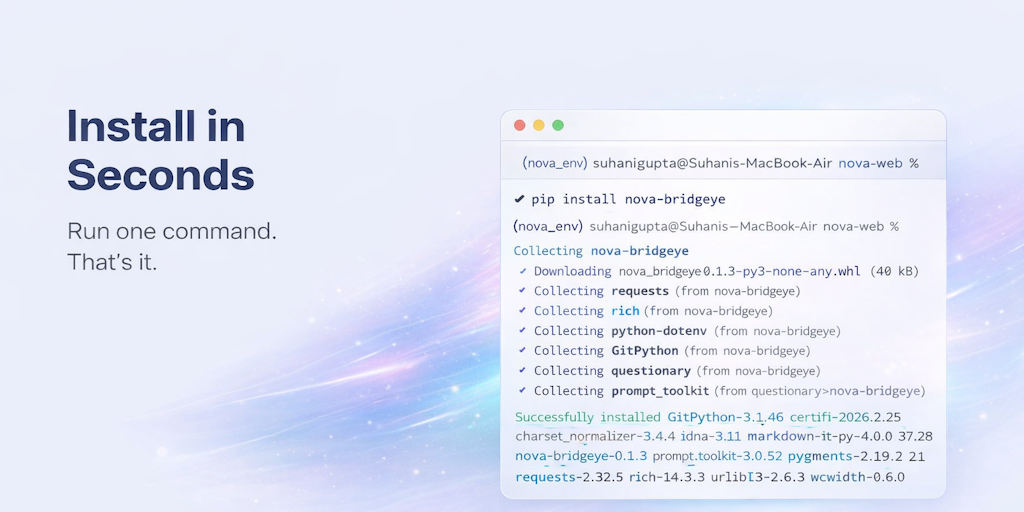
NOVA's overall methodology centers on a unified terminal workflow from first prompt to production deploy. After installing with 'pip install nova-bridgeye', developers invoke NOVA inside their terminal. They describe tasks using natural language—for example, 'create a REST API endpoint for user authentication'—and NOVA writes the corresponding files. When the code runs, NOVA watches for errors and automatically fixes them, then commits changes via Git integration. The workflow is iterative but seamless: describe, generate, execute, debug, deploy, all without leaving the terminal. Context accumulates as the project evolves, so later tasks require less hand-holding. This approach mimics pair programming with an always-available expert who knows the codebase intimately.
Early users report significant time savings and quality improvements. For instance, one developer caught a bug before the build broke, saving 20 minutes of debugging. Another appreciated that the diffs generated were clean and reviewable, allowing them to ship without rewriting. A backend engineer used NOVA to clear ignored 'todo' comments, effectively cleaning up technical debt. A frontend developer successfully handled a complex login flow with solid, hallucination-free code. These scenarios highlight outcomes: reduced debugging time, easier code review, automated technical debt reduction, and reliable generation for complex logic. Users also praise the minimal setup—installation takes seconds, and the tool stays in the terminal, eliminating the need to switch tabs for help.
NOVA targets developers of all specialization levels—backend, frontend, DevOps, and full-stack engineers—who work in terminal-centric environments. It supports Python projects initially (with pip installation) and is built for those using Git for version control. The product is currently in public beta (v0.1.5) and free to try. While no pricing is explicitly stated, the open beta suggests a future freemium or subscription model. The takeaway is clear: NOVA transforms the terminal into a full-featured AI development environment, drastically reducing context switching and accelerating the build-test-deploy loop. For any developer tired of fragmented workflows, it offers a unified, secure, and context-aware assistant that lives where they already work.
Full-stack developers, backend engineers, frontend developers, DevOps engineers, and software engineering teams who want to eliminate context switching and accelerate their coding, debugging, and deployment workflows directly from the terminal. Ideal for developers working on complex projects with multiple files, those who value efficient Git operations, and teams looking to reduce technical debt and improve build times. The tool is designed for individual developers and small to medium-sized teams who prefer terminal-native tools over heavy IDEs or AI chatbots. It suits both experienced coders who want a fast assistant and newer developers who need guidance on architecture and debugging. Current early adopters include professionals from frontend, backend, and infrastructure roles who need a unified, secure, and context-aware assistant that lives where they work.
Updated 2026-03-05