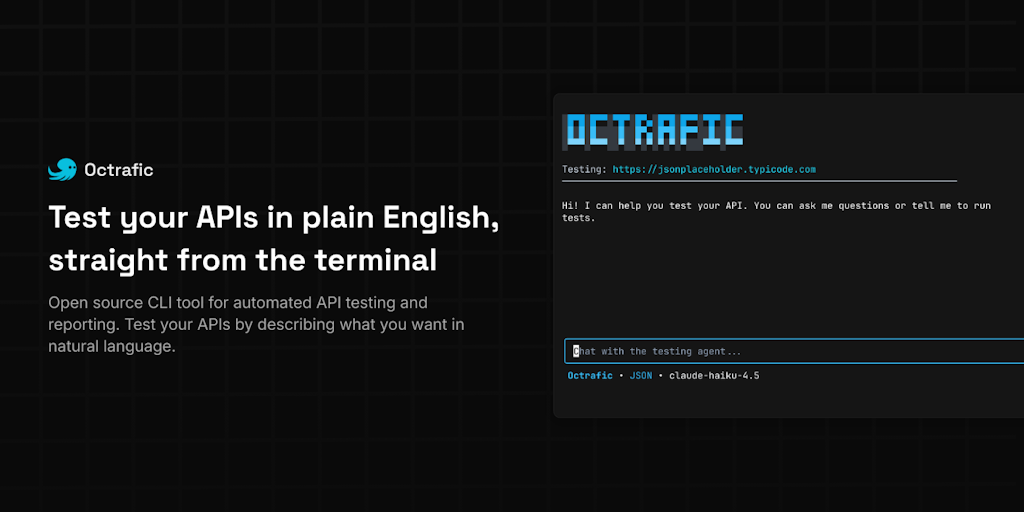
Octrafic is an open-source CLI tool that enables plain English API testing directly from the terminal. Designed for backend developers, DevOps engineers, and QA teams, it transforms how APIs are tested by removing the need to write code. Users describe what they want to test in natural language, and the AI agent interprets the request, plans test scenarios, executes real HTTP calls, validates responses, and generates professional PDF reports. This core value proposition—speed, simplicity, and accessibility—makes API testing accessible to technical and non-technical team members alike.
Traditional API testing often relies on complex test frameworks like Jest or Pytest, which require writing and maintaining substantial test code, or heavyweight GUI tools like Postman that introduce performance overhead. These approaches create friction: developers spend more time wrestling with test scripts than actually validating endpoints. Octrafic solves this pain point by accepting plain English instructions that eliminate boilerplate and learning curves. Instead of debugging test code, users focus on what matters—ensuring their API behaves correctly. This shift accelerates development cycles, reduces maintenance burden, and empowers team members who lack coding expertise to contribute to API quality.
The first major feature group is Natural Language API Testing and the integrated AI Agent. Users simply type commands like “test /users endpoint” or “check if /users returns paginated results.” The AI agent breaks the request into concrete test scenarios, determines which HTTP methods to use, executes real requests against the live API, and validates status codes and response bodies. This feature is immensely useful during rapid development cycles—developers can quickly verify new endpoints without switching contexts or writing test code. It also allows non-technical QA engineers to run comprehensive tests by describing expected behavior in plain English, significantly lowering the barrier to thorough API validation.
The second major feature group includes One-Command PDF Reports and Headless Mode. After executing tests, users can export results to a styled PDF with a single command, perfect for sharing with stakeholders or archiving test outcomes. The PDF includes detailed test results, durations, and pass/fail statuses. Headless Mode enables running tests in CI/CD pipelines without any interactive TUI—it accepts a URL and test specification, executes tests, and returns exit codes for integration with tools like GitHub Actions, GitLab CI, or Jenkins. This allows teams to automate regression testing on every commit, catching issues before they reach production, and generating auditable reports automatically.
admin
The third feature group includes OpenAPI Spec Generation, Schema Validation, and Multiple LLM Provider Support. The `octrafic scan` command automatically generates an OpenAPI 3.1 specification by analyzing source code—detecting frameworks, discovering routes, and extracting endpoints in parallel. Schema Validation then verifies that API responses conform to the generated or imported OpenAPI spec, catching mismatches like missing required fields or incorrect data types. Additionally, Octrafic supports multiple LLM providers: OpenAI, Anthropic (Claude), OpenRouter, and local models via Ollama and llama.cpp. Users can switch providers without changing test definitions, offering flexibility in cost, latency, and privacy.
Octrafic’s overall workflow is elegantly simple: from command to report in seconds. The user provides a natural language description or a predefined test specification. The AI agent plans the test strategy by identifying endpoints, generating request payloads, and defining validation criteria. It then executes real HTTP calls against the actual API (not mocks), captures responses, and validates against expected outcomes. Results are displayed in the terminal with clear pass/fail indicators and durations. Finally, users can export a comprehensive PDF report or integrate the headless mode into automated pipelines—all with the same single binary, no runtime dependencies required.
Concrete use cases illustrate Octrafic’s transformative impact. Backend developers can test newly built endpoints during development without leaving the terminal or writing boilerplate—they simply type “test POST /users with valid data” and get immediate feedback. DevOps teams integrate Octrafic into CI/CD pipelines to automatically run a suite of tests on every push, catching regressions early. QA engineers, even those without coding skills, validate REST APIs using plain English commands like “verify that GET /orders returns paginated results.” Teams migrating away from Postman find Octrafic a lightweight, scriptable alternative that fits naturally into terminal-first workflows. Regression testing becomes trivial: run the same natural language tests after every deployment to ensure nothing breaks. The outcome is faster feedback loops, fewer production bugs, and better collaboration across technical and non-technical roles.
Octrafic targets backend developers, DevOps engineers, QA engineers, and non-technical team members involved in API quality assurance. It works with any HTTP API, requires no runtime dependencies beyond a single binary, and runs on macOS, Linux, and Windows. The tool is open-source and free to use—users only need to bring their own LLM API key (supporting OpenAI, Claude, OpenRouter, or local models). This pricing model removes financial barriers while giving teams full control over their testing infrastructure. Octrafic’s approach—converting natural language into automated API tests and reports—fundamentally redefines API testing as a conversation rather than a coding chore, making thorough validation accessible to everyone in the development lifecycle.
Backend developers who need to rapidly test APIs during development without writing boilerplate code. DevOps engineers integrating automated API testing into CI/CD pipelines using GitHub Actions, GitLab CI, or Jenkins. QA engineers, including those without coding experience, who want to validate REST APIs using natural language commands. Non-technical team members who need to perform API checks and generate reports for stakeholders. Terminal-first developers seeking a lightweight, scriptable alternative to GUI tools like Postman. Organizations building and maintaining HTTP-based APIs across any industry that require fast, reliable, and accessible testing workflows.
Updated 2026-03-02