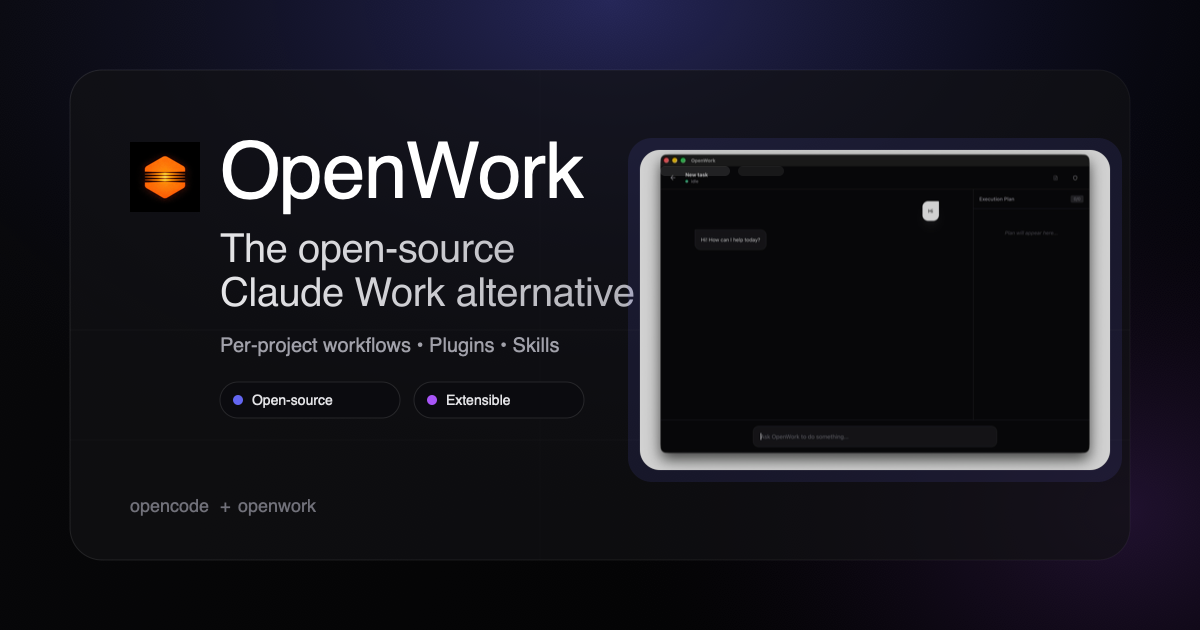
OpenWork is a comprehensive desktop application specifically engineered for agentic work, enabling users to automate complex tasks through a flexible and extensible platform. It is designed for teams and individuals who need to streamline workflows, automate repetitive actions, and leverage large language models (LLMs) without being locked into a single provider. The app's primary purpose is to transform plain-language requests into executable browser actions and data operations, facilitating seamless automation across various tools and services. By providing an open-source foundation, OpenWork ensures that users can customize and extend its capabilities to fit their unique requirements, making it a versatile solution for modern work environments.
In today's fast-paced digital landscape, professionals and teams often grapple with time-consuming manual tasks such as social media engagement, data extraction, and report generation. These repetitive activities not only drain productivity but also introduce the risk of human error, leading to inefficiencies and missed opportunities. The challenge is compounded by the need to integrate multiple tools and platforms, each with its own interface and limitations. OpenWork addresses this pain point by offering a unified desktop app that automates these processes, allowing users to focus on higher-value strategic work instead of getting bogged down in routine operations.
One of the major feature groups of OpenWork is its browser automation capability, which allows users to turn plain-language requests into precise browser actions. For example, a user can instruct OpenWork to open a Twitter thread, like all replies, and extract user details into a CSV file, with the app executing steps like navigating to the URL, scrolling to load content, clicking 'like' on replies, and saving data locally. This feature works by interpreting natural language commands and translating them into a sequence of automated interactions within web browsers, eliminating the need for manual scripting or coding. The significance lies in its ability to handle complex multi-step tasks reliably, saving users substantial time and ensuring consistency across repetitive digital interactions.
Another key feature group is the built-in package manager and extensibility framework, which enables users to install skills, plugins, and configurations via a seamless system. Skills and plugins run on top of the OpenCode ecosystem, allowing for easy integration of new functionalities and customizations. This extensibility means that users can enhance OpenWork's capabilities by adding pre-built modules or developing their own, tailoring the app to specific workflows or industry needs. The package manager simplifies the process of discovering, installing, and updating these components, ensuring that the platform remains adaptable and up-to-date with evolving requirements.
admin
OpenWork also supports data analysis and outreach creation, expanding its utility beyond simple automation to more sophisticated operational tasks. Users can leverage the app to summarize data, draft communications, and perform analytical functions, all within the same interface. This capability is powered by integration with over 50 LLMs, giving users the flexibility to choose models that best suit their needs while bringing their own API keys for cost control and privacy. The ability to share entire setups—including skills, MCPs, plugins, and configs—through a single link further enhances collaboration, allowing teams to standardize processes and onboard new members quickly.
Technically, OpenWork operates as a desktop application that combines local execution with cloud-connected services, ensuring both performance and accessibility. It uses an agentic architecture where tasks are broken down into discrete steps, executed sequentially or in parallel, with real-time feedback and error handling. The app interfaces with web browsers, APIs, and local file systems to carry out instructions, maintaining a secure environment by processing sensitive data on the user's machine. This approach balances power with usability, making advanced automation accessible to non-technical users while offering depth for developers.
Benefits for users include measurable outcomes such as reduced time spent on manual tasks, increased accuracy in data handling, and enhanced team collaboration. By automating processes like social media engagement or report generation, users can achieve higher productivity and focus on strategic initiatives. The seamless sharing of setups eliminates onboarding friction and ensures consistency across team members, leading to faster project execution and reduced training overhead. Additionally, the open-source nature allows for cost savings and customization, avoiding vendor lock-in and fostering innovation within user organizations.
Concrete use cases illustrate OpenWork's versatility: a sales team can automate daily tasks like drafting follow-up emails or summarizing revenue outliers, while marketing professionals might use it to manage social media interactions and export user data for analysis. In customer support, workflows can be created to monitor and respond to queries across platforms, and in research, data extraction from web sources can be automated for analysis. Each use case involves describing a task in plain language, with OpenWork executing the necessary browser actions, data processing, and file operations to complete it efficiently.
Target users include teams and enterprises across sectors like sales, marketing, customer support, and research, who need to automate repetitive digital tasks. Integrations span web browsers, LLM APIs, and local file systems, with a tech stack built on open-source frameworks for extensibility. Pricing plans include a free tier for individual users and enterprise options with advanced features and support, though specific details are not provided in the content. The app is designed for both technical and non-technical users, with an emphasis on ease of use through its package manager and sharing capabilities.
In summary, OpenWork stands out as a powerful, open-source alternative for agentic work, combining browser automation, extensibility, and team collaboration into a single desktop application. Its ability to leverage multiple LLMs, execute complex tasks from simple commands, and share setups seamlessly makes it a valuable tool for modern workflows. By addressing common pain points around manual task inefficiency, it empowers users to achieve greater productivity and consistency, ultimately driving better outcomes in their daily operations.
OpenWork targets teams and enterprises in sectors like sales, marketing, customer support, and research who need to automate repetitive digital tasks. It is designed for both technical and non-technical users, including professionals seeking to streamline workflows, reduce manual effort, and leverage LLMs for agentic work. The app appeals to organizations looking for an open-source, extensible solution that avoids vendor lock-in and fosters collaboration through seamless sharing of automation setups.
Updated 2026-02-28