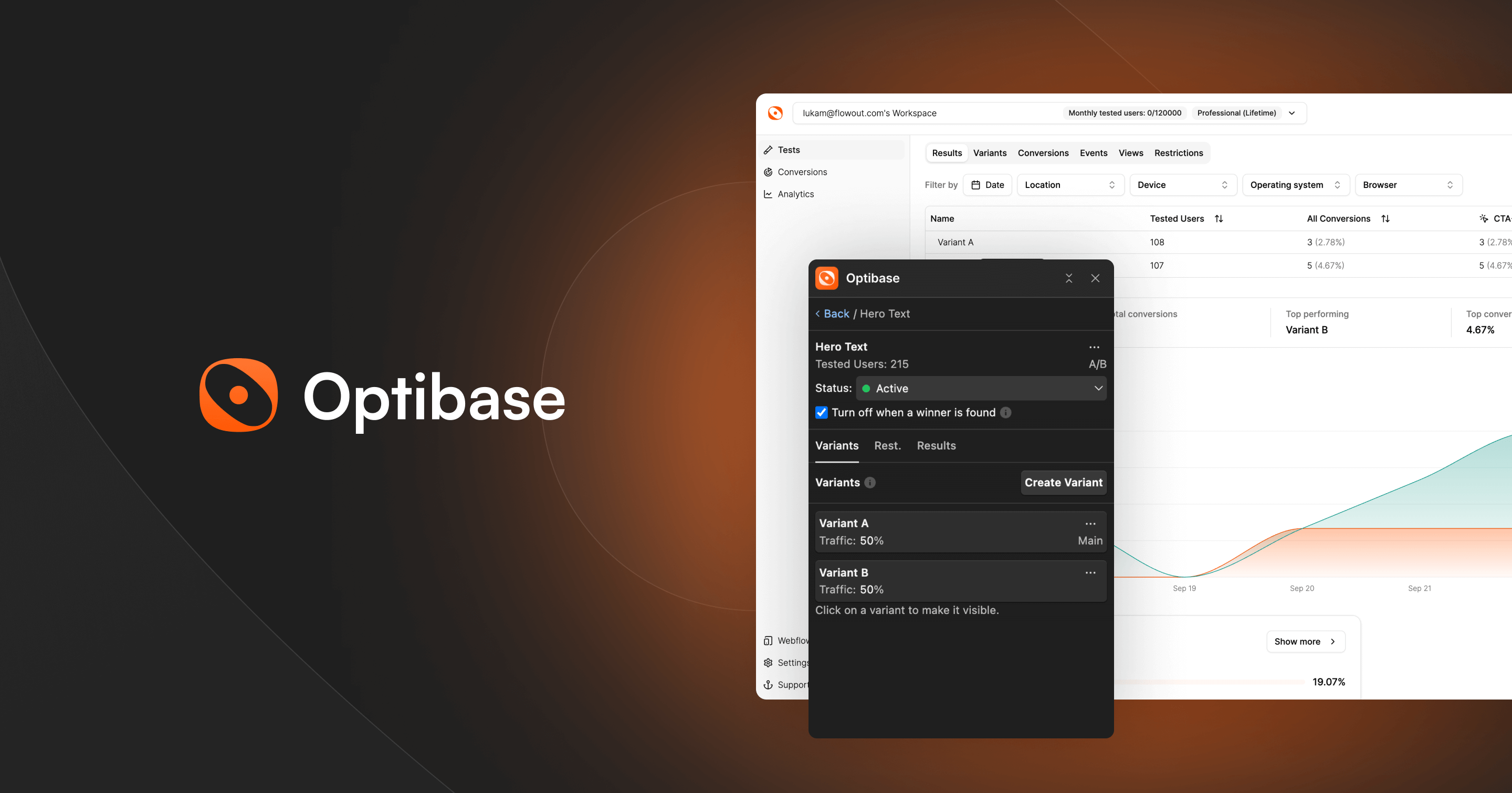
Optibase is a comprehensive website experimentation platform designed to empower teams to run A/B tests, analyze user behavior, and improve conversions through data-driven decisions. It is specifically built for marketing teams, agencies, and businesses that use modern page builders like Webflow, WordPress, Elementor, and others, providing a native integration that eliminates the need for complex coding or developer involvement. The platform's main purpose is to democratize conversion rate optimization by making sophisticated testing and personalization tools accessible and affordable, allowing teams to validate ideas, understand user intent, and personalize experiences at scale without the overhead of enterprise solutions.
Before tools like Optibase, many teams building on platforms like Webflow faced a significant gap in their ability to run proper A/B tests, especially after the deprecation of solutions like Google Optimize. This left marketers and growth teams unable to validate changes, often relying on guesswork or assumptions about what would improve conversions, which led to missed opportunities and stagnant conversion rates. The pain point was particularly acute for non-technical users who needed to coordinate with developers for every experiment, creating bottlenecks and slowing down the optimization cycle. Agencies and freelancers also struggled to offer robust CRO services to clients without a tool that integrated seamlessly with the page builders they used daily.
The first major feature group is its versatile testing suite, which supports multiple experimentation methods to validate ideas at any level of complexity. Teams can run standard A/B tests to compare two variations of a page element for fast validation of focused changes, such as different headlines or button colors. For more comprehensive comparisons, Optibase offers split URL testing, allowing users to test entirely different pages or complete user flows across separate URLs, which is ideal for evaluating major redesigns or new landing pages. Additionally, the platform includes multivariate testing capabilities, enabling teams to test multiple elements simultaneously to discover winning combinations and understand how different components interact, all without slowing down the website or disrupting the user experience.
The second major feature group focuses on measurement and analytics, turning experiments into clear, actionable results. Optibase provides robust conversion tracking that monitors clicks, form submissions, page views, and custom events, giving teams a unified view of experiment impact. The built-in analytics dashboard displays variant performance and test results at a glance, with consistent metrics across all tests to ensure data reliability. Furthermore, the platform includes comprehensive reporting tools that allow users to review results on a daily, weekly, or monthly basis, facilitating regular performance reviews and data-driven decision-making without requiring external BI tools.
admin
The third feature group encompasses behavioral insights and personalization capabilities, helping teams understand why users behave the way they do and act on those insights. Optibase offers heatmaps that visually reveal where users click, scroll, and focus on a page, providing immediate feedback on engagement patterns. It also includes user recordings that capture actual sessions, allowing teams to watch how visitors navigate the site to spot points of friction, confusion, or drop-off. These insights can then fuel personalization rules, enabling marketers to tailor content, messages, and layouts based on user attributes like device, location, traffic source, or behavior, creating more relevant experiences that drive conversions.
Overall, Optibase works through a technical approach centered on seamless integration with popular page builders via native apps and a simple script for other platforms. The setup is designed to be no-code friendly, allowing marketers to install, configure, and launch tests directly within their chosen environment like Webflow or WordPress without developer assistance. Once installed, the platform manages traffic allocation between variants, collects interaction data, and processes results in real-time, all while ensuring a smooth user experience with no flickering between variants. This streamlined workflow reduces the time from idea to live test from days or weeks to mere minutes.
The benefits and measurable outcomes for users are substantial, as evidenced by customer stories like Memberstack boosting revenue by $500K and Style Arcade increasing demo conversions. Teams gain the ability to launch experiments independently, removing dependencies on engineering and accelerating the optimization cycle. Clear, actionable analytics help identify winning variations that directly improve conversion rates and revenue-driving actions. The platform's affordability and transparent pricing also make advanced CRO accessible to startups, agencies, and mid-market businesses that previously found enterprise tools cost-prohibitive, delivering a strong return on investment.
Concrete use cases include marketing managers running headline tests on landing pages to improve click-through rates, agencies optimizing client acquisition funnels by testing different call-to-action placements, and product teams validating new feature announcements with split URL tests. For example, a growth team can use heatmaps to identify where users drop off in a signup flow, then create an A/B test with a simplified form, and finally personalize the experience for returning visitors with a tailored message. Another workflow involves using multivariate testing to find the optimal combination of hero image, value proposition, and button style on a homepage, then applying those learnings through audience segmentation rules.
The target users include marketing teams, growth managers, CRO specialists, digital agencies, Webflow developers, and founders who build their sites on modern page builders. Optibase integrates natively with Webflow, WordPress, Elementor, Bricks, Divi, Oxygen, Gutenberg, and Breakdance, catering specifically to these ecosystems. The tech stack is designed for ease of use with no-code setup, and pricing is structured to be affordable without enterprise complexity. The platform is GDPR compliant, ensuring data privacy and security for teams operating in regulated markets, and it emphasizes a marketer-first design that prioritizes intuitive interfaces and quick time-to-value.
In summary, Optibase fills a critical market gap by providing a purpose-built, affordable experimentation platform for teams using modern page builders, enabling them to run tests, gain insights, and personalize experiences without coding. It transforms conversion rate optimization from a technical chore into a streamlined, accessible practice, empowering businesses to make smarter decisions backed by real user data. By reducing dependency on developers and offering clear ROI through improved conversions, Optibase helps teams move faster, learn continuously, and drive measurable growth directly from their existing website workflows.
Optibase is designed for marketing teams, growth managers, CRO specialists, digital agencies, Webflow developers, and founders who build and optimize websites using modern page builders like Webflow, WordPress, Elementor, Bricks, Divi, and others. It caters to non-technical users who need to run experiments without developer involvement, as well as technical users who value seamless integrations and reliable data. The platform is ideal for businesses seeking an affordable, marketer-friendly alternative to enterprise testing tools, with a focus on teams that prioritize speed, clarity, and actionable insights to drive conversions and revenue.
Updated 2026-02-28