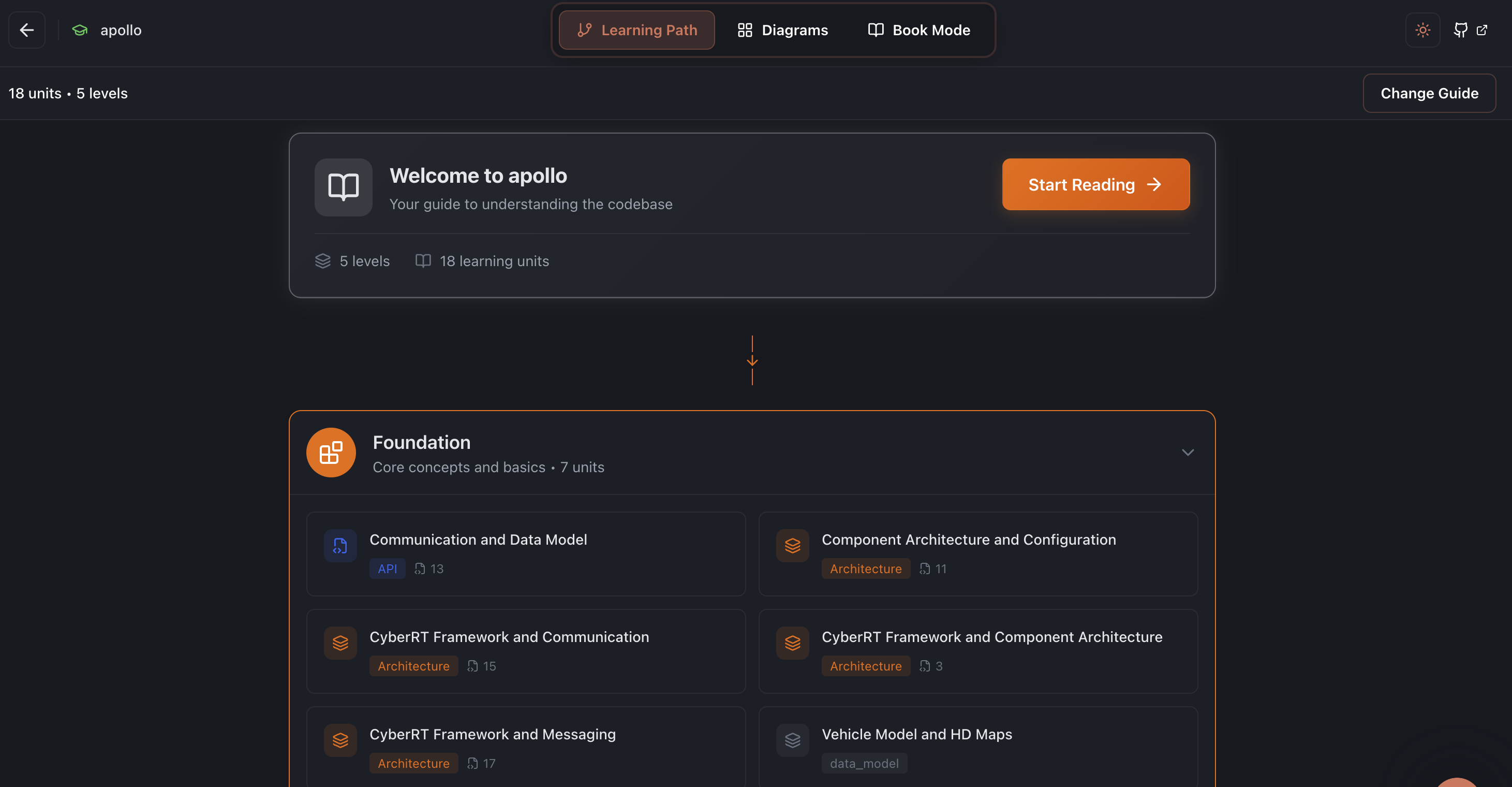
OS Ninja is a specialized platform designed to decode complex open source codebases and transform them into structured, interactive learning journeys powered by artificial intelligence. It serves developers, engineers, and learners who need to deeply understand intricate software projects, from foundational libraries to cutting-edge AI models, by providing a guided educational experience that adapts to individual preferences. The core purpose is to move beyond static documentation and wikis, offering dynamic paths that evolve alongside the code itself, making open source knowledge more accessible and actionable. This system addresses the critical need for efficient mastery of vast and often poorly documented repositories, which are the backbone of modern software development but can be overwhelmingly complex to navigate and comprehend thoroughly.
Traditional methods of learning open source, such as reading wikis, browsing scattered documentation, or diving directly into source code, present significant challenges and inefficiencies for developers. These approaches often lack structure, context, and guidance, leaving learners to piece together understanding from disparate, sometimes outdated, resources without a clear educational progression. The pain point is particularly acute for complex projects involving AI, distributed systems, or low-level infrastructure, where the learning curve is steep and the cost of misunderstanding is high. Developers waste valuable time searching for relevant information, struggling to grasp architectural concepts, and missing key insights that are buried deep within the codebase, hindering both personal growth and effective contribution to projects.
The platform's first major feature is its deep research engine, which performs a comprehensive, high-fidelity analysis of an entire open source repository to generate structured learning paths. This process involves scanning and interpreting the codebase in detail, identifying key components, architectural patterns, and functional modules, which can take up to twenty-four hours to complete for thorough accuracy. The engine extracts meaningful relationships between different parts of the project, creating a logical educational sequence that guides users from fundamental concepts to advanced implementations. This automated research ensures that learning materials are grounded directly in the actual source code, providing an authentic and up-to-date understanding that static documentation cannot match, thereby forming a reliable foundation for all subsequent learning activities.
admin
A second core capability is the support for multiple, distinct learning styles, allowing users to choose how they engage with the material based on personal preference and cognitive needs. The Socratic questioning mode presents the content through an interactive dialogue of probing questions and answers designed to stimulate critical thinking and uncover underlying principles. The Feynman technique format emphasizes explanation in simple terms, challenging learners to break down complex topics into fundamental concepts they can teach others, reinforcing comprehension. Alternatively, the traditional book format offers a linear, narrative-driven approach with chapters and sections for those who prefer conventional structured reading, ensuring flexibility to accommodate diverse educational backgrounds and objectives within the same platform.
Additional functionalities include a discovery system where users can search for any open source project or request additions to the library, expanding the available knowledge base collaboratively. The platform organizes repositories into curated collections across categories like AI, data systems, robotics, game engines, crypto and web3, distributed systems, file systems, machine learning, infrastructure, compilers, CLI tools, developer tools, mobile, and frameworks and applications. It also provides integration for AI agents via the Model Context Protocol (MCP), enabling coding assistants to query the platform for learning paths, repository summaries, and structured documentation directly. This extends its utility beyond human learners to automated tools, supporting the broader ecosystem of AI-native development and intelligent software engineering workflows.
The overall technical approach combines AI-driven code analysis with pedagogical frameworks to create adaptive learning experiences. The system likely utilizes natural language processing and code understanding models to parse repositories, identify key concepts, and generate coherent educational narratives. It structures output into manageable learning units or chapters, tagged and categorized for easy navigation and progression. By connecting directly to source code, it ensures content remains current with project evolution, unlike manual documentation that may lag. The integration with MCP demonstrates a commitment to interoperability within modern developer toolchains, allowing the platform's insights to be accessed programmatically by other applications and agents in a standardized way.
Benefits for users include measurable outcomes such as reduced time to proficiency when learning new open source technologies, deeper conceptual understanding compared to surface-level tutorials, and increased confidence in contributing to or utilizing complex projects. Developers can systematically master topics like Rust async runtime internals, generative AI models, or distributed consensus algorithms through guided paths rather than fragmented resources. This leads to more effective onboarding for new team members, better-informed architectural decisions, and enhanced ability to innovate by building upon existing open source foundations without being hindered by knowledge gaps or misunderstandings that could lead to costly errors in implementation.
Concrete use cases involve specific workflows, such as a backend engineer needing to understand the Tokio asynchronous runtime in Rust to optimize server performance, who uses OS Ninja to get a structured learning path with fourteen chapters in Feynman mode. A data scientist exploring machine learning frameworks like TensorFlow or PyTorch can request a repository analysis and receive a Socratic questioning path to grasp underlying algorithms and design patterns. A developer building a decentralized application might study smart contract platforms via curated crypto and web3 collections, while a robotics engineer could delve into perception libraries through interactive book-format modules. Teams can integrate the MCP server to let their coding agents fetch learning materials during development, automating knowledge retrieval.
Target users are primarily software developers, engineers, data scientists, researchers, and students engaged with open source technologies, especially those working in AI-native development, infrastructure, and complex systems. The platform integrates with AI agents via MCP and fits into tech stacks that emphasize modern, intelligent tooling. While explicit pricing plans are not detailed in the content, the service is supported by XHawk and offers a newsletter with monthly updates on new repositories, AI-native development trends, and curated insights. It caters to both individual learners seeking self-paced education and organizations aiming to upskill their technical teams efficiently, bridging the gap between open source availability and practical, applicable expertise.
In summary, OS Ninja redefines open source education by replacing passive, outdated wikis with dynamic, AI-generated learning paths tailored to multiple styles. It solves the critical problem of navigating complex codebases by providing deep, structured analysis and flexible engagement methods, from Socratic dialogue to traditional chapters. By enabling both human learners and AI agents to access curated knowledge, it accelerates mastery and fosters a more intelligent approach to software engineering, ultimately making the wealth of open source innovation more accessible and actionable for the global developer community.
OS Ninja targets software developers, engineers, data scientists, researchers, and students who need to deeply understand complex open source technologies. It is particularly relevant for those engaged in AI-native development, infrastructure, distributed systems, machine learning, and other advanced domains where codebases are intricate and documentation is often lacking. The platform serves both individual learners seeking self-paced education and organizations aiming to upskill technical teams efficiently. It also integrates with AI agents via MCP, appealing to developers working with intelligent coding assistants and modern toolchains that emphasize interoperability and automated knowledge retrieval.
Updated 2026-02-28