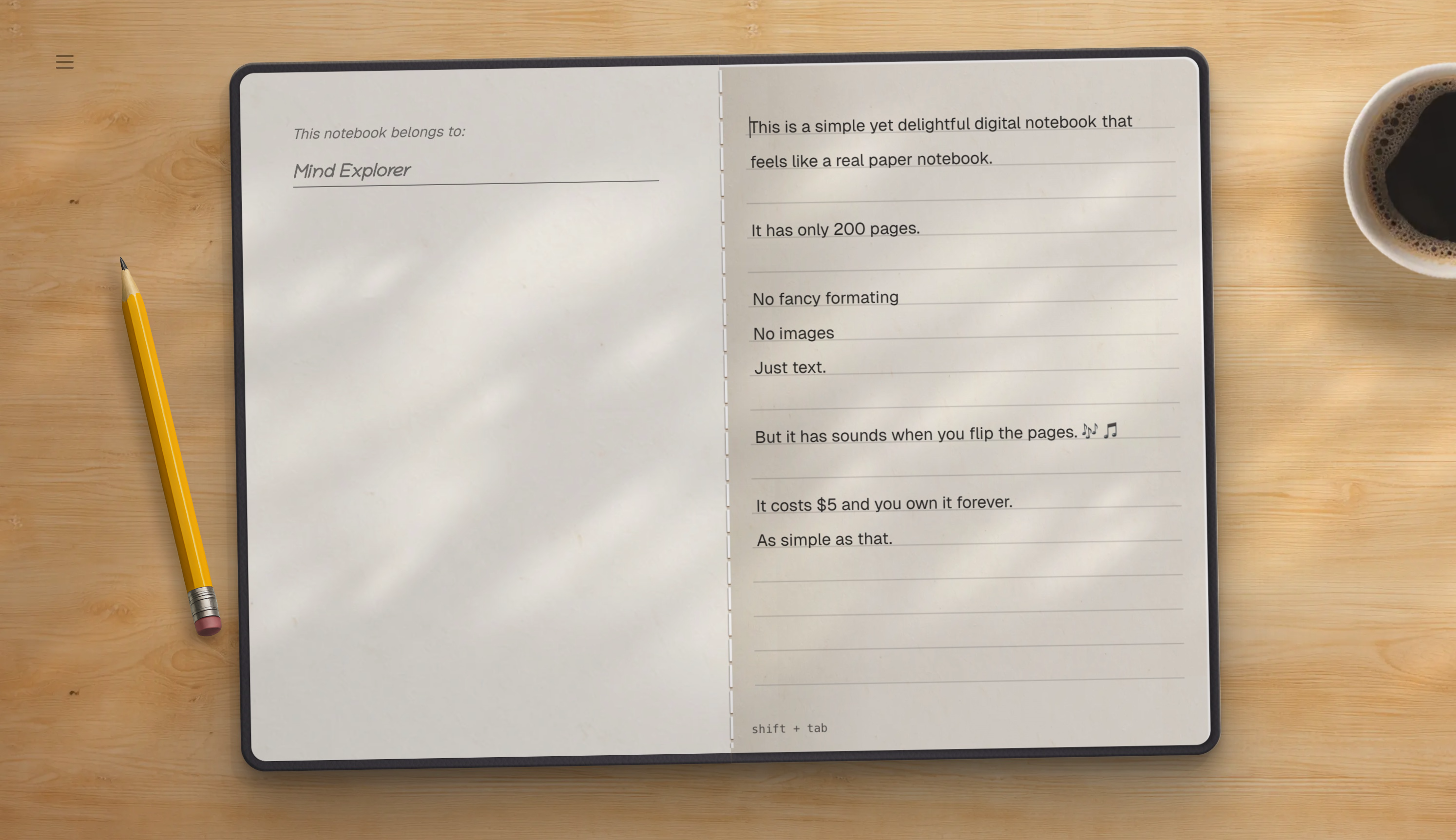
Paper is a realistic digital notebook that provides a simple, focused environment designed exclusively for writing, offering a quiet place to think. It feels like paper and opens like paper, creating a digital experience that mimics the tactile and visual qualities of a physical notebook. The product is a simple yet delightful digital notebook intended for users who seek a minimalist tool for capturing thoughts without distractions. Its main purpose is to encourage thoughtful journaling and writing by stripping away unnecessary features, presenting a clean slate of 200 pages where only text belongs. This design philosophy ensures the user's attention remains solely on the act of writing, fostering a deeper connection with their thoughts and ideas in a serene digital space.
In a world saturated with complex note-taking applications filled with formatting options, images, and organizational tools, many individuals find themselves distracted from the core activity of writing. The problem context is that these feature-rich environments can overwhelm users, pulling focus away from the simple act of putting thoughts into words. Paper addresses this pain point by eliminating all such distractions, offering nothing more than a realistic digital notebook interface. It recognizes that sometimes the most profound thinking occurs in the simplest settings, where the tool itself recedes into the background. This approach solves the issue of digital clutter, providing a sanctuary for writing that honors the tradition of pen and paper in a modern format.
The first major feature group is the realistic digital notebook simulation, which meticulously replicates the experience of using a physical notebook. It feels like paper and opens like paper, providing visual and interactive cues that ground the user in a familiar, tangible experience. This realism is enhanced by subtle auditory feedback, specifically sounds that play when you flip the pages, adding an extra layer of immersion. The inclusion of these sounds, denoted by musical note emojis, makes the digital flipping action feel satisfying and authentic. This feature group matters because it bridges the gap between digital convenience and the sensory pleasure of analog tools, making the writing process more enjoyable and engaging. By focusing on realism, Paper creates a psychological environment conducive to focused, thoughtful writing without the coldness often associated with digital text editors.
The second major feature group is the enforced simplicity and limitation, which is central to the product's philosophy. The notebook has only 200 pages, imposing a finite boundary that encourages meaningful content creation rather than endless, disorganized note-taking. There is no fancy formatting, no images, and just text, which forces the user to concentrate on words and ideas alone. This constraint eliminates the temptation to spend time on visual design or media insertion, streamlining the workflow purely for writing. This feature group works by removing all extraneous options, presenting a stark, clean page where the only action possible is typing. It matters because it reduces cognitive load, decision fatigue, and digital noise, allowing writers to enter a state of flow more easily and produce more authentic, focused content.
admin
A third key capability is the product's ownership and pricing model, which offers a straightforward, one-time purchase. It costs $2 and you own it forever, providing permanent access without subscriptions, recurring fees, or ongoing payments. This model emphasizes simplicity and transparency, aligning with the overall minimalist ethos of the application. The affordability and permanence lower the barrier to entry, making it accessible to a wide range of users who might be hesitant about software subscriptions. This approach works by providing a complete, finished product upfront, with no hidden costs or future updates that could complicate the experience. It matters because it builds trust and reduces financial anxiety, allowing users to invest in a tool for long-term writing without worrying about future expenses or losing access to their notes.
The product works overall through a technical approach that prioritizes a lightweight, focused application delivering a simulated paper notebook experience. It likely operates as a desktop application, as indicated by the 'Install Desktop App' link, providing offline access and system integration. The technical implementation centers on rendering a realistic notebook interface with page-flipping animations and sounds, while strictly limiting functionality to text input. The underlying system manages the 200-page structure, saving content locally or possibly to a simple cloud sync, though this is not explicitly stated. The approach is minimalist, avoiding complex databases or rich text editors in favor of a straightforward document model. This ensures fast performance, reliability, and a distraction-free environment that feels immediate and responsive, much like opening a physical book.
The benefits and measurable outcomes for users include achieving a higher quality of focused writing and journaling due to the elimination of digital distractions. Users can expect to spend more time actually writing and less time fiddling with formatting or organizing, leading to increased productivity and thought clarity. The realistic paper-like experience provides psychological comfort and nostalgia, making the digital writing process more pleasant and sustainable over long sessions. The finite 200-page structure encourages completion and review of thoughts, as opposed to infinite scrolling documents that can become disorganized. Measurably, users may find they write more consistently, develop deeper reflections, and maintain a more valuable personal archive of thoughts, all within a tool that is both affordable and permanently owned.
Concrete use cases include daily journaling where a user opens Paper each evening to reflect on the day's events in a serene, dedicated space without notifications or other app interruptions. Another workflow example is drafting long-form writing like essays or stories, where the author benefits from the page-based structure to organize chapters or sections naturally. Thought capture is a key use case; when an idea strikes, a user can quickly open the notebook, click to flip to a new page, and jot down text without any setup or formatting decisions. Writers seeking a digital commonplace book can use Paper to collect quotes, insights, and observations over time, with the 200-page limit providing a tangible volume to fill. Each use case leverages the simplicity and realism to support a specific, focused writing practice.
Target users are individuals who value focused writing, journaling, and thinking, such as writers, students, journalers, and professionals seeking a digital analog to a paper notebook. The product appeals to minimalists and those overwhelmed by feature-rich note-taking apps. Integrations are not explicitly mentioned, suggesting a standalone experience, though a desktop app is available for installation. The tech stack is not detailed, but the product is presented as a simple, likely native or web-based application. Pricing plans consist of a single one-time purchase of $2 for permanent ownership, with a demo available to try before buying. This straightforward model targets users who prefer simple, transparent software purchases without subscriptions.
In summary, Paper's primary value is providing a distraction-free digital writing environment that authentically mimics the feel and limitations of a physical notebook. It champions the idea that less is more, using constraints like 200 pages and text-only input to foster deeper thinking and more meaningful writing. The realistic touches, such as page-flip sounds, enhance the experience, making digital journaling feel personal and tangible. By offering this at a low, one-time cost, it becomes an accessible tool for anyone looking to carve out a quiet digital space for their thoughts. The takeaway is that Paper successfully translates the simplicity and focus of a paper notebook into a digital form, proving that dedicated tools for writing need not be complex to be profoundly effective.
Paper targets individuals who value focused writing and thinking, including writers, journalers, students, and professionals seeking a minimalist digital tool. It appeals to users overwhelmed by complex note-taking apps and those who prefer the tactile experience of paper but want digital convenience. Minimalists, analog enthusiasts transitioning to digital, and anyone needing a quiet, distraction-free space for capturing thoughts are the core audience. The simple pricing also attracts users wary of software subscriptions, offering a straightforward, affordable, and permanent writing solution.
Updated 2026-02-28