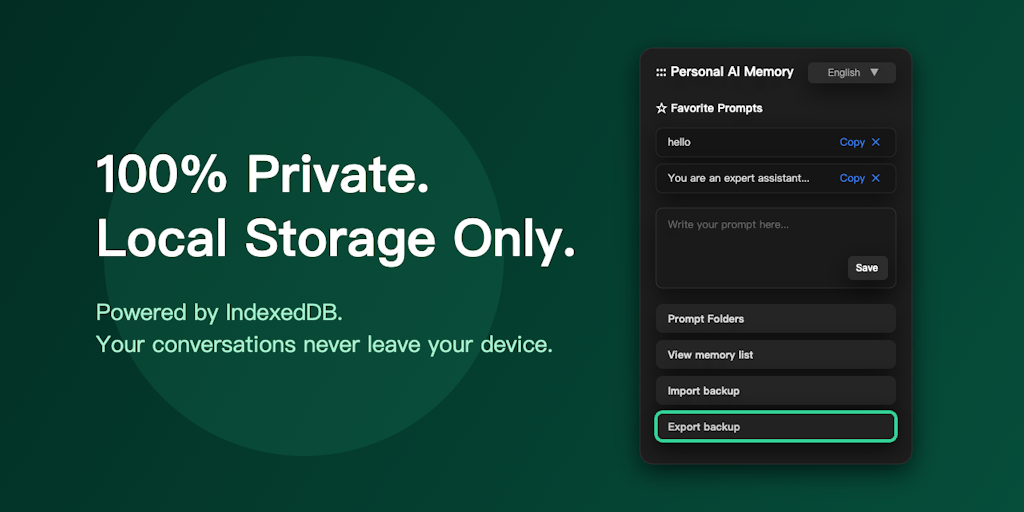
AI Memory is a privacy-first browser extension that captures, organizes, and lets you seamlessly recall your ChatGPT, Gemini, Claude, and Perplexity conversations locally without data leaks.
Personal AI Memory is a privacy-first browser extension that acts as a local AI conversation manager for users of ChatGPT, Gemini, Claude, and Perplexity. It belongs to the category of AI productivity tools, designed to capture and organize every chat interaction automatically. The core value is providing a secure, local-first repository that allows seamless recall of conversation history without any data leaving the user's device. By using open-source code and leveraging modern browser technologies, it ensures transparency and trust for technical users who demand control over their data. This extension is particularly valuable for prompt engineers and frequent AI users who need to manage multiple threads across different platforms.
The concrete problem Personal AI Memory solves is the fragmentation and loss of AI chat history across multiple platforms. Users often switch between ChatGPT, Gemini, Claude, and Perplexity, but each platform stores conversations in isolated silos with limited search capabilities. Cloud-based storage raises privacy concerns, especially for sensitive prompts or confidential work. Additionally, without a unified archive, users lose track of successful prompt engineering strategies, making it hard to replicate or improve interactions. This extension addresses these pain points by automatically capturing every conversation and storing it locally, eliminating reliance on third-party servers. The importance lies in saving time, preventing data loss, and empowering users to refine their AI workflows with complete historical context.
First major feature group: Automatic capture and multi-platform support. Personal AI Memory seamlessly integrates with ChatGPT, Gemini, Claude, and Perplexity via its browser extension. When a user interacts with any of these AI assistants, the extension detects the conversation and stores it in a local database without manual effort. This feature works because it uses browser-level APIs and Manifest V3 to intercept page content securely. The benefit is that users no longer need to copy-paste or manually save important prompts and responses. All history is automatically cataloged, searchable, and accessible from a single interface. This eliminates the risk of losing valuable insights and streamlines the process of revisiting past exchanges.
Second major feature group: Local-first architecture and privacy guarantee. The extension employs a local-first storage approach using WebAssembly and Manifest V3 to keep all conversation data on the user's own device. Unlike cloud-based alternatives, no information is sent to external servers or third parties. WebAssembly provides high-performance data processing, enabling fast search and retrieval even with large conversation volumes. This architecture ensures that sensitive data—such as proprietary prompts or personal queries—remains strictly under the user's control. The open-source nature of the code further allows independent verification of privacy claims, appealing to security-conscious users. Essentially, the product turns the browser into a private vault for AI interactions.
Publisher
A
admin
Launch Date2026-03-04
Platformweb
Pricingfree
Traffic Insights
Month2026-01
Estimated Visits0
MoM Visits GrowthN/A(+0)
Avg Time on Site0s
MoM Time GrowthN/A
Bounce Rate0.0%
Updated 2026-03-05