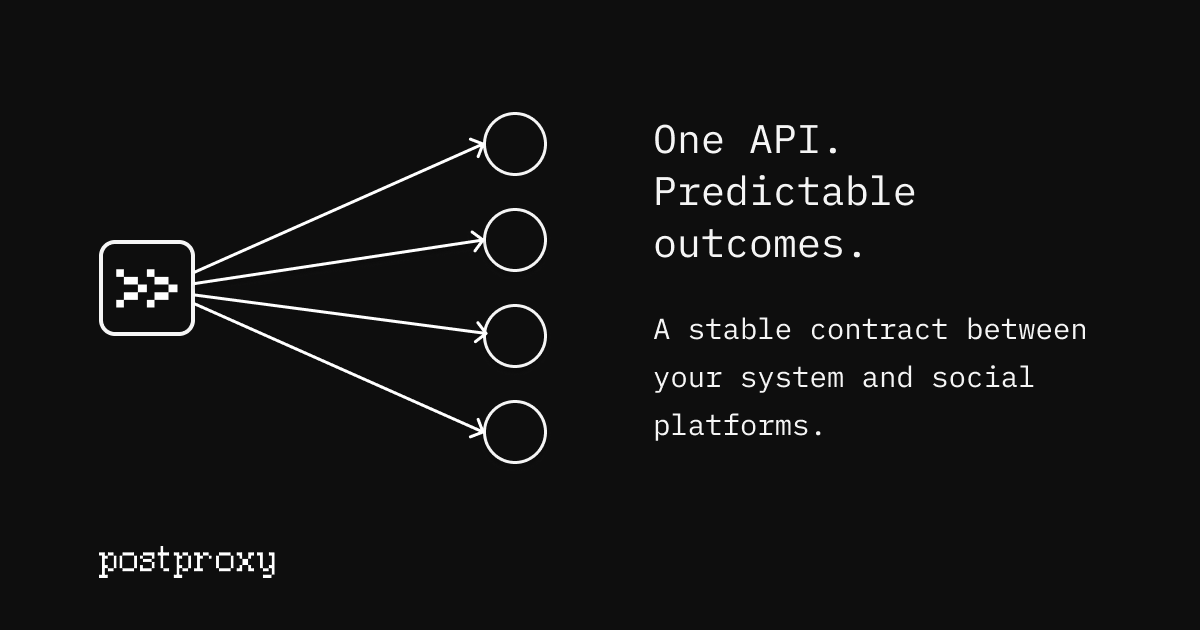
Postproxy is a unified API for publishing to social media platforms. It replaces individual platform integrations and handles platform-specific failures at publish time with one stable publishing layer.
Postproxy is a unified social media API that serves as a single integration point for publishing posts, comments, and direct messages across multiple social platforms. Designed for developers, marketers, and SaaS companies, it replaces the need to manage individual APIs for each network. Its core value lies in abstracting away the complexity of platform-specific requirements, authentication flows, and error handling. By providing one stable API layer, Postproxy enables teams to build social features rapidly without becoming experts in each platform's idiosyncrasies. The product handles format conversion automatically, ensuring content appears correctly on Instagram, Twitter, LinkedIn, and others.
Developers building multi-platform social features face a significant burden: each social network has its own API with unique authentication, rate limits, content formatting rules, and unpredictable late failures. Coordinating publishing across platforms often requires weeks of integration work and ongoing maintenance as APIs change. Teams must handle token refreshes, manage separate error handling for each service, and deal with posts that fail after the initial publish call. This complexity slows down development and creates brittle systems. Postproxy eliminates these pain points by presenting a consistent interface that handles platform-specific nuances, ensuring that a single request reliably reaches multiple networks with clear outcomes for each.
The core publishing feature allows users to send a single JSON payload containing post content, media attachments, and a list of target profiles. Postproxy automatically transforms the content to match each platform's specific formatting rules, from character limits to image aspect ratios. It then dispatches the post to each platform's API, managing authentication tokens and handling rate limits. The system returns a per-platform outcome indicating success, failure, or pending status, with detailed logs for every attempt. This deterministic approach means developers no longer need to write separate logic for Instagram, Twitter, LinkedIn, or others. Instead, they rely on one endpoint to orchestrate all publishing, significantly reducing code complexity and maintenance overhead.
Beyond publishing, Postproxy provides a unified API for managing social engagement. Developers can programmatically reply to comments, respond to direct messages, and handle reviews across all connected platforms through a single set of endpoints. This eliminates the need to poll each platform's API separately for incoming interactions. The engagement API is designed for both real-time and batch workflows, supported by webhooks that notify your system when new comments or DMs arrive. For customer support teams and community managers, this centralization means conversations from Instagram, Facebook, LinkedIn, and others can be handled from one codebase or dashboard, ensuring no messages fall through the cracks.
Publisher
A
admin
Launch Date2026-02-04
Platformweb
Pricingfreemium
Domain Authority
Ahrefs DR30/100
Traffic Insights
Month2026-01
Estimated Visits0
MoM Visits GrowthN/A(+0)
Avg Time on Site0s