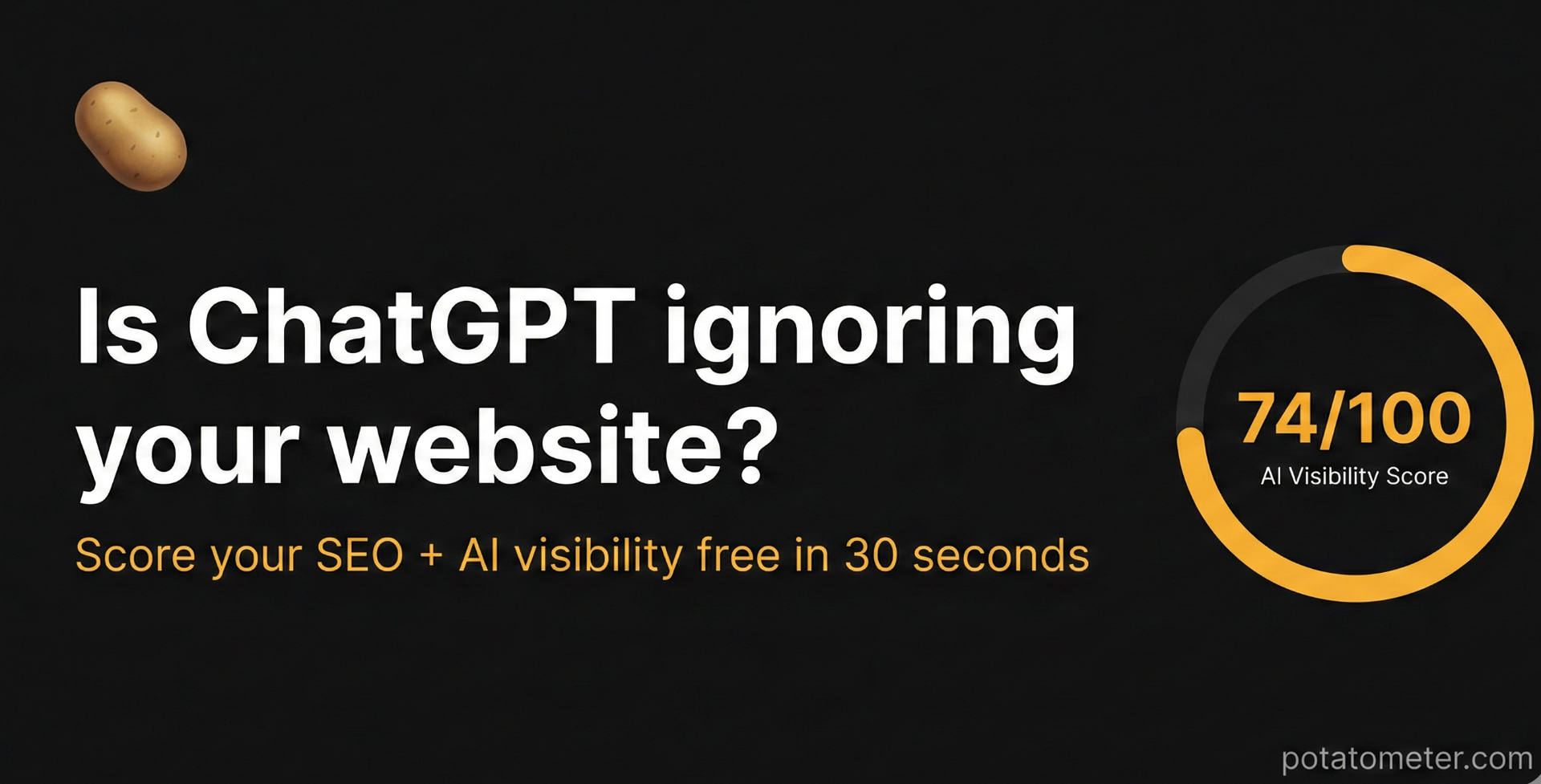
Potatometer is a comprehensive web analysis tool designed for website owners, developers, and marketers who need to evaluate and enhance their site's search engine optimization (SEO) and AI visibility, known as GEO. It performs over 100 deterministic, rule-based checks across technical SEO, on-page content, and AI readiness, delivering prioritized, actionable recommendations with step-by-step instructions, code examples, and time estimates to facilitate immediate improvements. The primary purpose is to transform a website from a 'raw potato' state into a 'perfectly loaded' one by systematically addressing gaps that hinder performance in both traditional search engines and emerging AI platforms like ChatGPT, Perplexity, and Google AI.
In today's digital landscape, websites face the dual challenge of optimizing for conventional search engines while also ensuring they are visible and citable by AI assistants and large language models. Many site owners struggle with complex, often vague SEO advice and lack clear, actionable insights into how AI systems perceive and utilize their content. This leads to missed opportunities for organic traffic and authority, as AI-driven platforms increasingly influence how information is discovered and consumed, creating a critical pain point for maintaining competitive online presence.
The tool's first major feature group is its real, verified checks for technical SEO and on-page elements, which include deterministic assessments of HTTPS, meta tags, canonical tags, Open Graph, favicon, language attributes, robots.txt, sitemap, and schema markup. Each check is designed to be transparent and free from 'AI fluff,' providing a clear pass/fail or measurement against established best practices. This matters because it gives users a trustworthy foundation, eliminating guesswork and ensuring that fundamental technical health is addressed before more advanced optimizations, which is essential for both search engine crawling and AI model accessibility.
A second core feature group is the GEO or AI visibility scoring, which evaluates whether AI platforms like ChatGPT, Perplexity, and Google AI can effectively crawl and cite the website's content. This involves checks for elements like 'llms.txt' and analysis of content structure and authority to predict citation likelihood. This capability is crucial as AI becomes a primary information source; understanding and improving GEO visibility ensures a site remains relevant and authoritative in AI-generated responses, directly impacting referral traffic and brand perception in an AI-first world.
admin
Additional capabilities include comprehensive content and user experience analysis, covering page speed, Core Web Vitals, mobile usability, heading hierarchy, image alt tags, internal linking, word count, multimedia usage, lists and tables, semantic HTML, and FAQ detection. These checks ensure the site is not only technically sound but also provides a high-quality experience for human visitors, which indirectly supports SEO and GEO by satisfying user intent and engagement metrics that search engines and AI models consider when ranking and citing content.
The product works overall by taking a user-inputted website URL and optionally a target keyword, then running a suite of automated checks against its database of over 100 rules. The technical approach is rule-based and deterministic, meaning scores are calculated from concrete, verifiable criteria rather than subjective or black-box AI assessments. It then compiles results into an overall score on the 'Potato Scale,' categorizing sites from Raw Potato (0-20) to Perfectly Loaded (81-100), and generates a detailed report with prioritized fixes, each accompanied by practical implementation guidance.
Benefits and measurable outcomes for users include a clear, visual score that instantly communicates website health, saving hours of manual auditing. Users receive specific, actionable fixes that translate into improved search rankings, increased organic traffic, and enhanced visibility within AI platforms. The step-by-step instructions and code examples reduce implementation time and technical barriers, enabling even non-developers to make meaningful improvements, ultimately leading to a more performant, authoritative, and competitive website.
Concrete use cases involve a developer launching a new site who uses Potatometer to identify missing meta tags and schema markup before going live, ensuring strong initial SEO. A content marketer might run the tool to analyze a key pillar page, using the content quality and topic authority insights to fill gaps and improve its chances of being cited by ChatGPT. An agency could employ it for competitive intelligence, comparing a client's site against top competitors to uncover technical and content advantages or weaknesses, then using the 90-day roadmap feature to plan a strategic overhaul.
Target users are website owners, developers, digital marketers, SEO specialists, and content creators who need to optimize sites for both search engines and AI. Integrations and tech stack are not explicitly detailed, but the tool appears web-based. Pricing plans include a free tier with core SEO and GEO checks available now, and a premium waitlist for advanced AI features like citation prediction, content quality analysis, competitive intelligence, topic authority mapping, personalized strategy, real-time AI testing, and automated optimization.
In summary, Potatometer provides a unique, actionable, and comprehensive solution for modern website optimization by combining rigorous SEO auditing with pioneering AI visibility analysis. Its rule-based, transparent approach demystifies optimization, offering clear pathways to improvement that cater to both technical and strategic needs, ensuring websites are prepared for the evolving landscape of search and AI-driven discovery.
Potatometer targets website owners, developers, digital marketers, SEO specialists, and content creators who need to optimize their websites for both traditional search engines and emerging AI platforms. It is ideal for those seeking actionable, step-by-step fixes to improve technical SEO, on-page content, and AI visibility (GEO), with tools ranging from free core audits to premium features for advanced competitive intelligence and automated optimization.
Updated 2026-02-28