Website Unavailable
This product's website is no longer reachable — it may have shut down. The listing is kept for reference.
0 upvotes
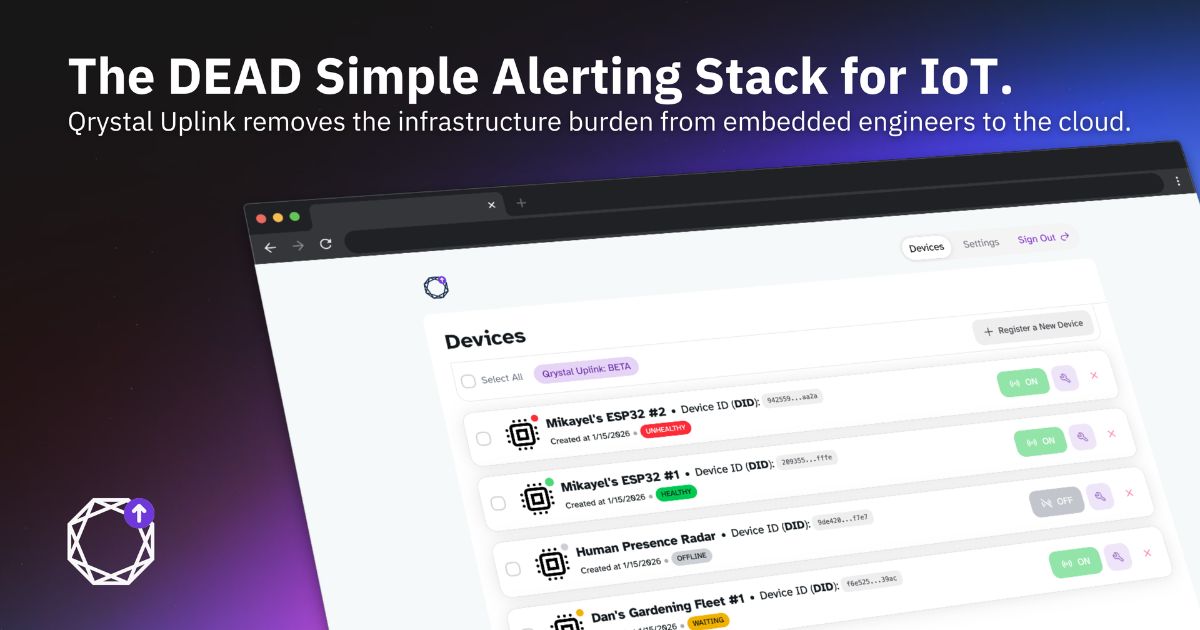
BacklinksQrystal Uplink is a cloud-based monitoring platform that provides instant alerts when IoT devices go offline or miss heartbeat signals. It eliminates the need for custom monitoring infrastructure with easy SDK integration.
Qrystal Uplink is a cloud-based IoT monitoring platform designed for developers and operators who need reliable, real-time visibility into device connectivity. By automatically detecting when IoT devices go offline or fail to send expected heartbeat signals, the platform ensures that critical infrastructure remains operational without requiring manual checks or complex custom monitoring setups.
The primary challenge in IoT deployments is that device disconnections often go unnoticed until they cause significant downtime or data loss. Custom monitoring solutions demand extensive engineering time to build alerting pipelines, maintain heartbeat protocols, and scale infrastructure. Qrystal Uplink addresses this by offering an out-of-the-box monitoring service that eliminates the need for proprietary monitoring systems, allowing teams to focus on their core product rather than infrastructure plumbing.
A key feature is the instant alerting system for offline devices and missed heartbeats. When a registered device fails to communicate within a predefined interval, the platform triggers immediate notifications through configurable channels. This means operators are proactively informed the moment a device drops off the network, enabling rapid response before minor glitches escalate into major outages or service interruptions.
Easy SDK integration stands as another critical capability. Instead of building custom agent software or complex API orchestration, teams can embed a lightweight SDK into their device firmware or application code to begin sending heartbeat signals. The platform then handles the heavy lifting of receiving, processing, and analyzing these signals, which drastically reduces time-to-market and avoids the hidden costs of maintaining distributed monitoring infrastructure.
The platform operates entirely in the cloud, providing a centralized dashboard that aggregates device health data from globally distributed endpoints. This architecture removes single points of failure and scales automatically with your device fleet. Users gain a unified view of connectivity status, historical uptime patterns, and alert logs without managing servers or databases themselves.
Qrystal Uplink’s workflow is straightforward: after integrating the SDK, devices periodically emit heartbeat signals to the cloud service. The platform continuously evaluates signal timeliness against configurable thresholds. If a device misses a consecutive number of expected heartbeats, it is marked as offline and an alert is dispatched. This methodology ensures that transient network hiccups are filtered out while genuine disconnections are quickly surfaced.
Publisher
A
admin
Launch Date2026-01-18
Platformweb
Pricingpaid
Domain Authority
Ahrefs DR5/100
Traffic Insights
Month2026-01
Estimated Visits0
MoM Visits GrowthN/A(+0)
Avg Time on Site0s