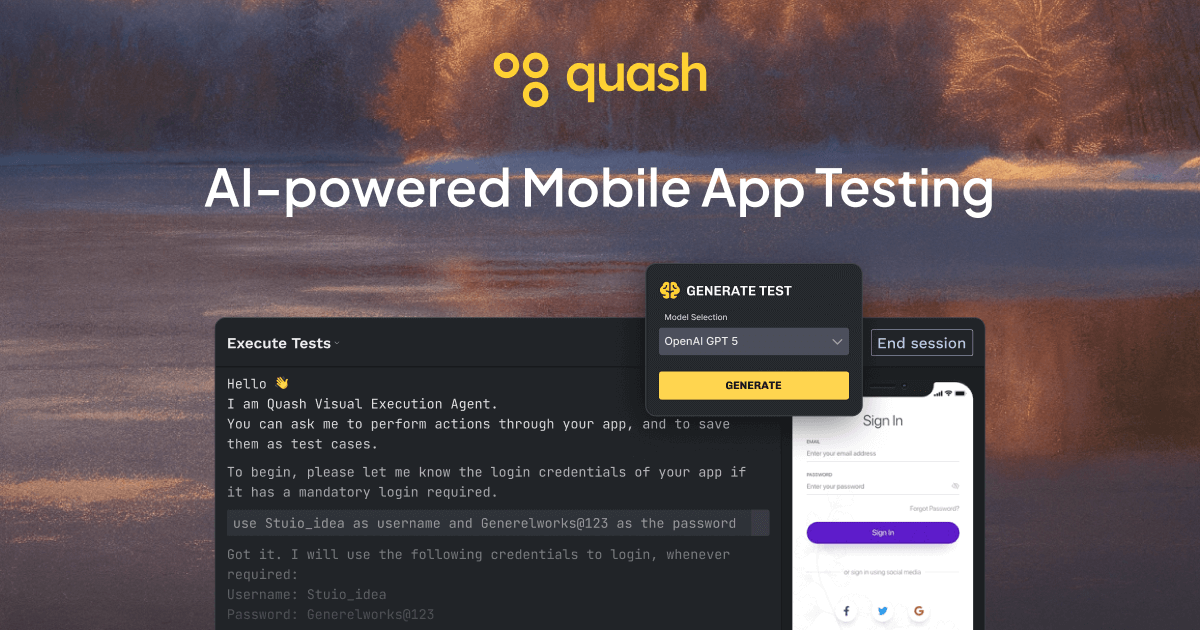
Quash is an AI-powered mobile QA agent that transforms the testing landscape by enabling teams to run functional and visual tests using natural language instead of scripts. Categorized as a scriptless mobile test automation platform, it is built specifically for quality assurance teams who need to keep pace with fast development cycles. The core value proposition is that testers can describe a flow in plain language, execute it on real devices, and achieve full coverage without maintaining brittle test scripts or locators. This approach dramatically accelerates test creation and increases coverage, as evidenced by a 25X faster test suite creation and 87% increase in test coverage reported by teams using Quash.
The primary pain point Quash addresses is the maintenance burden of script-based mobile testing. Traditional test automation frameworks like Appium require writing and maintaining complex scripts, which break whenever the UI changes, leading to frequent rewrites. Testers spend excessive time on test upkeep rather than exploring new scenarios. Additionally, many tools cannot handle dynamic screens, loading states, or backend validation, leaving critical bugs undetected. Quash solves these issues by adaptively executing tests that adjust to UI changes, reducing the need for constant test rewriting. This matters because it frees QA teams to focus on exploratory testing and edge case discovery, resulting in 4X more edge cases caught and 85% less manual testing effort.
The first major feature is Intent-driven Test Execution, which allows users to describe an app flow in plain language. Quash automatically handles taps, swipes, typing, navigation, and form interactions without requiring any scripted commands. Tests run against the actual app behavior on real devices, not in mocked environments, ensuring realistic validation. This approach eliminates the need to translate test intent into code, removing the barrier for non-technical testers. By converting natural language directly into executable actions, Quash drastically reduces test creation time—25X faster—and lowers the skill threshold required for effective test automation. The agent also intelligently handles popups and permission dialogs during execution, as noted by testers who observed it downloading apps from the Play Store and managing system dialogs automatically.
The second major capability is the platform's ability to adapt tests to UI changes and validate backend responses. Quash's intelligent execution engine handles dynamic screens, loading states, and data differences, meaning tests do not break when the app’s layout changes between releases. This adaptive execution drastically reduces test maintenance across sprints. Additionally, Quash enables backend validation within the same test run—testers can verify server responses, API calls, and system behavior directly while performing mobile interactions. This integrated approach catches issues that the UI alone may hide, such as erroneous data sent to the backend, providing a more comprehensive quality check. No longer do teams need separate UI and API testing phases; Quash combines them seamlessly.
admin
Quash provides execution reports with detailed steps, screenshots, and contextual information, enabling the entire team to understand failures without extra follow-ups. This rich reporting is complemented by complete analytics covering test coverage, results, and product quality trends. Role-based access controls allow administrators to manage permissions for team members, ensuring appropriate access to test projects. Debugging insights pinpoint the root cause of failures, reducing time spent on investigation. Additional features like seamless migration from other tools and a unified platform for generating, executing, and reporting tests eliminate tool-switching overhead. The goal is to provide a single source of truth for mobile quality, with precision over bloat—generating only the tests that matter for the application.
The workflow in Quash begins with testers describing a test scenario in natural language, such as "Open the app, log in, add item to cart, and checkout." The AI agent interprets this intent and executes the actions on a chosen real device—either local, emulator, or cloud—without any script setup. During execution, the agent adapts to UI variations, loading delays, and dynamic content. After the test run, Quash generates a comprehensive report showing each step, screenshots, and any failures with contextual details. This unified process covers test creation, execution, and reporting within a single platform, removing the need for separate tools. The approach is built around reducing friction: no script maintenance, no infrastructure setup, and no handoffs between teams. It follows a continuous testing methodology that aligns with agile and DevOps release cadences.
Concrete use cases span multiple industries. In e-commerce, Quash helps catch cart, promo, and payment bugs on real devices before major campaigns, preventing revenue loss. For healthcare apps, it validates patient intake, scheduling, and records flows with clinical confidence on real mobile devices. Travel companies stress-test search, pricing, and booking processes to ensure reservations hold during peak demand. Insurance firms run end-to-end tests on policy purchase and claims flows, keeping releases audit-ready. Testers have also used Quash for ad-hoc tasks like downloading apps from stores, sending emails intelligently, or selecting files—actions that traditional automation tools cannot handle. The outcome is higher test coverage, faster release cycles, and fewer production incidents.
Quash is purpose-built for QA engineers, testers, SDETs, and product managers who need to ensure mobile app quality without deep technical scripting skills. It supports macOS and Windows desktops and runs on users’ own devices, emulators, or cloud infrastructure with no vendor lock-in. The platform is compliant with SOC II, GDPR, DPDPA, and ISO standards, making it suitable for regulated industries like fintech and healthcare. For teams accelerating their development velocity, Quash provides the missing link between fast code shipping and thorough quality coverage. By eliminating script maintenance, enabling natural language test creation, and combining functional, visual, and backend validation in one platform, Quash empowers QA teams to keep pace with modern development—without compromise.
Quash is designed for QA engineers, manual testers, and SDETs who need to automate mobile app testing without deep scripting expertise. It is equally valuable for product managers and development teams shipping fast, who require comprehensive quality assurance without slowing down releases. The platform serves industries with stringent quality requirements, including fintech, healthcare, travel, e-commerce, and insurance. Quash's purpose-built approach means it is not a bent development tool but a dedicated testing solution. It is ideal for teams transitioning from manual testing to automation, as well as experienced automation engineers looking to reduce test maintenance overhead.
Updated 2026-02-28