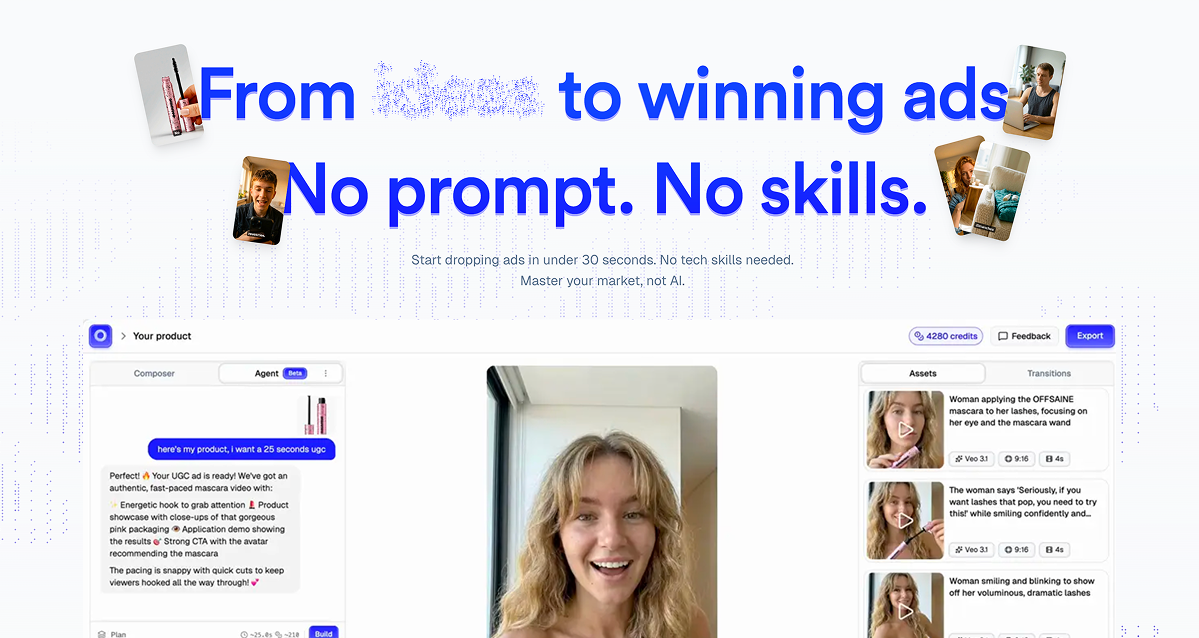
Reloop is an AI-powered platform designed to generate scroll-stopping user-generated content (UGC) video advertisements featuring realistic AI avatars through a conversational creative agent. It is built for marketers, e-commerce brands, and businesses seeking to scale their advertising efforts efficiently, eliminating the traditional barriers of video production. The primary purpose is to enable users to go from a simple product idea to a fully produced, high-converting video ad in a matter of minutes, without requiring any scripting, video editing skills, or complex AI prompting. This tool democratizes professional ad creation by automating the entire creative workflow, making it accessible to users regardless of their technical or creative background.
Creating effective video ads at scale presents significant challenges for modern businesses, whether they rely on traditional human creators or contemporary AI tools. The traditional path involves high costs, long timelines with endless revisions, managing creator contracts, and no guaranteed results for performance. Alternatively, using standard AI video tools demands considerable technical expertise, including skillful prompting, iterative troubleshooting, and a deep understanding of AI parameters to achieve usable outputs. Furthermore, the process of finding winning ad concepts through testing various angles and hooks is described as unpredictable, costly, and akin to gambling, creating immense friction in scaling advertising campaigns effectively.
The first major feature group is the Conversational Creative Agent, which acts as an intelligent assistant that understands user input and autonomously plans the ad. This agent engages in a dialogue with the user, asking for preferences like the desired vibe—such as 'Energetic & fun, or soft & elegant'—and the ad duration. Based on the product and these inputs, it generates a complete, timed shot-by-shot plan for the video, including hooks, product demos, application shots, and calls-to-action. This matters because it removes the need for users to write scripts or outline video sequences manually, translating a simple conversation into a structured creative blueprint instantly.
The second major feature group is the library of Realistic AI Avatars and voice capabilities. The platform offers a vast selection of diverse, photorealistic AI avatars with names like Zara, Sofía, Matilda, and Priya, who can deliver authentic-seeming performances. A newer capability allows users to create a custom digital twin by cloning their own appearance and voice, enabling content that looks and sounds personally authentic. This feature is crucial for building trust and relatability in ads, as it provides the human touch and social proof of UGC without the logistical hurdles and costs associated with hiring real actors or influencers.
admin
The third feature group encompasses the complete suite of automated production tools that bring the agent's plan to life. This includes AI-powered auto-captions that generate styled and synced subtitles in any language, automatic background music selection tailored to the ad's vibe, and the seamless rendering of all visual frames into a cohesive video. The system handles close-ups, scene transitions, timing, and audio integration automatically. These capabilities ensure the final output is polished and platform-ready, eliminating the need for separate editing software or skills in post-production.
Overall, the product works through a streamlined technical approach where the user first provides their product, then converses with the AI agent to define the ad's style and length. The agent analyzes this input to craft a detailed production plan, which is then executed by the system's AI models to generate video frames featuring the selected avatar, synthesize voiceover, add music and captions, and compile everything into a final video. The entire process is designed to be conversational and iterative, yet largely autonomous, requiring minimal manual intervention from the user after the initial brief.
The key benefits and measurable outcomes for users are dramatically reduced time and cost for ad production, the elimination of dependency on creative skills or external agencies, and the ability to rapidly test multiple ad variants. Users can generate a publish-ready ad in minutes instead of days or weeks, leverage a free forever plan with initial credits, and scale their creative output without proportional increases in budget or effort. This leads to faster iteration cycles for finding high-performing ads, ultimately improving return on ad spend and marketing agility in competitive digital landscapes.
Concrete use cases include an e-commerce brand creating a 25-second TikTok-style ad for a new mascara, where the user simply states the product and desired energetic vibe. The agent plans a hook with an excited avatar, product demo close-ups, application shots, and a call-to-action, then builds the complete ad with upbeat music. Another workflow involves a business owner cloning their own voice and appearance to create authentic testimonial-style ads for their service, bypassing the need for filming equipment or acting talent while maintaining a personal brand connection.
The target users are marketers, e-commerce store owners, DTC brands, SMBs, and content teams who need to produce high volumes of engaging video ads but lack the time, budget, or in-house expertise for traditional video production. The platform appears to be a standalone web application with a free forever plan offering 400 free credits, suggesting a freemium or credit-based pricing model. While specific integrations or detailed tech stack aren't explicitly listed, the product is presented as an all-in-one suite requiring no other tools, accessible directly through a web browser.
In summary, Reloop's primary value is delivering a frictionless, end-to-end automation of video ad creation, transforming a simple product input into a professional, avatar-driven advertisement through conversational AI. It fundamentally changes the economics and accessibility of performance video marketing by removing the need for scripts, editing, prompts, and creative expertise, enabling businesses to scale their ad production effortlessly and focus on strategy and optimization rather than creative execution hurdles.
The target audience includes marketers, e-commerce brand owners, direct-to-consumer (DTC) businesses, small to medium-sized businesses (SMBs), and content teams who need to produce engaging video advertisements at scale but face constraints in budget, time, or in-house creative expertise. These users seek to leverage the power of video ads for platforms like TikTok and Instagram without the high costs, long timelines, and technical complexity associated with traditional video production or current AI tools that require prompting skills. They value efficiency, scalability, and accessibility in their marketing tools.
Updated 2026-02-28