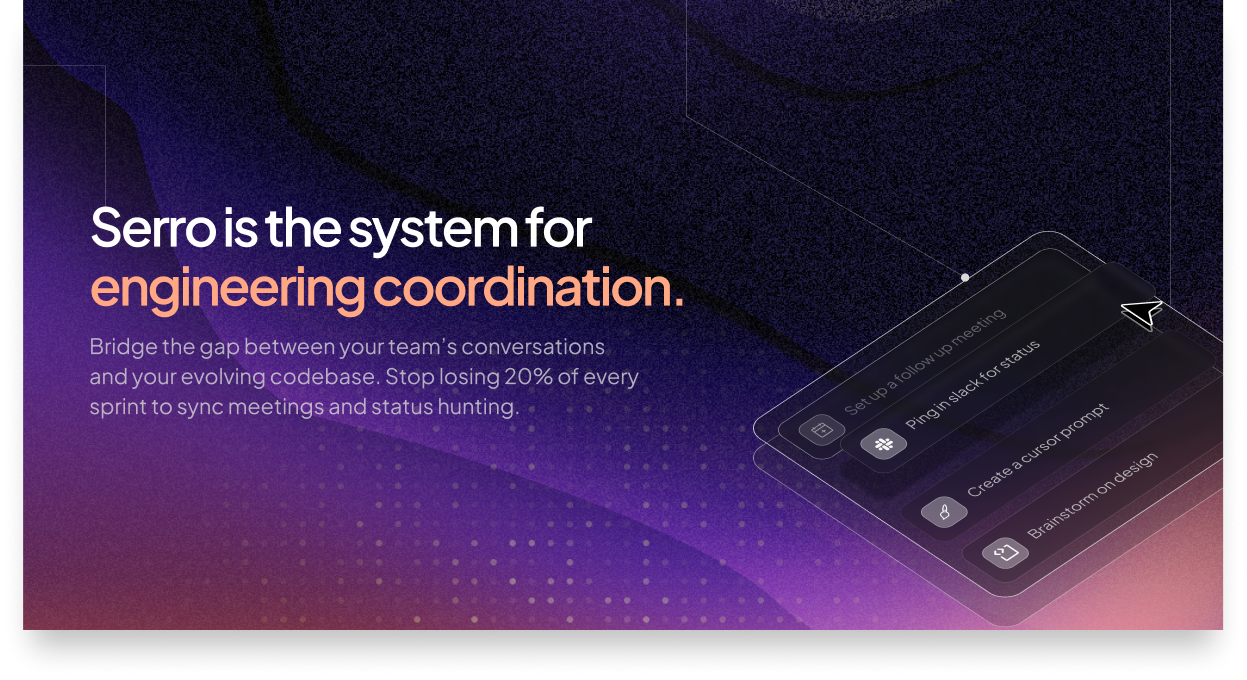
Serro is the shared context layer for modern engineering teams that bridges the gap between team conversations and your evolving codebase. It helps teams capture context seamlessly and get answers without additional meetings.
Serro is a program-native coordination platform designed for modern engineering organizations where human and agent teams work together. It turns meetings, code, tickets, messages, and decisions into live program-native memory, acting as the shared control plane that keeps both humans and AI agents aligned. The core value is eliminating the need to reconstruct context after the fact by continuously maintaining a live picture of organizational reality. Built by operators in the USA, Serro addresses the coordination bottleneck that emerged as AI increased output but didn't scale coordination. It is for technical program managers, engineering managers, product managers, and leadership who need a single source of truth for program health.
The primary pain point Serro solves is that engineering organizations are producing more code, more decisions, and more moving parts than ever before, yet the coordination infrastructure hasn't scaled. As stated on the site, "AI increased output. Coordination didn't scale with it." Teams waste time reconstructing context from scattered meetings, messages, tickets, and code changes. This leads to missed dependencies, slipped timelines, and ownership confusion. The bottleneck has shifted from writing software to coordinating work across humans and agents. Serro directly addresses this by providing a live, program-native view that eliminates the need for status meetings and manual update chasing. For teams running multiple cross-functional programs, this overhead can cost hours per week, which the site quantifies as a six-figure impact saved from day one.
The first core system is Program Memory, which provides live memory across every active program. According to the site, "decisions, risks, owners, history, and activity stay current automatically as work moves." This works by connecting to tools like Slack, Linear, GitHub, Jira, Zoom, Notion, email, and the codebase. Serro ingests signals from these sources and surfaces the work being run. Users name each program, own it, and decide what is shared. The memory holds the complete state of a program, so anyone can query it without needing a meeting. This is useful because it eliminates stale documentation and ensures that the entire team has access to the latest context, reducing miscommunication and accelerating decision-making.
The second system is Loops on Programs, which are automated workflows that keep complex work moving. The site explains that "loops drive the work" and are a core part of how Serro operates. These loops can be configured to generate updates on cadence, turn meeting outcomes into actionable tasks, and follow through on decisions. For example, after a meeting, Serro can automatically capture action items, assign owners, and track progress. The loops work in the background, reducing the manual overhead of chasing updates and ensuring that nothing falls through the cracks. This feature is particularly valuable for technical program managers who manage multiple cross-functional programs simultaneously, as it automates the repetitive coordination tasks and frees up time for strategic thinking.
Publisher
A
admin
Launch Date2026-01-16
Platformweb
Pricingpaid
Domain Authority
Ahrefs DR28/100
Traffic Insights
Month2026-01
Estimated Visits0
MoM Visits GrowthN/A(+0)
Avg Time on Site0s