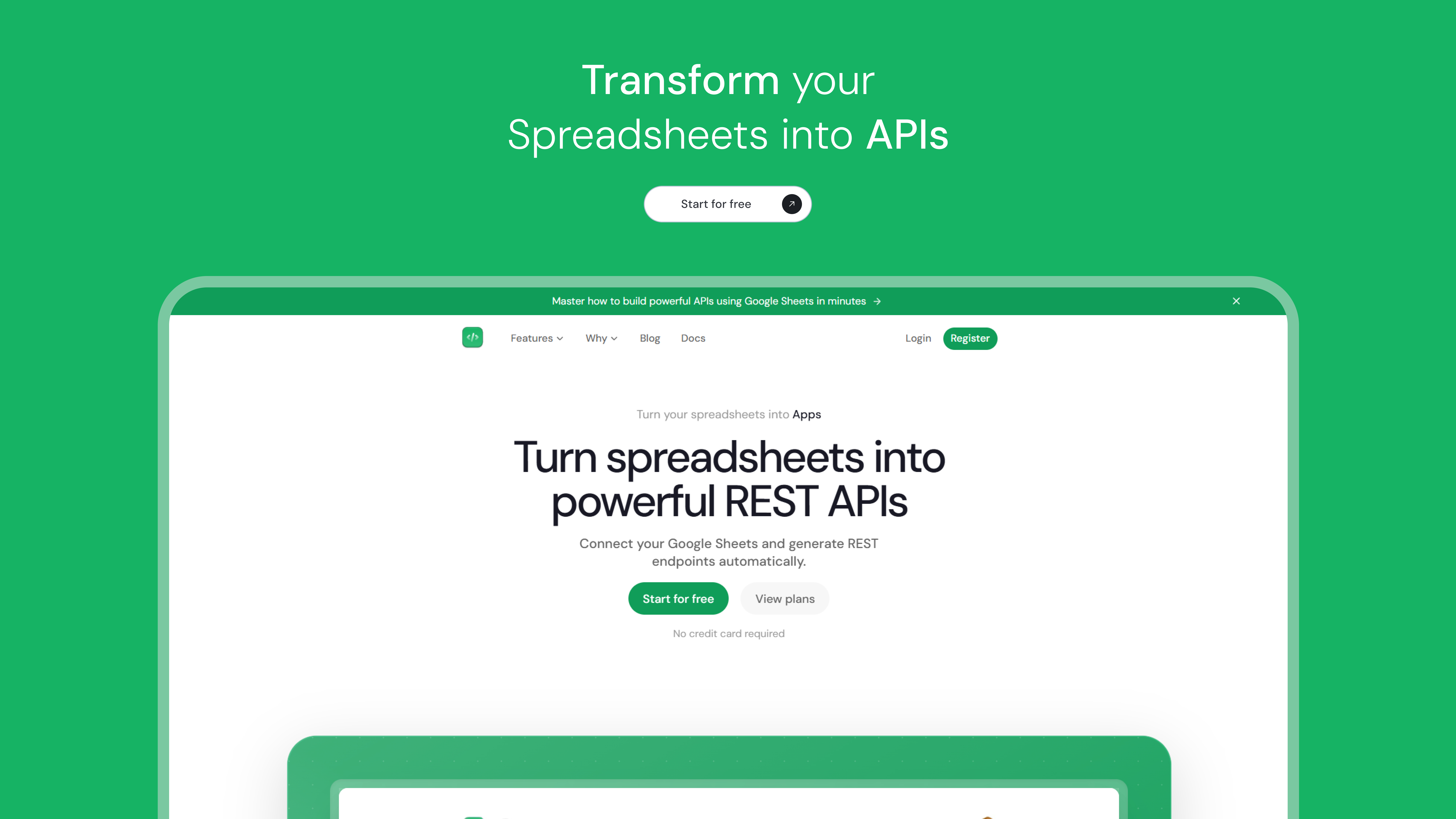
Sheetful transforms Google Sheets into powerful REST APIs instantly. It provides GET, POST, PUT, and DELETE endpoints to power applications without coding.
Sheetful is an API-as-a-Service platform that turns your Google Sheets into high-performance REST APIs, allowing you to use your spreadsheets as a database for web and mobile apps, no-code tools, or internal systems. It generates professional REST APIs from Google Sheets in just one click, providing a robust backend in seconds. The platform is designed for developers and teams who need to ship applications faster by leveraging familiar spreadsheet interfaces as a data source without the complexity of traditional database setup and management.
Many projects and businesses rely on Google Sheets for data entry, collaboration, and storage due to its accessibility and ease of use. However, integrating this data into custom applications, dashboards, or automated workflows typically requires significant coding effort to build and maintain custom API layers. This creates a bottleneck, slowing down development and limiting the ability to create dynamic, data-driven applications. Sheetful addresses this pain point by eliminating the need for custom backend development, enabling instant API creation directly from existing spreadsheets.
The first major feature group is the instant generation of secure and smart API endpoints. By connecting your Google Sheets, Sheetful automatically creates REST endpoints that support full CRUD operations: GET to retrieve data, POST to add new rows, PUT to update existing records, and DELETE to remove information. This works by leveraging Google's official API to fetch data only when requested, ensuring real-time synchronization. The importance lies in providing production-ready endpoints instantly, which drastically reduces development time and allows teams to focus on building application logic rather than infrastructure.
A second major feature group encompasses advanced API management and security capabilities. Sheetful includes Bearer Token authentication (API Key) to secure your data with industry standards, ensuring only authorized applications can access or modify your spreadsheet data. The platform offers advanced filtering, allowing you to query data with powerful parameters directly through the API. Additionally, it provides detailed API security logs for all your endpoints, giving you visibility and control over data access. These features are critical for maintaining data integrity and security in production environments.
Further capabilities include real-time analytics and live endpoint testing. You get instant insights and real-time analytics to monitor every request, keeping your data moving efficiently. The dashboard includes live endpoint testing tools, enabling you to test GET, POST, PUT, and DELETE methods directly without external tools. You can also connect multiple tabs from the same spreadsheet, creating different endpoints for each tab to organize data effectively. These capabilities ensure robust performance monitoring and streamlined development workflows.
Publisher
A
admin
Launch Date2026-02-04
Platformweb
Pricingfreemium
Domain Authority
Ahrefs DR9/100
Traffic Insights
Month2026-01
Estimated Visits0
MoM Visits GrowthN/A(+0)
Avg Time on Site0s