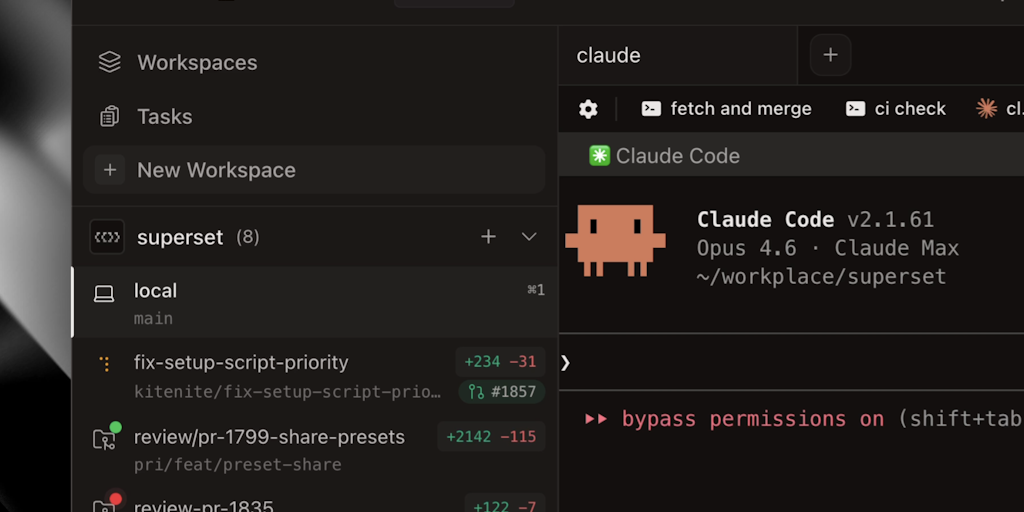
Superset is a turbocharged IDE that allows you to run any coding agents to 10x your development workflow. It enables running multiple agents simultaneously without context switching overhead.
Superset is a next-generation code editor specifically designed to orchestrate multiple AI coding agents in parallel. This product belongs to the emerging category of AI agent IDEs, built for developers who want to dramatically accelerate their programming workflow. Its core value lies in enabling users to run 10 or more coding agents simultaneously on their local machine, without the typical overhead of context switching or merge conflicts. By providing a dedicated environment for agent coordination, Superset transforms how developers approach complex coding tasks, making it an essential tool for anyone serious about AI-assisted development.
The primary pain point Superset solves is the inherent serialization and friction when using multiple AI coding agents. Traditionally, developers run one agent at a time, frequently switching contexts and manually managing changes across tasks. This leads to wasted time and reduced productivity. With Superset, users can launch several agents concurrently on independent branches, each working on separate features, bug fixes, or refactoring efforts. The tool eliminates the risk of one agent overwriting another's work by leveraging Git worktrees for complete isolation. This matters because it directly addresses the bottleneck of sequential agent execution, allowing teams to achieve more in less time.
The first major feature group is Parallel Execution, explicitly named on the site. This feature lets you launch dozens of AI coding agents at once, each dedicated to a different task such as adding a feature, fixing a bug, or refactoring code. The interface shows real-time progress with status indicators like 'Generating' and 'Ready for Review', along with detailed change summaries. This works by creating isolated environments per agent, so they don't interfere with each other. The benefit is obvious: instead of waiting for one agent to finish before starting the next, you can parallelize your entire development pipeline, significantly reducing the time from idea to code.
The second major feature group is Universal Compatibility, meaning Superset is agent-agnostic and works with any CLI-based coding tool. The site prominently lists supported agents including Claude Code, OpenCode, Cursor, Codex, Gemini, and Copilot. Users can switch between these agents seamlessly within the same workspace, using a simple terminal selector. This is useful because it avoids vendor lock-in and gives developers the freedom to choose the best agent for each specific task. For example, you might use Claude Code for complex reasoning tasks and Cursor Agent for rapid prototyping, all within the same Superset environment.
Publisher
A
admin
Launch Date2026-02-27
Platformdesktop
Pricingfree
Domain Authority
Ahrefs DR52/100
Traffic Insights
Month2026-01
Estimated Visits15.9K
MoM Visits GrowthN/A(+15.9K)
Avg Time on Site52s