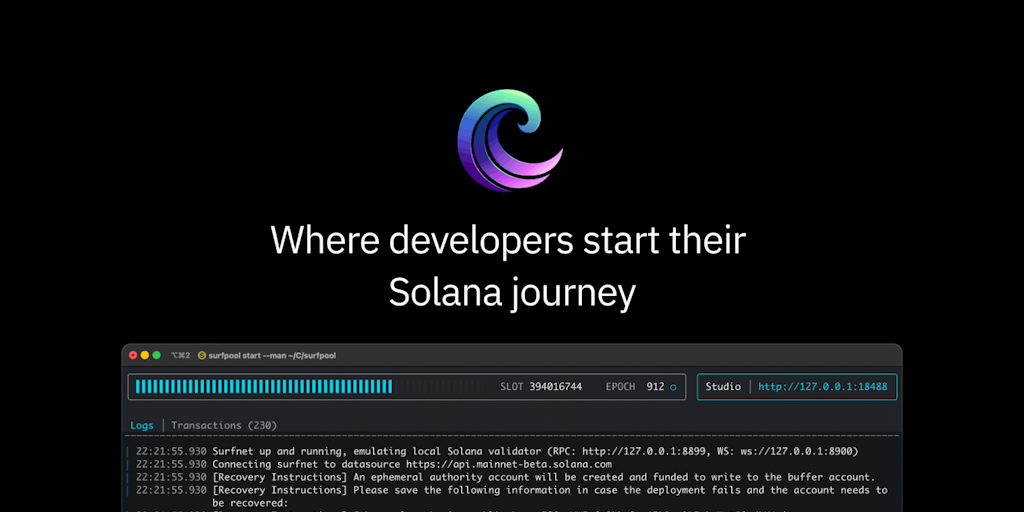
Surfpool is a drop-in replacement for solana-test-validator that allows developers to simulate programs locally using Mainnet accounts. It enables deployment with Infrastructure as Code and provides tools for Solana development.
Surfpool is a drop-in replacement for solana-test-validator, positioning itself as the premier Solana test validator replacement for local development. It is a dedicated simulation tool for Solana developers who require the ability to test against exact mainnet state without the cost or risk of live network interaction. By allowing developers to fork any mainnet account, program, or token balance directly to their local machine, Surfpool delivers the full power of the Solana runtime in a sandboxed environment. This core value prop eliminates the friction of testnet token acquisition and artificial state, enabling realistic testing that catches production bugs early. Whether working on DeFi protocols, NFT marketplaces, or infrastructure, Surfpool streamlines the development lifecycle.
The concrete problem Surfpool solves is the disconnect between testnet and mainnet environments that plagues Solana development. Testnets often lack real token distributions, mature program states, and the transaction volume seen on mainnet. Developers frequently encounter bugs only after deployment, leading to costly failures and security vulnerabilities. Surfpool addresses this by allowing instant forking of mainnet's entire state, including token accounts like USDC and USDT, and programs such as the Token Program. This means developers can test interactions with real holders, verify edge cases around token balances, and simulate complex multistep transactions in a safe local environment. The result is fewer production incidents and faster iteration cycles.
The first major feature group is the simulation and forking capability. Surfpool clones any mainnet account, program, or token balance onto the local machine with a simple one-line installation command: curl -sL https://run.surfpool.run/ | bash. This forking process is instantaneous and provides a full replica of mainnet state, including slots, transactions, and account data. Developers can test against real-world conditions like the current Token Program version or specific token holdings without waiting for testnet faucets. The forked network is fully interactive and can be reset anytime. This feature is invaluable for teams needing to validate application logic against actual on-chain data, ensuring compatibility before any mainnet deployment.
The second major feature group is the cheatcodes, exposed via Surfnet RPC methods. These cheatcodes give developers god-like control over the local network: surfnet_setAccount for modifying account data, surfnet_timeTravel to advance the clock or warp to any slot, surfnet_setTokenBalance to adjust SPL token holdings instantly, and surfnet_resetNetwork to restore a clean state. They are additive and fully compatible with standard Solana RPC methods, so existing tools like Anchor CLI or Solana CLI continue to work seamlessly. Cheatcodes enable testing of time-sensitive logic like auction deadlines, emergency pause mechanisms, or balance-dependent conditions that are impossible to simulate on real mainnet. This accelerates debugging and ensures thorough coverage of edge cases.
Publisher
A
admin
Launch Date2026-02-28
Platformweb
Pricingfree
Domain Authority
Ahrefs DR31/100
Traffic Insights
Month2026-01
Estimated Visits2.2K
MoM Visits Growth+10.6%(+215)
Avg Time on Site3m 17s