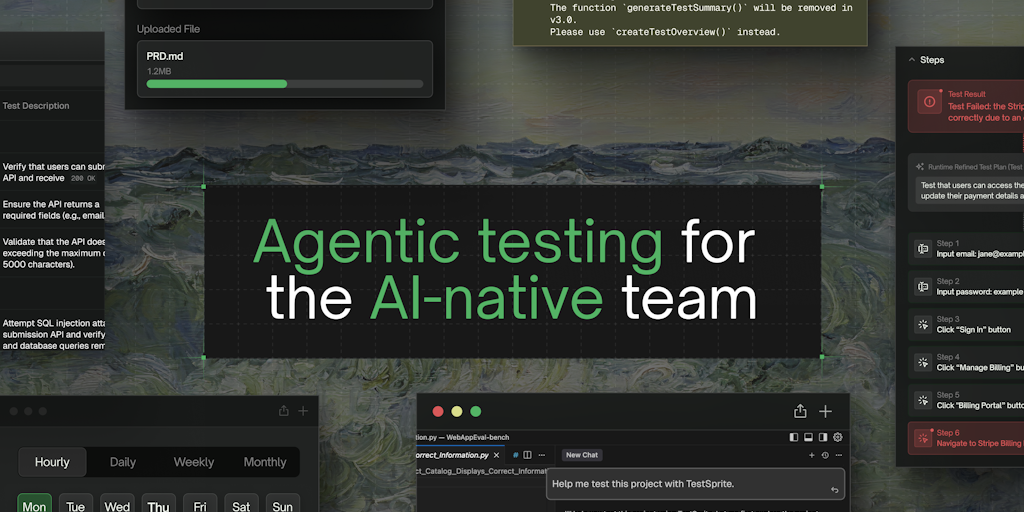
TestSprite is an AI testing agent designed specifically for AI-native teams that ship code at machine speed. It sits in the verification loop of coding agents like Claude Code, OpenAI Codex, and Cursor, providing an autonomous quality assurance mechanism that tests software the way a real user would. The core value of TestSprite is closing the verification gap—ensuring that every feature an agent claims to have built actually works in the live application. By integrating directly into the terminal, IDE, or CI pipeline, it gives developers a self-running QA loop that cuts testing costs by up to 90% and eliminates the manual babysitting required by traditional test runners.
The central pain point TestSprite solves is what the industry calls the verification gap: AI coding agents frequently report tasks as 'done' even when the software does not render, breaks unrelated features, or fails to meet basic requirements. Measurements show that even the strongest agents regress roughly 12 to 25 percent of previously passing features after a single change. Existing testing tools assume a human is watching a screen, but overnight agents work in the terminal without oversight. This gap forces developers to manually re‑verify every agent deliverable, slowing down release cycles and undermining the promise of autonomous development. TestSprite fills that gap by giving agents a verifier that lives where they do.
The first major feature group is real‑user simulation. TestSprite reads both the codebase and the product requirements document (PRD) to understand the intended behavior, then launches dozens of agents that open the live application in a real browser or hit live APIs. These agents click through every feature exactly as a human user would, capturing screenshots, DOM snapshots, and network interactions. This approach eliminates the fragility of mock‑based testing because it validates against the actual running product. Developers can replay any agent session as a video to inspect exactly what the agent saw. The result is a verification layer that proves the product works in its real environment, not just in a simulated one.
The second major feature group is the failure bundle. When a test fails, TestSprite returns a single self‑consistent package containing the failing step and its neighboring actions, screenshots, DOM snapshots, the test source code, a root‑cause hypothesis, and a recommended fix. This bundle is machine‑readable by the coding agent, which can immediately read the hypothesis, apply the fix to the source code, and rerun the test. The auto‑heal capability repairs tests when the user interface drifts due to changes in CSS classes or layout, reducing flaky failures. Every bundle is tied to the exact snapshot of the application state at the moment of failure, so there is no chasing moving state. This tight feedback loop accelerates debugging and turns failures into actionable improvements.
admin
The third feature group is the self‑growing test suite. Each time TestSprite runs it generates dozens of new end‑to‑end tests based on the code and PRD, and it retains every passing test. As the codebase expands, coverage grows in lockstep. The suite is rerun on every change to catch regressions immediately, and scheduled re‑verification ensures 24/7 reliability. Backend, frontend, and data layer tests are generated together, providing holistic coverage. This cumulative memory compensates for the limited context windows of large language models—if an agent forgets a requirement, a failing test puts that requirement back in front of it mid‑task. The suite becomes a living specification that keeps the agent accountable.
TestSprite operates through a straightforward four‑step workflow from install to a self‑running QA loop. No test scripts need to be written and no CSS selectors maintained. The first step is connecting TestSprite to the live application and providing access to the code repository and PRD. Second, TestSprite learns the application by launching its autonomous agents that interact with every page and API endpoint. Third, it executes the generated test suite against the live app, returning failure bundles for any broken behavior. Fourth, the coding agent reads the bundle, applies the fix, and reruns the tests. This loop repeats until the full feature set passes. TestSprite works across surfaces: a no‑code web app for QA teams, a CLI for autonomous agents, an MCP server inside IDEs like VS Code, and a gate in CI pipelines.
Concrete use cases demonstrate the impact. In the live CoderCup competition, Claude Code, OpenAI Codex, and Google Antigravity each built the same ten‑phase application under a single clock. TestSprite served as the neutral referee, scoring every phase against 16 to 22 end‑to‑end test plans. One agent began a phase with zero target features working and finished with roughly 80% passing after ten rounds of reading failure bundles and fixing the code. Across the competition, teams with the verification loop in place saw feature delivery climb from meeting 42% of requirements to 92%. These numbers prove that autonomous agents become dramatically more reliable when they have a verifier to guide them. Developers no longer need to manually check every agent output; TestSprite ensures that only proven code reaches production.
TestSprite targets AI‑native software teams, engineering managers, QA engineers, and anyone using coding agents such as Claude Code, Codex, Cursor, Trae, or Kimi. It integrates into the tools those teams already use—VS Code, terminal emulators, and CI platforms like GitHub Actions. The platform is open source under the Apache 2.0 license, allowing teams to inspect and customize the verifier. TestSprite offers a free tier that requires no installation and delivers first results in roughly ten minutes. Pricing scales with usage. The overarching takeaway is that TestSprite transforms the software development lifecycle by giving every coding agent a verification loop it can drive autonomously, turning the promise of AI‑speed delivery into a reality backed by proof.
TestSprite is built for software engineering teams that use AI coding agents such as Claude Code, OpenAI Codex, Cursor, Trae, and Kimi. It is specifically valuable for engineering managers who need to maintain velocity while ensuring software reliability, QA engineers who want to automate end‑to‑end testing without writing scripts, and full‑stack developers working in AI‑native environments. The tool also serves DevOps engineers who need a verification gate in their CI pipelines and open‑source contributors building projects that demand continuous validation. TestSprite is designed for teams that ship code rapidly but refuse to compromise on quality, making it ideal for startups, scale‑ups, and enterprise R&D groups adopting autonomous development workflows.
Updated 2026-03-08