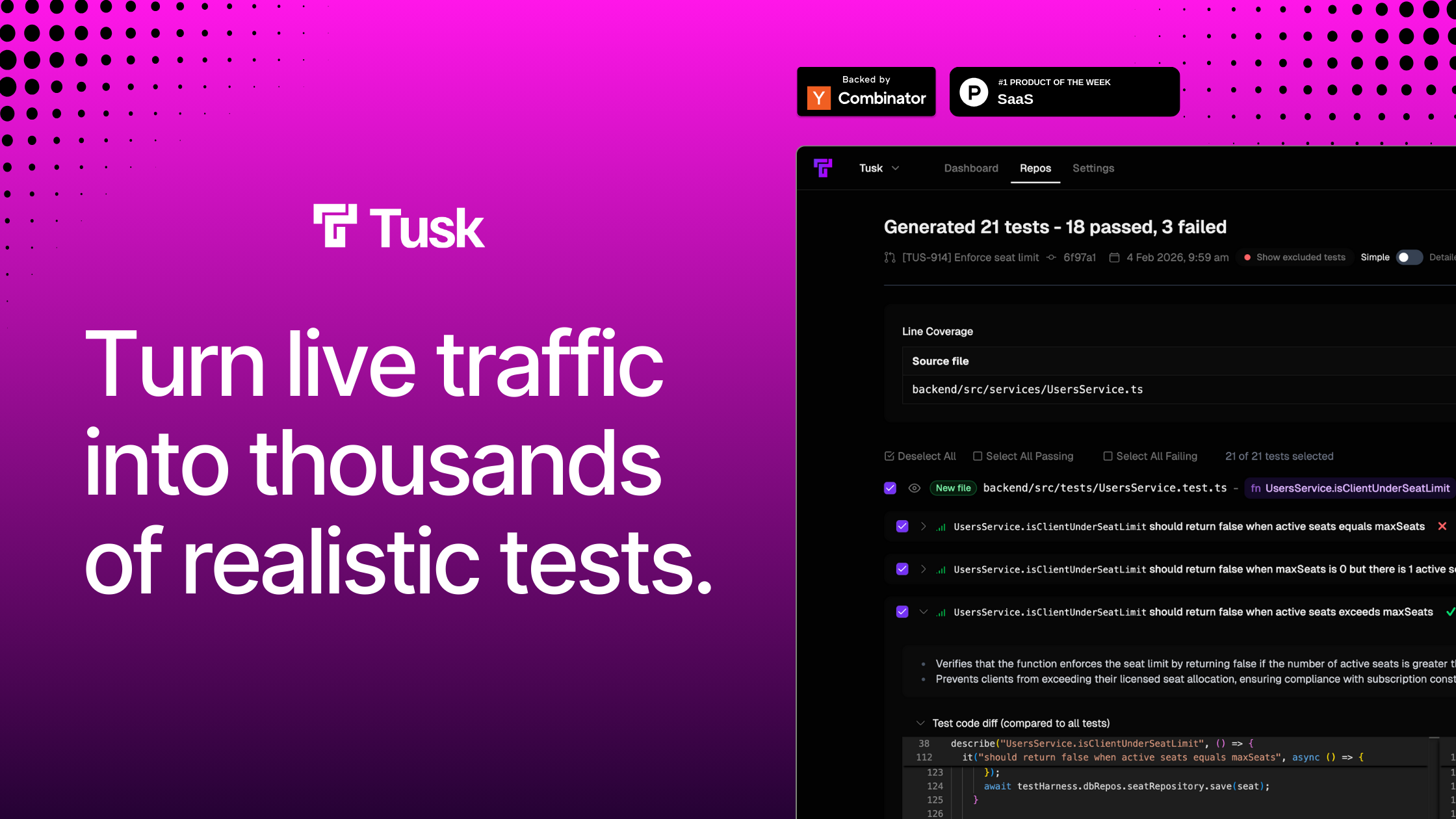
Tusk is an AI verification layer specifically built for coding agents, leveraging AI test generation from production traffic to create comprehensive test suites autonomously. It serves development teams that use AI-assisted coding to accelerate delivery, offering a safety net that prevents regressions without manual effort. By capturing real user behavior and business context, Tusk generates high-quality unit and API tests that validate code changes against actual edge cases. The platform enables engineers to ship faster by shifting testing left, ensuring that every pull request is vetted against live traffic patterns. Designed for companies that prioritize rapid iteration and code quality, Tusk integrates seamlessly into existing CI/CD pipelines. This AI-driven approach replaces the laborious manual test-writing process, allowing teams to focus on building features rather than maintaining tests. With Tusk, organizations can achieve continuous coverage improvement while adapting to evolving business logic.
Modern software engineering increasingly relies on AI coding agents that generate code at an unprecedented pace. However, this speed introduces a critical gap: the generated code often lacks corresponding tests, making it vulnerable to regressions and functional bugs in production. Manual test creation cannot keep up with the volume of AI-authored changes, and existing test suites quickly become outdated or insufficient. Tusk solves this problem by automatically deriving tests from live production traffic, ensuring that every new code change is validated against real-world scenarios. Instead of guessing edge cases, Tusk’s AI engine observes actual user interactions and transforms them into executable test assertions. This dramatically reduces the risk of deploying faulty code, giving developers confidence that their rapid iteration does not compromise software quality.
Tusk’s autonomous test generation capability is its cornerstone. By running a simple `tusk drift setup` command, teams initialize the platform within their repository. Tusk then analyzes incoming production HTTP requests, database operations, and response data to build a deep understanding of the application’s expected behavior. The AI engine generates granular unit and API tests that mirror real user journeys, covering thousands of edge cases in minutes. Developers do not need to define test scenarios or assertions; Tusk infers them from traffic patterns and business logic. After generation, these tests can be run locally using `tusk drift run`, instantly revealing potential failures before code is committed. This approach reduces the time spent on test writing while achieving coverage that manual methods could never match, making it ideal for fast-moving teams using coding agents.
admin
One of Tusk’s standout features is its self-healing test maintenance. When generated tests encounter unexpected changes or failures due to evolving business logic, Tusk autonomously iterates and refines the tests until they pass. This eliminates the common pain of brittle test suites that break after every refactor. On every commit, Tusk reviews the existing test suite and updates assertions to align with the latest code behavior, ensuring that tests remain accurate and relevant. This self-healing mechanism is fully automated, requiring no developer intervention or back-and-forth with an AI copilot. As a result, test suites remain healthy, reducing false positives and maintaining high engineering velocity. The platform’s ability to self-correct means that code coverage continues to grow without manual maintenance, a critical advantage for teams scaling their codebases with AI assistance.
Tusk is engineered for seamless integration into AI coding agent workflows. It provides a streamlined command-line interface (CLI) that developers and agents can use with a single command. For instance, `tusk drift setup` initializes test generation, while `tusk drift run` executes the suite in a CI environment or locally. Tusk also integrates with GitHub, automatically commenting on pull requests with newly generated test files and indicating whether all checks have passed. The platform’s CoverBot feature proposes additional tests directly within the PR conversation, helping teams reach coverage goals without altering their existing review processes. By embedding tests into the development pipeline at the PR level, Tusk catches regressions before code merges, cutting release cycles in half. This frictionless integration ensures that quality enforcement does not become a bottleneck, even as AI agents rapidly contribute code.
Tusk's overall methodology revolves around transforming real production data into test artifacts. The workflow begins when an engineer or coding agent pushes a branch. Tusk, via its cover bot, analyzes the changes against a database of captured production traffic. It then generates a set of test files covering the affected services, including both unit and API tests. These test files are added to the pull request, and the CI pipeline automatically executes them. Any failures are immediately flagged, and Tusk may iterate on the tests to fix false alarms. The whole process is designed to be fully autonomous, requiring only an initial setup command. By leveraging live traffic as the source of truth, Tusk ensures that tests reflect what users actually experience, rather than theoretical assumptions. This approach creates a robust safety net that evolves with the application.
Real-world deployments of Tusk highlight its impact on engineering velocity and code quality. DeepLearning.AI integrated Tusk into their CI/CD pipeline, giving their engineers a heightened sense of security when pushing code; the head of engineering described it as an integral part of their process. Hamming, a company building AI evaluation tools, used Tusk’s CoverBot to increase their test suite from 2,500 to over 7,000 tests within a single month, significantly strengthening their core evals functionality. Similarly, TeamFeePay saw three quarters of their recent test coverage increase on a large legacy codebase attributed to Tusk. In each case, the tool’s ability to automatically generate and maintain tests from production traffic delivered measurable improvements in coverage and regression detection, proving its value across diverse tech stacks.
Tusk is built for engineering leaders, CTOs, and platform teams who prioritize software quality without slowing down their AI-augmented development cycles. It is particularly valuable for organizations at fast-growing companies that deploy multiple times per day and rely on coding agents to write a significant portion of their codebase. The platform supports modern cloud-native architectures, integrates with any CI system, and operates independently of language or framework. With SOC 2 Type II compliance, Tusk meets enterprise security requirements. By automating test generation and maintenance, Tusk eliminates the manual overhead that traditionally hinders rapid development. The result is a quality-first culture where every code change is validated against real user behavior, dramatically reducing post-deployment incidents and building trust in AI-driven software delivery.
Tusk is designed for engineering leaders, CTOs, and platform teams at fast-growing technology companies who deploy frequently and rely on AI coding agents. It serves software engineers who want to eliminate the manual burden of test creation and maintenance, QA engineers seeking to automate regression detection, and DevOps professionals integrating quality gates into CI/CD pipelines. The platform is ideal for organizations with complex cloud-native architectures, legacy codebases needing coverage uplifts, and startups scaling their development velocity without compromising on code reliability.
Updated 2026-02-28