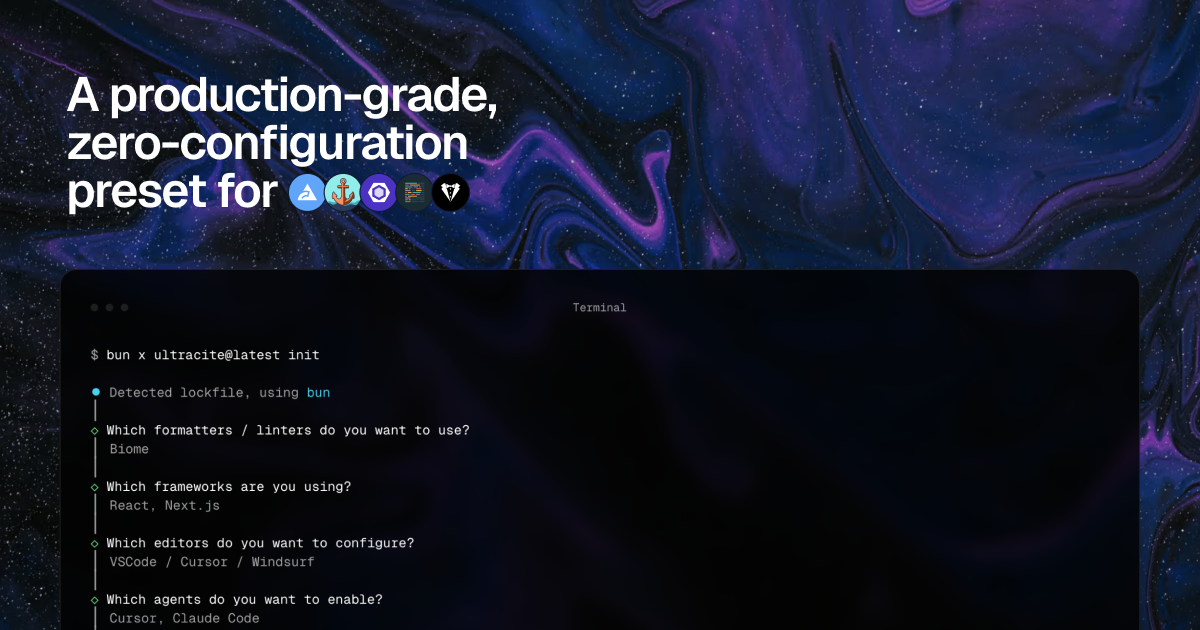
Ultracite is a production-grade, highly opinionated preset designed for modern JavaScript and TypeScript development, specifically targeting developers and teams who want to enforce consistent code quality without the overhead of manual configuration. It serves as a comprehensive, zero-configuration solution that integrates seamlessly with popular linters and formatters like ESLint, Biome, Oxlint, Prettier, and Stylelint, providing an out-of-the-box rule set optimized for frameworks such as React and Next.js. The primary purpose of Ultracite is to eliminate the time-consuming and often contentious process of setting up and maintaining linting and formatting configurations, allowing developers to focus on writing code while ensuring high standards of type safety and stylistic consistency across projects, whether the code is written by humans or generated by AI models.
In the context of modern software development, teams frequently struggle with maintaining consistent code quality as projects scale and more contributors join. The pain point is particularly acute when integrating AI-assisted coding tools, which can generate code that doesn't adhere to a team's established conventions, leading to style inconsistencies, potential type errors, and increased friction during code reviews. Without a unified, automated standard, developers waste time debating formatting rules, manually fixing stylistic issues, and maintaining complex configuration files across different linters and formatters, which diverts energy from building features and solving real problems. Ultracite directly addresses this by providing a single, authoritative preset that works across the entire toolchain, ensuring that every line of code, regardless of its origin, meets the same high-quality bar.
One of the major feature groups of Ultracite is its zero-configuration design, which provides hundreds of pre-configured rules specifically optimized for popular JavaScript and TypeScript frameworks. This works by bundling best-practice configurations for ESLint, Biome, and Oxlint into a single package that developers can install and extend with minimal setup. The importance of this feature lies in its ability to instantly apply a production-ready linting standard to a project, covering aspects like code style, potential errors, and type safety without requiring developers to research, debate, and manually enable individual rules. This not only accelerates project setup but also ensures that teams start with a robust quality foundation from day one, preventing technical debt related to code quality and making the codebase more maintainable and easier for new team members to understand.
admin
Another significant feature group is its deep integration with AI coding assistants and agents, supporting over 40 different agents for formatting rules and hooks. This capability works by generating specific configuration files, such as `.cursor` rules or agent hooks, that instruct AI models on the project's coding conventions, ensuring that AI-generated code adheres to the same standards as human-written code. This matters because it bridges the gap between human and machine coding practices, reducing the need for manual correction of AI output and making AI assistants more effective and consistent collaborators. By providing these agent-specific configurations, Ultracite enables developers to leverage AI tools without sacrificing code consistency, thereby increasing development velocity and reducing the cognitive load of reviewing and refactoring AI-suggested code.
Ultracite also offers extensive editor and environment configuration, automatically generating editor-specific files for popular IDEs like Visual Studio Code, Cursor, Windsurf, and others to enable features like format on save, auto-fixes, and TypeScript defaults. This works by detecting the user's environment during initialization and creating the necessary configuration files, such as `.vscode/settings.json`, to integrate Ultracite's rules directly into the developer's workflow. The value of this feature is that it creates a seamless development experience where linting and formatting happen automatically in the background, catching issues early and enforcing standards in real-time as code is written. This proactive approach prevents style violations from ever entering the codebase, reduces context switching for developers, and ensures that the entire team uses a unified setup, eliminating environment-specific discrepancies.
From a technical approach, Ultracite operates as a modular preset system that can be selectively applied to different parts of a project's toolchain. It uses a straightforward initialization command that interactively detects the project's setup—such as the package manager, desired linters, frameworks in use, and target editors—and then generates the appropriate configuration files. The system is built to be extensible, allowing teams to customize specific rules when necessary while maintaining the core preset as a foundation. This technical design ensures compatibility and avoids conflicts with existing tooling, as Ultracite integrates as a layer on top of standard linters rather than replacing them, making adoption non-disruptive and reversible if needed.
The benefits and measurable outcomes for users are substantial, starting with a dramatic reduction in time spent on code review debates over formatting and style issues. By enforcing a consistent standard automatically, teams can focus code reviews on logic, architecture, and functionality rather than superficial style points. This leads to faster review cycles, higher team morale, and a more collaborative environment. Additionally, the emphasis on type safety helps catch potential runtime errors at compile time, improving code reliability and reducing bug-fixing efforts. For organizations, this translates to higher developer productivity, lower maintenance costs, and a more scalable codebase that can efficiently onboard new developers and AI tools.
Concrete use cases illustrate Ultracite's practical value, such as a team starting a new Next.js project with React and Vitest. Using the initialization command, they can instantly configure ESLint, Prettier, and Stylelint with framework-specific rules, set up editor configurations for format on save, and generate agent files for Claude Code and Cursor integrations. This entire setup is completed in seconds, ensuring that from the first line of code, the project adheres to a high standard. Another example is an existing project integrating AI assistants; Ultracite can add agent hooks and rules files so that AI-generated code, such as a new React component, automatically follows the project's conventions for imports, JSX structure, and type definitions, eliminating manual cleanup.
The target users for Ultracite are development teams and individual engineers working with JavaScript and TypeScript, particularly those using frameworks like React, Next.js, and testing tools like Vitest. It is especially valuable for teams adopting AI coding assistants, as it ensures consistency between human and AI-generated code. Ultracite integrates with a wide range of tools in the modern web development stack, including linters (ESLint, Biome, Oxlint), formatters (Prettier, Stylelint), editors (VS Code, Cursor, Zed), and AI agents (Claude Code, GitHub Copilot, Gemini). The project is open-source and community-driven, with sponsorship from companies like CodeRabbit and Mintlify, and is trusted by top organizations including OpenAI, Vercel, Adobe, and Prisma, indicating its robustness and industry adoption.
In summary, Ultracite provides a comprehensive, zero-configuration solution for code quality that bridges the gap between human developers and AI assistants. By offering a production-ready preset for major linters and formatters, along with deep integrations for editors and AI agents, it eliminates configuration hassle and ensures consistent, type-safe code across any project. The primary takeaway is that Ultracite empowers teams to ship code faster and with higher confidence, establishing a strong foundation for code quality from the start and maintaining it effortlessly as projects scale and evolve, making it an essential tool for modern JavaScript and TypeScript development.
Ultracite targets development teams and individual engineers working with JavaScript and TypeScript, especially those using frameworks like React, Next.js, and testing tools like Vitest. It is ideal for teams adopting AI coding assistants such as Claude Code, GitHub Copilot, or Gemini, as it ensures consistency between human and AI-generated code. The tool is also valuable for organizations seeking to enforce code quality standards across large codebases, reduce configuration overhead, and streamline onboarding for new developers. Trusted by top companies including OpenAI, Vercel, Adobe, and Prisma, Ultracite serves both enterprise and open-source projects looking for a production-ready, zero-configuration linting solution.
Updated 2026-02-28