Unblocked is a sophisticated context engine designed specifically for modern engineering teams, transforming fragmented information from various sources into actionable, unified insights. It serves engineers and AI agents by reconstructing a complete picture of how a system works, drawing from codebases, documentation, tickets, and team conversations. The primary purpose is to eliminate the time-consuming process of manually piecing together context, enabling faster decision-making, more accurate agent outputs, and ultimately accelerating development velocity. By understanding relationships and staying current with changes, it provides a trusted source of truth that both humans and automated systems can rely on to understand what is current, what is trusted, and what actually happens in production.
Engineering teams constantly face the challenge of fragmented and outdated information scattered across multiple tools. Understanding how a system truly operates requires piecing together code from repositories, conversations in Slack, tickets in Jira, documentation in Confluence or Notion, and metrics from observability platforms like Datadog. This information is often conflicting, outdated, or represents tribal knowledge not captured formally. For example, documentation may state one architecture, while a recent pull request has refactored it, and a Slack discussion reveals an internal bypass. This context gap forces engineers to waste hours searching and synthesizing, while AI agents inherit the same problem, retrieving easy-to-find but incomplete data, wasting tokens, and generating unreliable outputs from flawed premises.
The first major feature group is Unblocked's ability to unify and build living context from disparate sources. It actively indexes and connects data from your codebase (like GitHub), documentation (Notion, Confluence), project management tools (Jira), communication platforms (Slack), and observability tools (Datadog). It doesn't just aggregate; it understands the relationships between these elements, tracking conventions, past decisions, and active work. The system stays current as the codebase evolves, resolving conflicts between sources—like outdated docs versus recent PRs—and personalizing relevance based on the user or task. This matters because it creates a dynamic, accurate model of the engineering system, replacing static searches with intelligent understanding.
The second major feature group focuses on delivering this context effectively to both engineers and AI agents. It surfaces answers and insights wherever work happens: directly in Slack via an @Unblocked bot, through a web interface for search and exploration, via a Command Line Interface (CLI) for terminal workflows, and critically, through MCP (Model Context Protocol) to feed context directly into AI agents like Cursor, Claude Code, or GitHub Copilot. This integration ensures that when an engineer asks a question or an agent begins a task, it has access to the unified, permission-aware model. The system enforces permissions to ensure users only see what they should and optimizes token usage for agents by providing precise, relevant information instead of forcing broad, wasteful searches.
admin
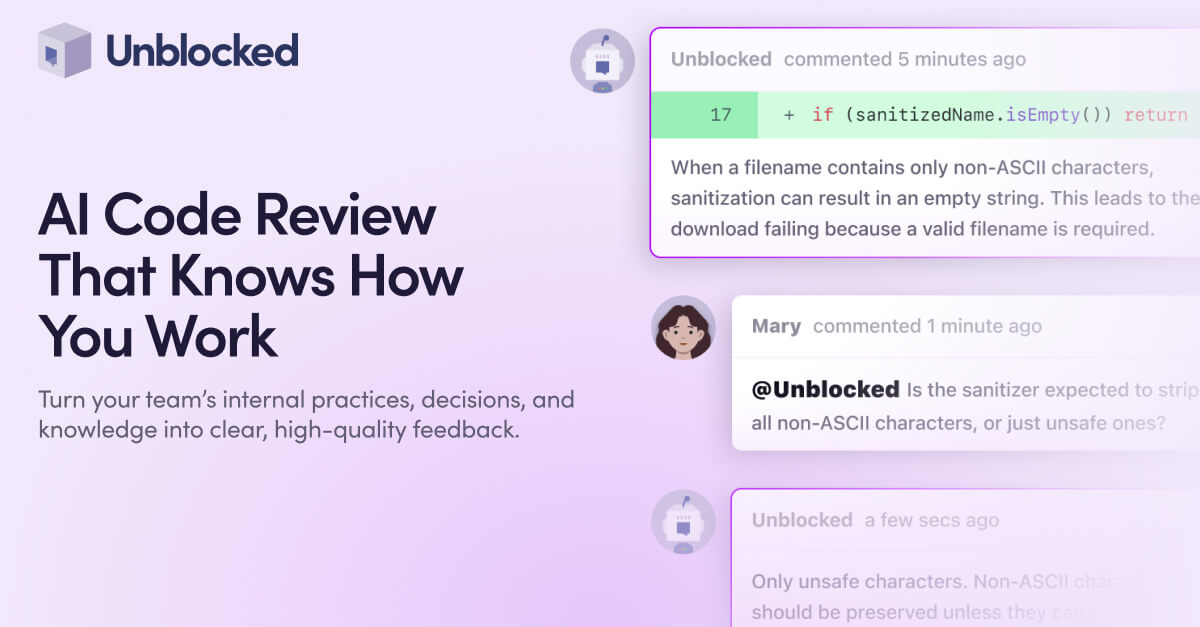
Additional capabilities include powerful use-case-specific functionalities that leverage the unified context. It enables instant answers to complex questions about codebases, architecture, or past decisions, citing specific sources. It assists in planning by providing agents with full context on patterns and prior conversations before they start a task. The platform facilitates contextual code review by checking against team conventions and prior art, not just syntax. It accelerates onboarding by giving new hires immediate access to institutional knowledge. For incidents, it can assemble relevant commit history, config changes, and Slack activity in seconds. It also aids bug investigation by quickly identifying if an issue is novel, related to recent changes, or a recurrence.
Technically, Unblocked works by building a continuously updated model of your engineering ecosystem. It ingests data from connected sources, processes it to understand entities and relationships, and resolves inconsistencies. The engine manages the hard parts of data freshness, source deconfliction, permission awareness, and personalization automatically. When a query is made—whether by a human or an agent—it retrieves and synthesizes the most relevant, current, and authoritative pieces of information from across the unified model. It then presents this as a coherent, grounded answer, explaining the current state, referencing sources, and highlighting any known gaps or conflicts, as demonstrated in the example explaining auth validation by synthesizing code, PRs, Slack, tickets, and metrics.
The benefits and measurable outcomes for users are significant. Teams experience faster resolution of questions and tasks, as engineers get instant answers instead of spending hours digging. AI agents become far more effective, using up to 48% fewer tokens because they receive precise context and avoid wasteful searches. This leads to faster task completion, with one example showing an 83% reduction in time spent babysitting an agent. The quality of outputs improves because answers are based on complete, conflict-resolved information, not noise. Overall, it translates to substantial time savings, reduced cognitive load, lower computational costs for AI workflows, and higher confidence in decisions made by both people and automated systems.
Concrete use cases are illustrated through specific workflow examples. An engineer investigating an authentication latency spike can ask "How does auth validation work?" and receive a synthesized answer citing the current token-service.ts file from a recent PR, noting a deprecated path mentioned in Slack, linking to an open Jira ticket about internal bypasses, and correlating it with Datadog metrics. A developer onboarding can immediately understand system architecture and conventions without interrupting colleagues. During an incident, a responder can instantly get a timeline of relevant commits, config changes, and team discussions. A code reviewer can assess if a new function follows established team patterns by seeing prior similar implementations and related design decisions documented elsewhere.
The target users are professional engineering teams, including software engineers, engineering managers, AI engineers, and onboarding specialists at companies of various sizes. It integrates seamlessly with the modern tech stack, including GitHub, Slack, Jira, Notion, Confluence, and Datadog via dedicated connectors, and broadly with any AI agent or tool via MCP, CLI, or API. The platform is built with enterprise security in mind, featuring SOC 2 Type II compliance, data isolation, SSO & SCIM support, and encryption in transit and at rest. Pricing plans include a free tier to get started and demo options for teams, emphasizing accessibility for professional use.
In summary, Unblocked's primary value is transforming the chaotic, fragmented landscape of engineering knowledge into a reliable, actionable context engine. It directly addresses the critical pain point of wasted time and unreliable information that blocks both human engineers and AI agents. By automatically building and maintaining a living model of your system from all available sources, it delivers fast, accurate, and trustworthy answers. This enables teams to move faster, reduce costs associated with AI agent inefficiency, and ship code with greater confidence, ultimately turning context from a bottleneck into a strategic advantage.
Unblocked is built for professional engineering teams, including software engineers, engineering managers, and AI engineers who need to understand complex systems quickly. It targets teams frustrated by fragmented information across GitHub, Jira, Slack, and docs, and those leveraging AI coding agents who suffer from incomplete context. It's ideal for organizations aiming to accelerate development velocity, reduce the time engineers spend searching for information, lower the cost and inefficiency of AI agent workflows, and improve the accuracy of technical decisions and incident responses through a unified source of truth.
Updated 2026-02-28